The Gen Z and Beyond survey results
provided information on the community’s
beliefs, views and attitudes
Parinaz M. Gandhi
What are the religious and social beliefs of Zoroastrians across the globe? What are their views on issues like mixed marriages, philanthropy, entrepreneurship? What is their attitude towards the challenges and opportunities the community faces and how would they like to strengthen the religion and the community for future generations? Gen Z and Beyond – A Survey for Every Generation was launched to gather data on these questions and to study if the responses differ by geography, gender or age.
The foremost challenge for the researchers in the recent online global survey was getting community members to sign up and complete the questionnaire. Eventually they managed to get 4,893 valid responses out of a total 5,003. The largest number of responses, 2,379, were from South Asia, who constituted 52% of the respondents, followed by 1,449 from North America who constituted 31.7%. The remaining numbers were from other countries: 265 from the UK, 256 from Australasia, 71 from the Middle East, 64 from Europe, 49 from South East Asia, 26 from Iran and 17 from the rest of the world.
While the research team managed "a respectable six percent response rate of Zoroastrians over 18 years of age,” they realized that as participants in the survey were permitted to voluntarily answer the questions, "the achieved sample cannot be seen statistically to represent the whole of the global Zoroastrian population.”
The privately sponsored research project was designed and conducted by the Shapoorji Pallonji Institute of Zoroastrian Studies at the School of Oriental and African Studies, University of London, led by principal investigator Dr Sarah Stewart, project manager Dr Nazneen Engineer and analyst Joe Turtle. Data was collected over an 18-month period starting July 1, 2021 and the final report was shared in May 2023 and the summary two months later.
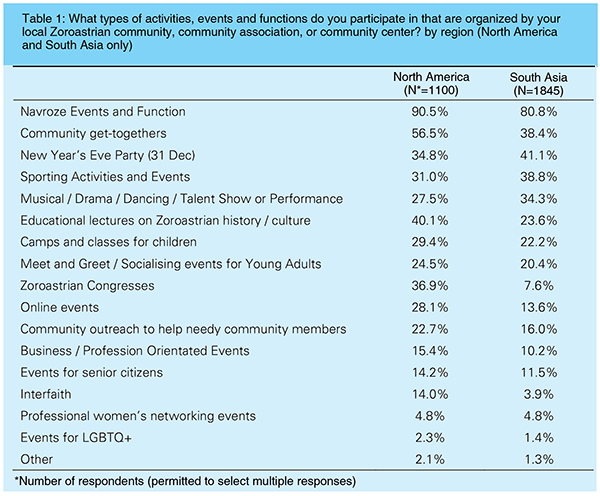
When asked regarding their participation in events organized by the local Zoroastrian community, Navroz programs and functions was clearly the largest draw for Zoroastrians in both North America as also South Asia. In North America, community get-togethers followed by educational lectures on Zoroastrian history and culture were the next two favored community activities. In South Asia, New Year’s eve parties and sports events were high on the list. The disparity was most seen in attendance at Zoroastrian congresses which saw participation from 36.9% in North America as compared to 7.6% in South Asia and online events which interested 28.1% North Americans as compared to 13.6% South Asians.
Reflections on religiosity
Responses on religiosity should be understood keeping in mind that 4,481 of the respondents had both Zoroastrian parents, 289 had one Zoroastrian parent (188 had a Zoroastrian father, 101 had a Zoroastrian mother), 19 had one Zoroastrian grandparent, and 104 non-Zoroastrians who had a Zoroastrian spouse. Thus 91.57% of the respondents were born of both Zoroastrian parents while less than six percent had one Zoroastrian parent.
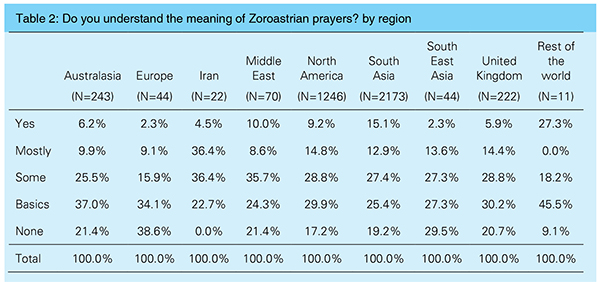
When asked whether they understood the meaning of the Zoroastrian prayers they recited, most respondents said they had some understanding (27.7%) or basic understanding (28%) of the meaning. More respondents said they had no understanding (18.9%) than full understanding (11.8%). Respondents throughout the world seemed to be aligned on the levels of understanding.
About 35% of respondents with one Zoroastrian parent had not undergone the navjote ceremony. Respondents with Zoroastrian fathers were much more likely to have undergone a navjote ceremony than those with Zoroastrian mothers (82.6% vs 46.7%). The difference was particularly pronounced in South Asia where 96.9% of respondents with a Zoroastrian father had undergone a navjote ceremony as compared to 70.4% in North America.
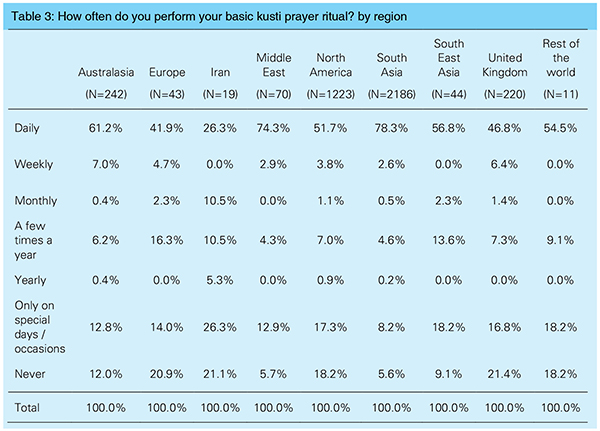
If performing the kusti is seen as a gauge to measure the practice of religious rituals, 66.4% said they performed the kusti daily, 3.4% weekly, 12.1% on special days, 5.8% a few times a year, and 11% never. While men were more likely than women to perform the kusti daily, among those who never did, the numbers were spread almost evenly across both the genders and across age groups.
Intermarried Zoroastrians in North America and South Asia were equally likely to raise their children as Zoroastrian (69.6% vs 68.9%). Intermarried men were more likely (68.6%) to raise their children as Zoroastrian as compared to intermarried women (54.2%). In South Asia which has a more male dominated society, respondents were more likely to have been raised as a Zoroastrian if they had a Zoroastrian father (81.7%) than if they had a Zoroastrian mother (55.6%). Respondents with Zoroastrian mothers were more likely to have non-Zoroastrian partners (79.3%) vs respondents with Zoroastrian fathers (56.1%).
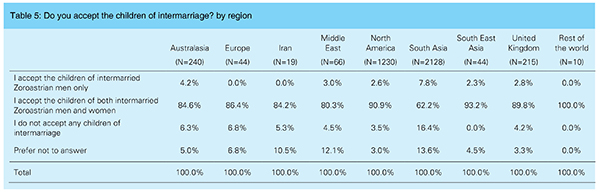
The Survey data indicated there is a preference to find a Zoroastrian partner, especially amongst the 18-25-year-olds, but nearly half of the respondents in that age group were already in relationships with non-Zoroastrians. This preference to find a Zoroastrian partner reduced with advancing age resulting in increasing intermarriage rates. The data also indicated that not only is there a rise in intermarriage, but there is a rise in the acceptance of intermarriage, and the acceptance of children of intermarried Zoroastrians, especially in the diaspora.
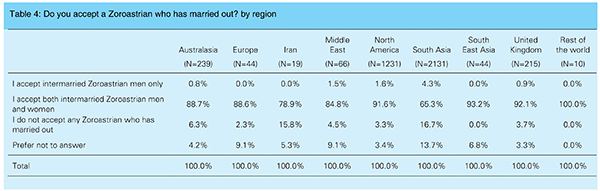
The global figures showed that both intermarried men and women were accepted as Zoroastrians by 77.4% and their children were accepted as Zoroastrians by 75.2%. In South Asia, 65.3% accepted intermarried men and women, and 62.2% accepted their children.
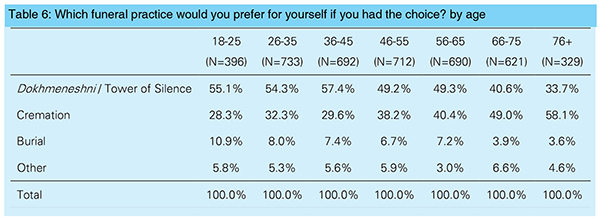
As expected, 67.3% respondents from South Asia preferred dakhmenashini as compared to 26.5% in North America. Cremation was preferred by 59.2% in North America as compared to 22.3% in South Asia. Age-wise comparisons across all regions showed surprisingly, in the 18-25 age bracket, the most favored mode of disposal was dakhmenashini (55.1%). In the 76+ age group, the most favored mode was cremation (58.1%).
Education and employment
In a community known to place a premium on education, the largest segment of respondents (41.1%) had a bachelor’s degree as their highest qualification, 29.3% had a master’s, 9.7% had professional qualifications and 6.5% had a doctorate. It is commonly believed that women are more educated in the community. Among the respondents, 45.9% women as compared to 36.4% men had earned their bachelor’s degree. However 31% men as compared to 27.8% women had a master’s degree.
When correlating levels of education with other religious practices, it was found that 65.2% respondents with no more than a high school qualification preferred dakhmenashini and 41.8% believed the opinion of priests was important to resolve religious disputes. Conversely, among those with a doctorate, 27.3% favored dakhmenashini and 21.5% were likely to give weightage to opinions of priests.
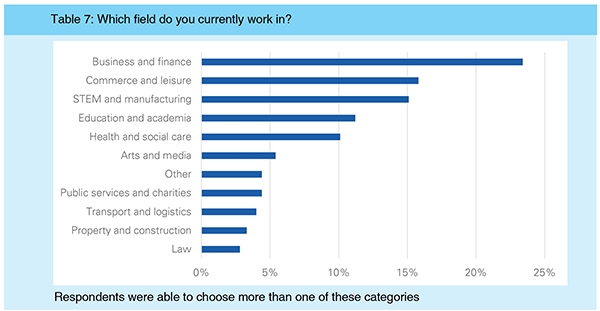
The most popular field of work was business and finance with 23.4% respondents, followed by commerce and leisure that had 15.8%, with STEM (science, technology, engineering and mathematics) and manufacturing, 15.1%.
Largesse and Lifestyle
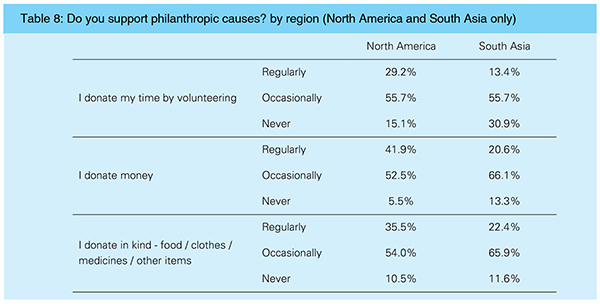
For a community associated with philanthropy, it is heartening that 72.5% gave to both Zoroastrian and non-Zoroastrian causes. However, respondents in North America were more likely than those in South Asia to regularly volunteer their time and to donate in cash and kind.
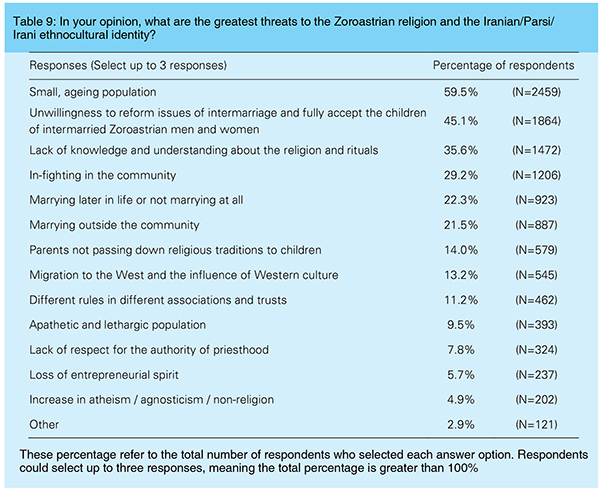
When asked what they considered the three greatest threats (from the 14 options given) to the Zoroastrian religion and ethnocultural identity, respondents cited: a small, aging population; unwillingness to reform issues of intermarriage and fully accept the children of intermarried Zoroastrians; and lack of knowledge and understanding about the religion and rituals.
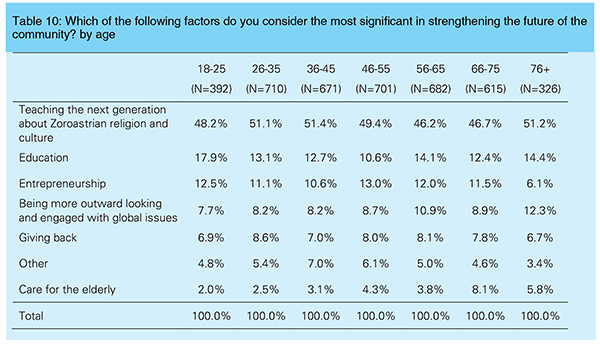
Likewise, when asked to select the most important factor to strengthen the future of the community, most respondents selected: Teaching the next generation about the Zoroastrian religion and culture. Education and entrepreneurship were the next two options that found favor across all age-groups.
South Asia showed a trend of having only one child while respondents in North America were more likely to have two or more children, possibly causing population numbers to stabilize in the diaspora.
About three-fifth of the senior respondents lived with their spouse or partner and around one-fifth lived alone. With the decline of the extended family due to migration and the preference for nuclear family living, the passing of culture and language would be adversely affected.
The data collected, "it is hoped, will lead to insights and ideas to inform and inspire Zoroastrian communities everywhere to develop future projects that will nurture harmony while strengthening and furthering the well-being of our community and religion,” noted Toos Daruvala who with Dinyar Devitre and Edul Daver sponsored the Survey.
The 200-page full report and 32-page summary by Nina Mistry are available on the website
www.genzandbeyond.com.