Over 40% of Parsis had blood pressure (BP) higher than the recommended levels of 120/80. Of these, more than 20% had blood pressure over 140/90 and are at high risk of cardiovascular diseases and stroke. These were the findings of the study carried out by Dr Hitakshi Sehgal for her doctoral thesis titled, "Single Ethnicity Study of High BP (SESHBP) and local neighborhood environments in Parsi Population in Mumbai” (see "Housing and health,” Parsiana, August 7, 2018). The findings were submitted to the University of Minnesota in May and earned the medical researcher and homeopath her PhD.
The study included 1,530 Parsis (774 females, 756 males) in the age group of 19-53 years. She completed the study over nine months and collected data on neighborhoods, BP and body mass index (BMI). Height and weight were taken to calculate the BMI and two readings of BP were recorded for all participants.
Participants were from four types of neighborhoods in Bombay: baugs with a playground and gymkhana, Dadar Parsee Colony (DPC), Parsi apartments or colonies without a playground or gymkhana, and Parsis from cosmopolitan apartments.
Parsis in Bombay are an active population, aware of physical fitness compared to the overall urban Indian population, noted Sehgal. However, fitness activity drops significantly after age 28, affecting BMI and BP. "The increasingly lower age at which inactivity, subsequent high BMI and high BP occur are worrisome... Sedentary lifestyles can lead to early ageing and higher BMIs...There is reason to worry about the 43% of people who did not spend any time on fitness. Those physically inactive were most likely to be obese and at high risk of high BP,” notes Sehgal.
The findings showed 57% of the participants were overweight or obese, which is higher than the average for the state of Maharashtra. The National Family Health survey of India "projected high BMI for urban females in Maharashtra is 32.4%, and for males 31.2%. A BMI of 25 and over is considered overweight while 30 and above is termed obese. Interestingly, Parsi "females had lower mean BMI (26.4) than males (27), which is contrary to national and global trends. Globally females have higher BMI than males.” Males have greater dependence on automobiles, and this could contribute to higher BMI, but it did not explain the significant difference between the two genders. It remains to be studied what is leading to the difference between females and males as data did not indicate more fitness activity or active lifestyle among females.
In an interview with Parsiana on May 30, 2019 Sehgal noted, "The environment plays a significant role in affecting BP. Genes can play a part in clinical disease, but latest data indicate that interaction of environment with genes determine health outcomes. In other words, our health is not determined by our genetic makeup alone. Results of the study indicated that family history did not significantly affect occurrence of high BP although it was linked to development of pre-hypertension. There is no single gene associated with a common disease like high BP which appears to involve many genes and environmental interactions. The G6PD enzyme deficiency, on the other hand, common among Parsis is the most common inherited enzyme deficiency so far reported, and the environment does not play a role in that deficiency.”
Sehgal selected the Parsis because they constitute "a founder population” with more "genetic stability… There is a big advantage looking at a single ethnicity. The Parsi community is small and has a closed gene pool.
"Of the participants in the study who had high BP, 84% were either unaware of their BP status or were not taking medications for it. Many of those with high BP were not active for fitness, were dependent on automobiles and had sedentary lifestyles. All of these factors could further worsen their BP. There may be several reasons why people don’t take or stop using medications, but this was out of the scope of this study.”
Past studies done between 1985 and 1991 by neurologist Dr Nadir Bharucha and others measured BP amongst other parameters. While their study in 2002 was to "determine the prevalence, awareness compliance to medication and control of hypertension,” Sehgal’s objective was to assess whether neighborhoods affect BP.
In a research study on hypertension in the Parsi community of Bombay, Drs Nadir Bharucha and Thomas Kuruvilla concluded that more than a third of the adult members of the Parsi community suffered from hypertension (HT) and nearly half of those were unaware of their illness. Compliance to medication was poor and only a small minority had optimally controlled BP. Their study was published in BioMed Central in 2003. Their study emphasized the need for regular check of BP for all adults and educational programs explaining the benefits of controlled BP. The age of the participants in Bharucha’s studies ranged from 20 to 70 versus 19 to 53 for Sehgal’s study. Bharucha reported that "more females (39%) had high BP than males (33%).” SESHBP results indicate that "more males (34%) have high BP than females (20%).” This difference is because young females are (naturally) protected from high BP. High BP among males in SESHBP was higher when compared to the 2002 study. "This is alarming because SESHBP included younger males (where) a lower prevalence of high BP is expected.” Bharucha did not report influence of BMI on high BP. SESHBP results indicate that obesity "significantly” affected BP. While both studies show higher BP prevalence the figures are comparable to BP of urban residents of Maharashtra. "The results indicate that better socioeconomic status and higher development index, common among the Parsi population of Bombay, were working to their disadvantage with regard to BP. Parsis of Bombay suffer the middle-income country conundrum where they are doing well economically but suffer the consequences of poor urban environments.”
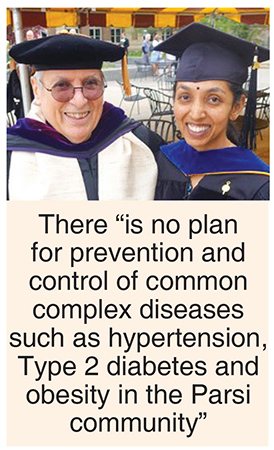
It is important to note that despite suggestions from the study in 2003, there "is no plan for prevention and control of common complex diseases such as HT, Type 2 diabetes and obesity in the Parsi community. SESHBP indicates that more young people are succumbing to higher BP and showing signs of secondary or early ageing. This is leading to a higher burden of disease in the population and a poor quality of life.” The results of this study can be extrapolated to the entire city of Bombay which is suffering from rapid and unplanned urbanization.
In SESHBP, participants self-reported regarding smoking, alcohol, physical activity, and salt intake, all of which affect BP. Sehgal found in her study that "prevalence of smoking was low in the population and 82% reported never having smoked. Alcohol consumption was also low and only eight percent reported that they consumed alcohol more than three times a week. Both these behaviors could have been underreported because of the stigma associated with those activities. Underreporting could also be because often people do not perceive themselves as drinking much alcohol even when they do,” Sehgal explained.
The main factor Sehgal examined in her study was the effect of neighborhood environments. She said security in baugs is good but there is less motivation to go out. Everything is available through the phone. People are sedentary, vehicle dependent. No lifts restrict mobility, especially for elders and less abled. People have become victims of urbanization. Local neighborhoods are dying. Mobility, social spatial opportunities are fewer. There is decreasing access to healthy food. People opt for take-aways or packaged/processed foods. Even the way cars are parked affects walkability and hence the level of physical activity. The quality of life and life expectancy of the people suffers. Local neighborhoods need to be sustained or improved, she noted. Even though the study reports that DPC residents had better BP and BMI, the difference was marginal, and the overall high BP and BMI levels are of greater concern and the community must focus on identifying ways to improve neighborhood liveability. "We owe it to the next generation to build safe and healthy environments just as it was handed to us by our ancestors,” Sehgal believes.
Social life has changed. "Many no longer ‘know thy neighbor.’ People don’t socialize much. You need space in a neighborhood to socialize,” she stated. The third place is important. The first place is home; the second, work. The third is out of the home and work without television or automobiles. As one of the participants stated, "I know my neighbors but I don’t socialize with them.” Another pointed out that Parsipanu from the neighborhood is gone.
"Neighborhoods are not just geographical areas but live, intricate environments which can interact in many ways to affect disease,” states a 2011 study by researchers Olden Isaacs and Roberts cited by Sehgal. Local neighborhoods are critical not only to cultural identity but also to the health of the residents. "The Parsi community needs to take note of it to set a positive example for the entire city of Bombay,” she recommends. This is another opportunity for Parsis to add sugar to the milk, says Prof William Toscano, the principal investigator of SESHBP and Sehgal’s PhD advisor. He strongly believes that Bombay is a paradise being destroyed by unplanned growth.
The healthiest cities in the world are the ones which provide "basic infrastructure for a healthy lifestyle including clean water, sanitation, clear air, proper housing, safe infrastructure, green spaces, employment... Vienna is one example. Other cities have adopted this theory of providing public resources successfully. New York City suffered high mortality and poor health outcomes compared to the population of USA until the 1980s (Frieden, 2008). The state overturned these statistics by improving access to disease prevention, healthy and safe environments, promoting maternal health and well-being among all,” notes Sehgal.
"Governments in high income countries try to increase mobility. They encourage the bicycle, not the car. In Bombay, the onus is on individuals to make healthy choices. The government needs to do more,” observes Sehgal. And apparently, so does the community.