Parsi cricketers scintillated in communal tournaments of yore
Kersi Meher-Homji
It is a well-known fact that the Parsi cricketers were the first to tour England way back in 1886.
Some of us may not be aware that Parsis took part in all inter-community tournaments in India from 1892-93 to 1945-46, winning many matches in the last century. The history of Indian cricket is laced with the contributions of pioneering Parsis.
They participated in the Presidency tournament against Europeans from 1892-93 to 1906-07 at Bombay Gymkhana and Poona Gymkhana. This tournament evolved into the Triangulars between Parsis, Europeans and Hindus held at the Bombay Gymkhana from 1907-08 to 1911-12, to the Quadrangulars between Hindus, Parsis, Europeans and Muslims from 1912-13 to 1936-37 in Bombay and Poona and finally to the highly popular Pentangulars contested between Hindus, Muslims, Parsis, Europeans and the Rest (Indian Christians) from 1937-38 to 1945-46.
The Pentangulars were as popular in Bombay as the Indian Premier League (IPL) matches played currently in India, drawing big crowds who cheered every boundary, every wicket, every appeal. Most of us are too young to remember those Pentangular cricket tournaments held at the Brabourne Stadium in Bombay, but my father told me that those matches were more exciting than Test matches.
Just like the current IPL matches are, like them or not.
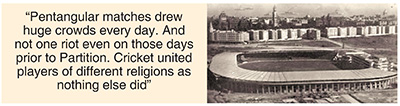
As my father, a respected doctor, told me in the 1960s, "Forget Ranji Trophy and even Test matches, the three-day Pentangular matches drew huge crowds every day. And not one riot even on those days prior to Partition. Cricket united players of different religions as nothing else did.” He was most disappointed when Mahatma Gandhi, expecting riots, put an end to the popular Pentangulars in 1946.
The quality of play was amazing, as I read the book From Presidency to Pentangular from 1892-93 to 1945-46 by Vasant Raiji and Mohandas Menon.
The standard of cricket was at its supreme best when Mushtaq Ali and Mohammad Nissar for Muslims, Harold Larwood, Douglas Jardine and Denis Compton for Europeans, Vijay Hazare from Rest as also the Kanga brothers (Pestonji D., M. D., Dinshaw D. and Homi D.), Dr Mehellasha Pavri, Kekhashru Mistry, Jehangir Warden and Rusi Modi for Parsis tried to outgun C. K. Nayudu, Vijay Merchant, L. Amar Singh, Lala Amarnath and Vinoo Mankad for Hindus.
Now let me highlight the Parsis’ performances in these four inter-community tournaments.
In the Presidency tournament from 1892-93 to 1906-07, of the 26 matches played, Parsis won 11, the Europeans 10 while five were drawn. The highest individual score was recorded by Homi Kanga, 233 at Poona in 1905-06. The highest partnership was also by the Parsi pair of Homi Kanga and Mistry who added 178 runs for the second wicket in the above match. The highest team total was also by Parsis; 503 at Poona in 1905-06. The great Ranji (Ranjitsinhji, one of India’s first great cricketers who played Test cricket for England) called Mistry the Clem Hill of India. Hill was a supreme stroke player from Australia.
K. B. Mistry had the best bowling spell, nine for 81 at Poona in 1906-07. The second best was also by a Parsi, Bamanji Billimoria, eight for 11 at Poona in 1895-96.
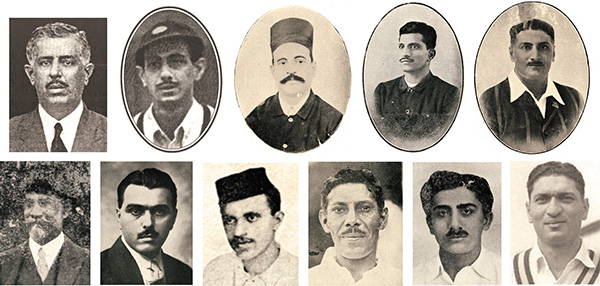
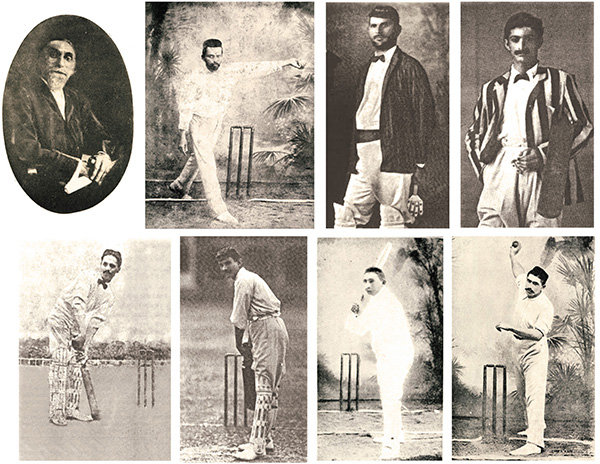
L-r, 1st row: Jehangir Warden, Rusi Modi, Nusserwanji Bapasola, Jehangir Elavia, Dolly Kapadia;
2nd row: Dinshaw Kanga, Keki Irani, Jehangir Dubash, H. Vajifdar, Jehangir Elchidana, Polly Umrigar;
3rd row: Pestonji Kanga, D. Writer, Dr Mehellasha Pavri, Homi Kanga;
4th row: Kekhashru Mistry, Rustom Meherhomji, B. Gagrat, M. Balsara
Photos: From Presidency to Pentangular from 1892-93 to 1945-46 and Parsis And Sports
On three occasions Parsi bowlers dismissed Europeans for a total under 50; 24 all out in 1894-95 at Bombay, 30 in 1895-96 at Poona and 40 in 1904-05 at Bombay.
Rustomji Meherhomji became the first one to score 99 runs in the match against Europeans which enabled Parsis to win by an innings. A graceful batsman, critics called him the "Parsi Palairet,” likening him to an elegant batsman from England.
In his book Stray Thoughts on Indian Cricket (1905), J. M. Framjee Patel wrote, "People go to see it (Presidency match) just as the Greeks went to their Olympic Games or the Spaniards go to visit the bullfights in Madrid.”
When Hindus entered their team in 1907, and the tournament, from 1907-08 to 1911-12, it was renamed the Triangulars. Parsis won the Triangulars most times (twice, in 1907-08 and 1911-12), Europeans once in 1908-09 and Hindus not even once. In 1909-10 and 1910-11 the finals were drawn due to rains. Meherhomji scored the maximum runs in the Triangulars, 354 in seven matches at an average of 32.18, highest score 100. John Greig from Europeans was next, with 320 in five matches at 40.00, highest score 115. Greig was nicknamed "Jungly Greig” by the locals! After retirement, he was ordained as a Catholic priest in Rome.
Warden from Parsis and Palwankar Baloo from Hindus dominated the bowling, taking 48 wickets at 7.85 and 42 wickets at 10.61, respectively. In the match against Europeans in 1911-12, Warden had amazing figures of 12 wickets for 96 runs. The critics labelled Warden the greatest all-rounder of his time.
Muslims made their debut in the inter-communal tournament in 1912 when it became known as Quadrangulars which were played from 1912-13 to 1936-37. Hindus won most times (six), followed by Europeans, four times, Parsis and Muslims, three times each. Parsis won the inaugural Quadrangular match on September 11, 1912 against Hindus by an innings thanks to M. D. Parekh taking six for 30 including a hat-trick and Warden scoring an unbeaten 115.
A week later Parsis beat Muslims by an innings in the final, Homi Kanga (150) and Warden adding 209 runs (a Quadrangular record) and Parekh capturing 13 wickets in the match (six for 42 and 7 for 34). Due to Parekh’s bowling wizardry, a strong Muslim team was dismissed for 86 and 70 in reply to Parsis’ impressive total of 333.
During a match against Europeans in 1936-37 Parsis’ wicket-keeper batsman Kharshed Meherhomji hammered the feared fast bowler Larwood of bodyline fame for four consecutive boundaries in the first over. Two years earlier Meherhomji had taken five catches behind the wickets against Muslims.
Bombay Presidency Cricket XI team
Apart from winning the Quadrangulars in its inaugural year 1912-13, Parsis won again in 1922-23 and 1928-29.
Now, finally to Pentangulars from 1937-38 to 1945-46. Of the eight tournaments contested, Muslims and Hindus won four times each. Hindus did not participate in 1937-38 and 1940-41. No tournament was held in 1942-43 due to the civil disobedience movement.
With Hindu and Muslims teams enriched with Test cricketers, it is not surprising that Parsis, Europeans and the newcomers Rest did not win any title.
All matches were played at the prestigious Brabourne Stadium. The first match was played between Parsis and Muslims from December 15-17, 1937. Muslims won by eight wickets. They won the final by beating Europeans by an innings and 91 runs as the famous daredevil Ali hit 135 runs and Amir Elahi, a googly bowler, took six for 33.
Hindus withdrew from the initial tournament due to a dispute in the allocation of seats.
Muslims retained the trophy the next year despite Hindus participating. Amarnath (Hindus) was the hero of the match against the Rest amassing 241 runs as the Hindus compiled seven declared for 560.
The legendary Merchant from Hindus aggregated the most runs, 1,480 in 12 matches at a fantastic average of 164.40, hitting five centuries (highest score 250 not out). My hero Hazare from the Rest totalled 1,212 runs in only eight matches at an excellent average of 101.00 with four centuries.
With his younger brother Vivek Hazare, Vijay added 300 runs for the sixth wicket against Hindus (with nine Test players) in 1943-44. This remains as the highest partnership in all inter-communal tournaments. Of the 300 runs added, Vivek contributed only 21. Amazing!
The only Parsi batsman to shine out was the elegant stroke player Modi. He scored 715 runs at 65.00, hitting three centuries with 215 as his top score. With M. F. Mistry (152), Modi (144) added 231 runs for the fourth wicket against Europeans in 1941-42.
Two bowlers took eight wickets each in a Pentangulars innings: Walter Bradshaw eight for 68 for Europeans against Muslims in 1937-38 and Elahi, eight for 160, for Muslims against the Rest in 1943-44. Elahi also captured the most wickets in the Pentangulars. In 13 matches he took 94 wickets at 18.15, taking five wickets each in seven matches (best figures being eight for 160).
The best bowler for Parsis was J. Palsetia who captured seven for 109 against Europeans in 1938-39.
The great Parsi all-rounder Polly Umrigar played only four Pentangular matches. He was a teenager when the crowd-pulling tournament concluded in 1945-46. A few more years and the prolific Umrigar could have won more matches for Parsis.
Those were the days my friends. I wish they had never ended!
Bawa clown!
During the 1930s, a short, rotund Parsi amused the crowd during dull moments of play with his tomfoolery and piercing whistles which could be heard all around the ground. Best known for his mimicry of comedian Charlie Chaplin, he called himself "Charlie.” The carnival spirit of Quadrangulars and Pentangulars was enhanced by the antics of this lovable Parsi clown. He once ran between the legs of the Maharaja of Patiala who presented him a gold watch for the joy he brought to the crowd without interfering with the game during actual play.
Cricket vignettes
In the 1935 book Parsis and Sports by H. D. Darukhanawala, there are some interesting asides on Parsi cricketers. The book featured an article by J. R. B. Jeejeebhoy who wrote in "The Sporting Parsi”:
"Take, for instance, the game of cricket. Amongst all the Indian communities the Parsis were the first to take to it so far back as 1848 and they made themselves masters of it within 50 years, so much so that they defeated two English teams that had arrived from England in 1890 under the captainship of G. F. Vernon and in 1892 under that of Lord Hawke, these being the only reverses the teams had experienced during their tour in this country. J. M. Patel writes in his Stray Thoughts on Indian Cricket that he was once told by Prince Ranjitsinhji, the Prince of Cricketers, that it was a Parsi who had first taught him cricket in India, and also Maharaja Sir Sayaji Rao, Gaikwad of Baroda, in a letter to Patel, said that he had the game taught to all his sons by professional 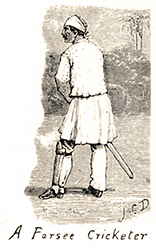 Parsi cricketers. With years rolling on, the Parsis made themselves more efficient in this manly pastime, but latterly with the game of bridge coming into vogue they exchanged the willow for the cards with the result that their play has now in a large measure deteriorated. It is, however, gratifying to take note, under these depressed circumstances, of the highly creditable performance of D. R. Havewalla, who, playing for the B. B. & C. I. Railway in December 1933, made 515 runs against St. Xavier’s College, a record and an achievement hitherto unsurpassed in the annals of Indian Cricket.”
In a section in the book titled "Reflections on the Test Matches played in India in 1933-34” Dr M. E. Pavri analyzed:
"Bombay players, with the solitary exception of that young colt Merchant, who showed excellent form very consistently, were not up to the mark and were unable to show their usual form, owing to the serious handicap to which they were subjected by the absence of the Quadrangular matches for three years on account of the political trouble in Bombay. The most likely players who are expected to shine in future are Jai, S. Colah, Vajifdar, Dadi Havewalla, Jamshedji, Pulsatia, Bahadur Kapadia, Marshall, Hindlekar, Champak Mehta, Pereira, D’Avoine, Richards, Bhagwandas, Meherhomji, Dadyseth, Chury, F. Nariman, Irani of Karachi and Poona, M. Mobed, Nagarwalla, Khote, Bamboat and Talukdar.
"For Bombay cricket, the Quadrangular tournament is a necessity, its popularity being firmly established amongst the cricket-going public of Bombay, although I believe that Inter-Provincial cricket, though difficult to manage and doubtful of immediate success, is essential for improvement of Indian cricket.”
Yet another visual narrative refered to the Parsi cricketers’ sartorial style and affinity to the game:
"These old pictures, supplied by J. R. B. Jeejeebhoy, are taken from the London Graphic of August 10, 1878. The handkerchiefs seen on the heads of Parsi cricketers are tied to keep off the burning heat of the sun, sun-hats having been forbidden by strict orthodoxy. The Parsi players of those days did not mind taking the field with bandis and pyjamas which stand in strong contrast to their present day fashionable cricket accoutrements.
"The Graphic describes them as follows:
"‘It is not everywhere, however, that John Bull finds any of the natives inclined to join in the sport; they are generally content to ‘assist,’ in the French sense of the word, by simply looking on. There are, nevertheless, exceptions to the rule, and in the Bombay Presidency, the Parsis, who have for long shown themselves superior to the prejudices with which other Indian races are more or less fettered, have come out quite strong as cricketers. Before long, it is rumored, a Parsi eleven will visit our shores for the purpose of contending with us on our native turf. We have already received several severe drubbings in the cricket field from our Australian cousins, perhaps next we are destined to be knocked (cricketically) into a cocked hat by the descendants of the fire worshippers of Persia.’”