A student’s attempt to
gauge the viewpoints of Parsis
Rohan Vakil
Sixteen-year-old Rohan Vakil states he conceptualized this survey as his "culminating middle years high school project. With one Hindu and three Parsi grandparents, and living in Poona while spending vacations in Valsad,” he has long been "fascinated with the varieties of Parsi identity, urban and rural.” A student of the Mercedes-Benz School in Poona, Vakil intends to join UWC Mahindra’s IB (International Baccalaureate) Diploma program next year.
He thanks his father Dr Cyrus Vakil for guidance in designing the survey and analyzing the results. Cyrus is a Yale-trained cultural historian, a pioneer of international education in India since 1998, and recently returned to Bombay to head the Bombay International School.
Rohan’s survey report titled, "Inside the Parsi mind,” is published below with minor editing. Though the survey results do not carry the weight of a scientifically conducted poll by a professional agency, the findings do give an indication on community thinking.
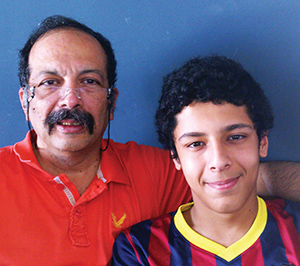
Dr Cyrus and Rohan Vakil: "Inside the Parsi mind"
Over the last few decades, the Parsi community has vigorously debated key issues about its identity such as conversion, intermarriage and the disposal of the dead. Few studies however have been done about what Parsis think about these issues.
Between June and October 2016, my father Dr Cyrus and I undertook a survey of Parsis/Iranis from various parts of urban and semi urban India and some abroad. One hundred and eighty nine people responded in person or through electronic means to a 15-point questionnaire. Responses to the statements were on a five-point scale, ranging from Strongly Agree to Strongly Disagree. The age of the respondents ranged from 15 to 86 years. The average age of the female respondents was 47 and of males, 41. The typical respondent was a college graduate (49%) but the education level ranged from those who had only completed school (23%) to those who had doctorates (3%). The respondents also ranged from the high priest at Udvada to the pickle merchant outside the fire temple there.
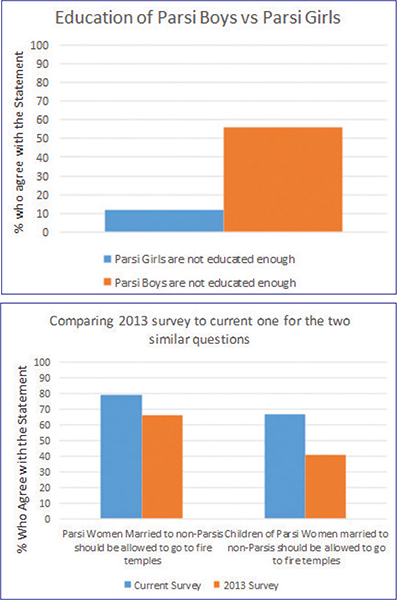
Perhaps the most interesting finding was that 79% of the respondents believed that Parsi women married out of the community should be allowed to remain Zoroastrians and enter fire temples; 67% felt that their children should also have the same rights. A previous survey done in 2013 by the Hansa Research Group for Parsiana, which had asked two very similar questions had received more conservative responses. In the Parsiana survey, 66% had approved the entry of women married outside the community into fire temples, while 41% had approved of their children entering.
In the current survey, while women felt more strongly on both issues, males too supported this (66% for women and 54% for their children). Parsis from the smaller cities and towns, while more conservative, supported the women (59%). However only 45% of them believed that the children of Parsi women married to non-Parsis should be allowed to become Zoroastrians.
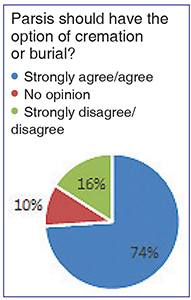
Seventy-four percent of all surveyed Parsis believed that cremation or burial should be available options after death. For Poona Parsis, this proportion went up to 80%, perhaps as a consequence of the lack of vultures at the Poona dakhma. When asked whether the system should be changed, a female respondent from Poona cited lack of vultures, saying "Cremation should be allowed rather than the Towers of Silence. They should have freedom of choosing their method after dying.”
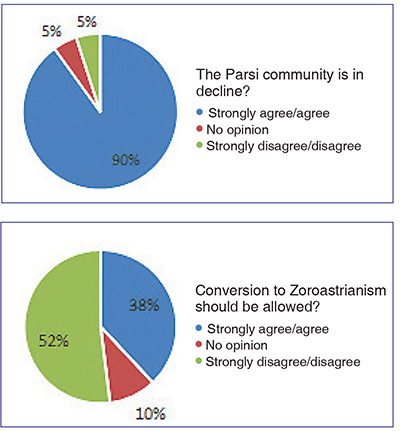
While Parsis took a reformist position on intermarriage and the disposal of the dead, 64% admitted to "Parsis not paying enough attention to the rituals and prayers.” Likewise, only 38% would welcome converts into Zoroastrianism. This ranged from 53% of Poona Parsis welcoming converts, to 34% of Parsis from the smaller cities, to only 28% of Bombay Parsis.
Ninety percent of respondents agreed with the statement that "The Parsi community is in decline;” 86% attributed the decline in numbers to "late/no marriage or no children.” In qualitative terms, some perceived a decline in the Parsi inclination toward charity. Fifty-one percent felt that "Richer Parsis are failing to meet social responsibilities.” Of these respondents, Bombay constituted 58%, Parsis from smaller cities 57% and Poona 37%.
Perceptions of decline also seem to stem from a dissatisfaction with educational levels of the youth, especially boys. Fifty-six percent of respondents strongly agreed or agreed that "Parsi boys are not educated enough nowadays.” Only 12% said the same for Parsi girls. Indeed, one Poona respondent commented that "Parsi girls want to marry out of the community because the boys are not educated enough.”
No contradiction was seen between Parsi identity and Indian identity. Only 19% believed that "the main identity of Parsis should be Parsi rather than Indian,” with 65% disagreeing. Nineteen percent agreed "Parsis should not leave India and go abroad,” while 65% disagreed.
Unsurprisingly, those with masters and doctoral degrees were more liberal, while those without college degrees were the most conservative. Females were more liberal than males on all relevant questions including, but not limited to, the ones on the marriage outside the community and the status of their children. Interestingly, out of all the age groups surveyed, the people in the 45 to 64 age group were the most conservative. The most liberal was the 25 to 44 age group.
A survey based on less than 200 randomly chosen individuals of course needs wider corroboration. It is however a good starting point for academic research. The overall picture of Parsis that emerged from this perception study is that of a community which is much more liberal and interested in changing rules than may seem from letters to editors and from speeches. As an 86-year-old Poona mobed said, "The rules need to be changed, but they cannot.” It is a community that would however not like to open its faith to outsiders, and is deeply concerned about numerical and philanthropical decline as well as the education of males. The community wants Parsi youth to contribute to the continuing legacy of Parsis in Indian history.
Questionnaire
Please circle the appropriate response to each question: strongly agree, agree, no opinion, disagree, strongly disagree.
1. Conversion should be allowed for others to convert to Zoroastrianism; 2. Parsi women married to non-Parsis should be allowed to remain Zoroastrians and go to fire temples; 3. Children of Parsi women married to non-Parsis should be allowed to remain Zoroastrians and go to fire temples; 4. The Parsi community is in decline; 5. Parsis should not leave India and go abroad; 6. Parsis should live in their own mono-religious colonies rather than spread themselves into mixed ethnicity areas; 7. Parsi boys are not educated enough nowadays; 8. Parsi girls are not educated enough nowadays; 9. Parsi youth are losing their cultural and religious heritage; 10. Richer Parsis are failing to meet their social responsibilities towards helping the poorer Parsis; 11. The biggest cause of falling numbers of Parsis is late/no marriage or no children; 12. The main identity of Parsis should be Parsi rather than Indian; 13. Parsis should visit sacred Zoroastrian sites in Iran at least once in their life; 14. Parsis are not paying enough attention to the rituals and prayers of the religion; 15. Parsis should have the option of cremation or burial instead of being committed to the Towers of Silence.
Survey facts
Size: 189 Parsis (including four with only Parsi mothers).
Data collection method: 51 survey forms were filled and received in physical copy, 138 responses electronically through Google Forms. After the link was sent to three contacts they sent it to their Parsi groups and within three weeks over 100 responses came in from Ahmednagar, Daman, Hubli, Karjat, Navsari, Udvada, Valsad, Auckland, Dubai, Hyderabad, Bombay, Nagpur, Poona, Singapore, Surat and Vadodara. The survey was then closed to keep it from getting over-represented.