Died: Rati Faramroz Cooper, 89, the first Indian woman principal and subsequently principal emeritus of Rajkot’s prestigious Rajkumar College (RkC) and trustee of the Bai Awabai Cooper Agiary; in Lahore on March 8, 2019.
Built as a residential school in 1870 for the education of the princely order, RkC opened its doors to the public in 1938. Cooper contributed to its growth for over four decades from 1958 to 2000.
At the memorial gathering for "our Ma’am, our gem” on March 12, at the Bhavsinhji Hall in RkC, there was a large turnout of RkCians and staff members, standing in the galleries and near both the entrances, who had come to pay their respects to the erstwhile teacher, housemistress of the Preparatory House, headmistress of the junior school, and principal whom they loved like a mother.
Rati Cooper (left and right, 2nd from l) outside the building named after her in Rajkot
Rati Cooper (l) and Perin Boga at the Bai Awabai Cooper Agiary in Lahore
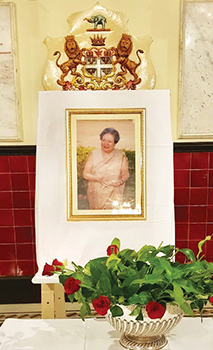
For her every student and staff member of RkC was a family member, remarked current principal Shankarsinh Adhikari, recalling how she bonded with all and remembered the names of her past students with her remarkable memory. President of the RkC council, Darbar Saheb Mahipal Wala of Jetpur alluded to his days as a student in this school and to Cooper’s "sterling qualities.”
She enjoyed the rare distinction of having a building in the College complex — Rati F. Cooper Kala Bhavan — named after her during her lifetime. As housemistress of the Preparatory House when she had to nurture the youngest lads of the school, she developed a Prep Yard that had a tree house, a pond, and a little enclosure for rabbits, deer, pigeons, sheep, peacocks and peahens with the little ones entrusted to look after their chosen creatures with the tags of peacock boys, pigeon boys or deer boys that they sported with pride. Even the trees on the premises were given due care and attention.
Sister Maria Teresa Unzu who was joint headmistress with Cooper at the RkC before she took charge of the Nirmala Convent School noted in her condolence letter that she held a mass in their chapel in memory of her peer. Together they have been given credit for creating "a culture of sincerity, good work and cheer without ever compromising on effort.”
During her 42 years at RkC, "her stature was unassailable which she had worked hard to earn… her word was law as headmistress and as the principal later,” summed up Ayaaz Khan, one of her students who was appointed principal of the School when she was designated principal emeritus. He recalled the occasion when she directed the carpets used for music class in the hall be sent to Priyalok Vilas (the preschool for RkC). Not happy with her unilateral decision, Khan wrote her a polite letter conveying he would not like her to give direct instructions to any staff without consulting him. "There is no doubt she must have been sorely hurt” but the next morning when he went to meet her he was "greeted with an even tighter hug.”
Their bonding continued even after her retirement when she settled in Lahore with her sister Perin Boga. She would regularly call Khan and his wife Kirtida who had worked under Cooper. "Ma’am would describe the new leaf that had just sprouted on a branch, a little bird that sat there making sweet music, a cultural program she had attended, the visits of friends… The Coopers took keen interest in all matters and pleasure in every little thing.” Close to her she retained a photo of the gulmohur tree at the RkC quadrangular with the famous Gujarati couplet: "Hu gulmohur né jovu ané gulmohur mané/ Koné joyi né koné kona rang yaad aavé (I look at the gulmohur and it looks at me/ Looking on, who is reminded of whose colors).”
Ex-student Kiran Patel, principal of the Galaxy group of schools, considered Cooper’s "fairness” her distinctive trait. "You are not making an effort,” Cooper would constantly chide Suren Vakil from the batch of 1978 even though he got better grades than some of his peers. Now on the faculty of CEPT University, he valued her goading, admitting that "Are you making an effort?” is the benchmark he has set for his students.
Another ex-student Gaurang Sanghavi from the class of 1982 wrote: "RkC was Ma’am’s lifeline and her mission. She came here in the spring of her life and gracefully passed through the autumn to the winter… In her youth she was a firm disciplinarian and we all feared her in junior school. We hated the detentions and always looked for corners where we could escape her attention and how all of this changed as we stepped out of the confines of this school (when) each of us longed for the moment when we could meet our beloved Ma’am, hold her hand and talk to her… Maybe once in a while in the crackle of the winds and in the chirping of the birds she will correct my English.”
As a homesick lad who had qualified for the first batch of government scholars from Bihar to be schooled at this prestigious institution, Tripurari Kumar Sangh from the batch of 1985 who later became a colonel, recalled how she created a separate class called "Special Form” to help students like him improve their English and performance in other subjects. When he left school to join the National Defence Academy in Khadakwasla, Cooper who assisted him with his farewell speech had then advised: "Be simple and yourself, wherever you are.”
Cooper’s early education was at the Sacred Heart School in Simla. Since her father Faramroz had business and property in Bombay as well as in Lahore, at the time of partition of the country, Rati became an Indian citizen and Perin, a Pakistani. Rati obtained a Bachelor’s degree in English, French and philosophy from the Sacred Heart College followed by a Master’s in Philosophy of Education from New York State College. A recipient of the Fulbright Award for Travel and Study in USA she had also won the British Council Visitorship Award for summer courses.
A trained pianist, she had done several courses in western classical music from the Trinity College of Music and other institutes in Rochester, Colorado and Warwickshire. With varied experience, teaching at the Cathedral School, Lahore, the Lawrence College in Murree, the Green Mountain College in Vermont, USA and working as director of the Child Development Department of the College of Home and Social Sciences in Lahore, a reluctant Cooper, then in her 20s, was persuaded by the British Council to visit RkC. Almost instantly she consented to work there. Along with Wynter Blyth and Peter Rogerson she formed "a formidable trinity to guide the destiny of the institution which was dearer to them than their own lives.”
Whilst Rati had only one sibling, her father was one of Ardeshir Cooper’s 27 children. The Agiary in Lahore was built by her grandfather. She continued to dutifully help manage the institution as a trustee and would earlier even sweep and swab the premises in the absence of a caretaker. Although one never heard the word "God” from her lips, to her, divinity was to be practised without a semblance of a sermon. Niloufer Bilimoria whose mother Thrity was Rati’s cousin chose to perpetuate Rati’s kindness by "planting trees in her memory via growtrees.com. I will also help educate a girl child. If I can imbibe a fraction of her compassion, I will be a transformed being,” she wrote.
One junior associate remarked that Rati "suffers from a malady that makes her restless and in great discomfort until she has found a way of helping everyone she has met: be it in terms of doling out vast sums of personal money to those in need of a house or seriously ill… to get a deserving person admission into a good institution… or even giving away her own fan or cooler so someone else’s mother may sleep more comfortably.”
Rati’s ex-student Bharat Avalani who continued to retain ties with her until the end appreciated that "both the governments showed enough compassion to allow both the sisters to live together and travel together,” permitting them to regularly cross the Indo-Pak border after retirement. His poem Mother, as a tribute to Rati, stated, "She may not have given birth to us/… But she bore the pains to shape our character/ But she made us see the world with compassion/ But she made sure we slept like babies and arose with purpose/ But she held our hands,/ And helped us take strides towards a brighter future./ How can she not be our mother?”