Anyone interested in ancient
Zoroastrian history must visit Uzbekistan
Noshir Khambatta
Our Zoroastrian past has left an indelible mark in several Central Asian countries but more so in Uzbekistan than anywhere else. Uzbekistan, much of which lies between the Oxus and Jaxartes rivers, is a truly beautiful, hospitable, interesting and welcoming country, well worth a visit for anybody interested in ancient Zoroastrian history. The Iranian festival of Navroz is still celebrated in Uzbekistan as it is in Zoroastrian and other communities throughout the world.
Samarkand, Bukhara, Khiva are all evocative names steeped in history and conjuring up images of mystery and remoteness. But, how many Zoroastrians know that they were also the centers of thriving Zoroastrian communities? To this day it is still possible to see and with a modicum of imagination, visualize the immense contribution made by our forefathers to the history of art, religion, culture and trade of ancient Khorezm (also called Khairizem or Khuarizem) and Sogdiana.
There is some evidence to believe that Avesta, the holy book of the Zoroastrians, originated in ancient Khorezm. The capital of this kingdom was Khiva which is mentioned in Zoroastrian sacred books as Urva. The people of this area were of Iranian stock. At Khiva, which was included in the World Heritage list of cities in 1990, is located the Avesta Museum. It houses a fine collection of pictures and artifacts related to our great religion and holy book. Unfortunately there are few English translations in the Museum and it is advisable to employ a good guide. There are very few English speakers in Khiva and apart from the Uzbek language itself, a knowledge of Russian would be helpful.
The Ark fortress in Bukhara
The Museum of Avesta History in Khiva
Top: Sun motif with sunbeams at the Divan Beghi Madrassa, Bukhara;
below: Close up of the Shir Dor
Madrassa in Samarkand showing lions, faces and sunbeams
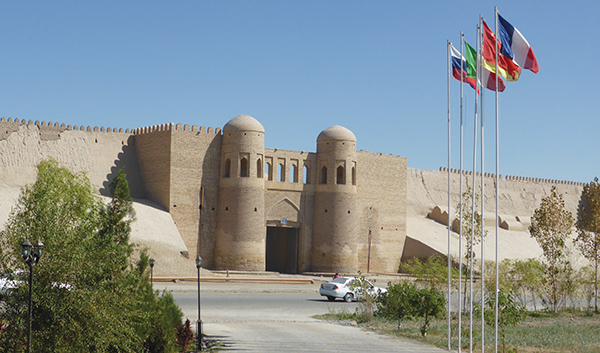
The approach to Khiva is absolutely breathtaking. The inner city is enclosed within a fortress with walls several meters thick running for 2.2 km and at an average height of about 20 meters. At the highest point of the walls stood a watch tower and, according to several local guides, in ancient times, a fire temple. Entrance to the city is via four enormously strong and large gates. The inner city therefore enabled camel caravans to enter, shelter and leave the city in safety on their way to distant destinations such as Xian in China or Ankara in Turkey along the fabled Silk Road.
Khiva lies on the fringes of the Karakum desert and the nearby Oxus river or Syr Darya is its lifeblood. Over the centuries the river has frequently changed course exposing old settlements which were once submerged by this mighty river. Material from these settlements had been recycled and reused in Khiva, especially plinths and pillars which one often finds in palaces, masjids and madrassas. Local guides consider the "Holy” Swastika plinth as proof of Zoroastrian influence. Since the Swastika represents the sun, the source of life giving fire and creavitity, this plinth or base probably originates from the city’s past association with the Zoroastrian faith. The second plinth (which the guides insisted also had a similar association) depicts an hour glass shape which was repeated in several other monuments throughout Uzbekistan.
A final proof, if any is needed, of Zoroastrian connections are ossuary finds in and around Khiva. Some can be seen at the Avesta Museum and at the Pahlavon Mahumed complex. An ancient dakhma dating back to the first century AD or possibly even earlier can be seen in Chilpik, not far from Khiva.
A main road running for long stretches through the Karakum desert and also at times along the shoreline of the Oxus, connects Khiva with Bukhara which is one of the oldest cities in Central Asia with a history stretching back for about 2,500 years. In pre-Islamic Bukhara, the main religion was Zoroastrianism along with Christianity, Buddhism and other beliefs in what was a tolerant society under Sogdian control.
According to Tarekh-i-Bukhara, a history of Bukhara, the Islamic faith had to be enforced on the reluctant Zoroastrians of the city. The ninth century Arab commander Qutaiba had to try four times to convert the people of Bukhara. The citizens rejected Islam three times and reverted to their Zoroastrian faith.
The Maok-i-Attari Mosque, one of the oldest shrines in Bukhara, was first a shrine to a heathen god on which was erected a Zoroastrian fire temple and subsequently an Arab mosque as learnt from the excavations of Soviet archaeologist V. A. Shiskin in 1935. Stacked one on top of the other, in a time span of 2,000 years, today it has unfortunately been reduced to the status of a carpet museum.
The Ark fortress built by the epic hero Siyavusha, a Persian prince, was the home of the rulers of Bukhara for many centuries. Arabs built the first ever Bukharan Mosque in 713 AD on the remains of a Zoroastrian fire temple destroyed during the Arab conquest of Bukhara.
The architectural format of the magnificent Ismail Samani Mausoleum sets it apart from its contemporaries.The basketweave brickwork, the brick suns, the canopy and its overall shape resemble the inner complex of a fire temple more than a mosque or mausoleum. Historical sources attributed this monument to Ismail Samani whose forefather Sama Khuda (founder of the Samanid dynasty) renounced Zoroastrianism and embraced Islam.
Finally the Madrassa of Divan Beghi with its images of mythical birds flying towards the sun also point to an association with the Zoroastrian past as do the sun motifs on the Shir Dor Madrassa in Samarkand.
Founded around 600 BC, Samarkand, that goes back to pre Achaemenid times, is a " must see” city, a UNESCO world heritage site with an amazing collection of architectural gems.
The Registan is without a doubt the jewel in Samarkand’s crown. George Curzon, later to become Viceroy of India, described it as "the noblest public square in the world” as it easily surpassed in its splendour any other square to be seen in contemporary Europe. The three amazing structures around the Registan square are all madrassas or Islamic schools. The Shir Dor (meaning "lion bearing”) depicts striped beasts at its portal that resemble tigers more than lions! The backs of the lions seems to carry beam fringed suns with human faces.This is strange because of the Islamic taboo on figurative art and stranger still to find this on an Islamic religious building.The sunbeams are similar to those on Zoroaster’s picture seen in many a Parsi home and shows the tenacious hold exerted by earlier Zoroastrian beliefs which pervaded this city until the ninth century AD.
The Shah I Zinda tomb is one of the holiest shrines and centerpiece in Samarkand’s necropolis. Legend traces its history to 676 AD when Kassam ibn Abbas, a cousin of Prophet Mohammed, arrived to convert Zoroastrian Sogdiana to Islam. Amongst a plethora of Muslim tombs beautifully decorated with ceramic tiles, carved teracotta and paintings stands a starkly simple structure, totally out of keeping with its richly decorated neighbors. Several guides pointed to this structure within the Shah I Zinda and described it as a fire altar left over from Zoroastrian times. While there is no conclusive proof of this, it is a possibility especially as Gengis Khan flattened the surrounding complex of graves but left Kassam’s grave intact and with it this small fire altar.
The Afrosiab History Museum is named after Afrosiab who established the capital of the Sogdian people some 2,500 years ago and became part of the Achemenid Zoroastrian empire in sixth century BC. In 1220, Afrosiab was destroyed by Gengis Khan and the citizens decided to rebuild the city to the south which is now the modern city of Samarkand. Known originally as Afrosiab then Marakand and finally Samarkand, it was a Sogdian stronghold for several centuries. The Sogdians were followers of Zoroastranism and the first mention of this city can be traced back to the Avesta where it is mentioned as the second of the best places or countries. The Sogdians became the principal merchants of the great Silk Road and so dominated the trade along this ancient highway that their language became the lingua franca all the way from China to Persia. The Afrosiab Museum displays bronze and ceramic articles, ossuaries, gems, coins, jewelry and some magnificent seventh century frescoes in vivid colors as testimony to what must have been a highly cultured and tolerant society.The outlines of the ancient city can still be viewed and it is thanks to the excavations conducted by Russian archaeologists in the 1880s that much of the amazing history of the Sogdians is known today.