Ronnie Screwvala, with his proven innate ability to merge creativity and commerce, has now turned philanthropist
Farrokh Jijina
"An entrepreneur will make at least one mistake in his career that will cost him or her dearly,” said Ronnie Screwvala, media magnate turned philanthropist. "Be prepared for failure, embrace it,” he exhorts. "But (then) analyze, recalibrate and move on,” he urges.
Screwvala, founder of the media and entertainment conglomerate, UTV (United Television) Group, was in conversation with Mini Menon, executive editor of Bloomberg TV at an event organized by Literature Live! and the Vinod and Saryu Doshi Foundation at the National Centre for the Performing Arts (NCPA) in Bombay on May 11, 2015 to celebrate the success of his book, Dream with your eyes open — An entrepreneurial journey. Anil Dharkar, organizer of Literature Live! and well-known literary figure introduced Screwvala, a first generation entrepreneur, while bemoaning that funding for cultural activities was at a low ebb in the city.
Screwvala, who has been named "the Jack Warner (former president of Warner Bros Studios) of India” by Newsweek magazine, set up UTV which has interests in television, digital, mobile, broadcasting, games and motion pictures, in 1991.
Successful collaborations helped the business he exited in 2013. Among the impressive list of collaborators Screwvala has worked with is Bloomberg. He stated that he "had to make many ‘day-trips’ to the United States, to be seen to be earnest about the collaboration.” He candidly mentioned that he had to work with them for 18 months before they agreed to collaborate with him. In a first ever for Bloomberg, they agreed to lend their name to a collaborator — UTV.
He quoted another instance where he landed up in the UK for a meeting with media baron Rupert Murdoch’s team "single-handed, to find himself facing a seven-member team that was ready to propose a deal and close it the same day!” Murdoch, the head of NewsCorp, who he had hosted earlier in "our cramped basement office,” was totally business-oriented. That meeting must have impressed the American tycoon, as Screwvala was called to London within only a few weeks of his hosting Murdoch in India, he said.
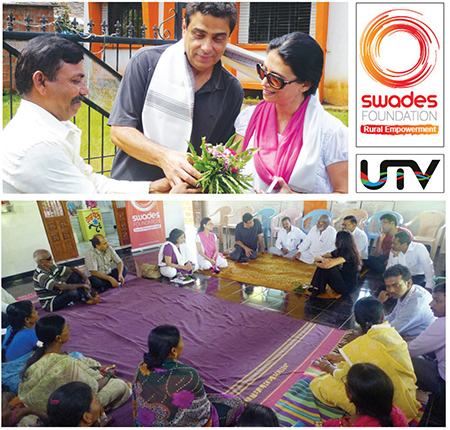
From top left: Ronnie and Zarina being felicitated at a Swades function;
logos; the Screwvalas with stakeholders at a Swades meeting
His collaboration with The Walt Disney Company started with the American media giant’s acquisition of Hangama, UTV’s television channel for young people. It was a win-win situation for both parties, he stated. Proud of Hangama’s achievements and reach, he stated modestly, "Why else would Disney be interested in a channel whose name they could not pronounce.” Of Disney he said, "It is a company that fosters entrepreneurship, is extremely focussed on their brand, and extremely selective in their collaborators.” Screwvala divested his stake in UTV to Disney in 2012, stayed on as leader for a year and then "exited the media business.”
A pioneer in the cable television business in Bombay in the early 1990s, Screwvala stated that he has learnt three major lessons from his various successful collaborations: that the partnership must be a win-win for both parties, go as an ‘equal’ partner, not as a party asking for favors, and involve the financiers and investment bankers as necessary. Friction between entrepreneurs and financiers is a given, but he urged entrepreneurs to look for the positives that financiers bring to the deal: sound industry experience and good management practices. He lamented that most Indian entrepreneurs hold out for a majority stake or are "obsessed with 51% equity.”
Reiterating that significant changes or "inflection points for a business have to be pursued and that they don’t just happen,” the two turning points in his career were when he transformed UTV from being a B2B (business to business) company to a recognized brand and the various collaborations UTV undertook. Scale has always fascinated Screwvala, who has been listed by Esquire as among the 75 most influential people of the 21st century. When asked what compelled him to think big, he stated that "India is a large market, but very price sensitive, so scale is a must.”
Justifiably proud of the UTV brand, which "everyone knows, and what it stands for,” this marketing focussed entrepreneur bemoans that the country has not been able to produce many instantly recognizable brands. Responding to questions from the audience whether it was possible for a fresh entrepreneur to be ethical in India, given corruption levels, this prolific entrepreneur said that one needs to take into consideration the environment as a whole before starting a business.
UTV was one of the first in the media industry to obtain funds from international financier, Warburg Pincus. Tongue-in-cheek, he stated that financiers should be kept at arm’s length during discussions with collaborators. "Cut your cloth according to your budget,” he advised.
He also focuses on nurturing the next generation of businesses in high-growth and high-potential areas. His company Unilazer has made investments in sport companies, and in agricultural businesses. Half jokingly, he stated, "I am not a hands-off investor. I get deeply involved with my investments.”
Never have a Plan B for running businesses was the advice this entrepreneur, who has been ranked in Fortune’s list of Asia’s 25 most powerful people, imparts. "One just needs to learn from one’s past, unlearn what needs to be unlearnt and move on,” he said briskly. Plan Bs are for start-ups only, he continued, and "of course there cannot be a Plan B when the business is facing grave danger.”
His years on the Bombay stage have helped him in his negotiations with collaborators. He quipped that "his ability not to show apprehension in tense situations” stemmed from his experience in the theater. "Theater teaches one to collaborate,” he averred.
Screwvala was named GQ (Gentlemen’s Quarterly) Philanthropist of the Year in September 2014 for his work with Swades Foundation established by him with his wife Zarina. He stated that he plans to spend more time in "empowering rural communities with choices for themselves and their families” through Swades. We need to "create 10 million first generation entrepreneurs in the next five years,” he said. According to the website of the Foundation, they are "well on our way to achieving our mission of transforming the lives of one million people in rural India in five years.”
A dream come true
Dream with your eyes open — An entrepreneurial journey by Ronnie Screwvala. Published in 2015 by Rupa Publications India Private Limited, 7/16, Ansari Road, Daryaganj, New Delhi 110002. Pp: xx + 185. Price: Rs 500.
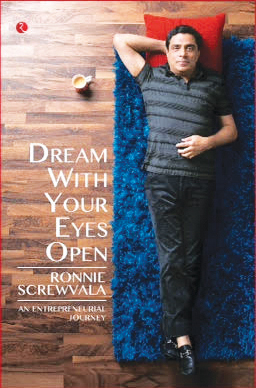 The first time entrepreneur, someone who wants to chuck up his job and start his own business, a person committed to be an effective leader in the company he or she works for. Ronnie Screwvala, best known as the man behind UTV Group, the media conglomerate, has tips for all in his debut book Dream with your eyes open.
This ex-theater man believes that "communication cements a company’s culture.” Leaders need to communicate with courtesy, charm and authenticity, he states. When UTV faced challenges after Doordarshan suddenly cancelled one of their on-air shows, clear communication with his team helped the company retain their support and even got them to accept a deferment in salaries, he relates.
He talks about the ability of a good business person to spot both trends and disasters that are round the corner. Spotting and seizing opportunities are the hallmarks of good entrepreneurship.
Screwvala lauds the benefits of being an outsider for it provides a fresh perspective. He recounts his early foray into manufacturing of tooth brushes. He only seized an available opportunity that came in the shape of secondhand machines which he bought without having any experience of manufacturing. He stumbled upon this while accompanying his father Soli Screwvala (who was then managing director of JL Morrison) to a hair and toothbrush factory. His track record at having broken into the film business and made a success of movie production and distribution without any family connections is another example where being an outsider worked.
"Do not follow the herd,” advises this personality who pioneered a new format for TV shows in the shape of a daily soap, Shanti. He sensed the need for a kids’ TV channel and up came Hangama. A gap in the ‘youth entertainment’ space? His answer was Bindaas channel.
Recalling how he was given the tag of ‘Cat of Twenty Lives’ by a financier, Screwvala emphasizes the importance of staying on course. He extols the benefits of planning, perseverance and agility in trying times. "Fear and uncertainty ...are natural, but this is also when your convictions are tested,” he states.
"Most exits are entirely unplanned,” he summarizes, in a chapter titled "Exit stage left?” in which he lists his sale of the toothbrush business, the cable TV initiative, Vijay TV, and the UTV – Disney venture. Founders should focus most on business strategy, teams, brands and scale — rather than just investor goals and timelines. Exits cannot be timed, according to this serial seller. Transitions during exits need to be handled sensitively, he cautions, reiterating that interests of all stakeholders need to be kept in mind.
In a chapter called "Second innings,” Screwvala states that when introspection on whether he could lead Disney in India for the next five years did not lead to an affirmative answer, he began approaching the "agonizing decision” of quitting the industry he had spent most of his working life in. A second innings is not about starting all over again, says this media personality who has won many accolades, including being named "Entrepreneur of the year” by Ernst and Young, international accounting and consulting giant. It’s about finding wisdom, not complacency.
The book is structured into chapters that offer a point of reference, not necessarily in chronological order. For instance in the chapter titled "Failure is a comma, not a full stop,” he talks about his company’s aborted attempt at success in the gaming business and at the same time offers nuggets of advice on how to survive failures. "Embrace failures” is one such lesson he imparts. Each chapter has a synopsis pinned at the top and important pointers bulleted at the end. The author has thoughtfully answered some frequently asked questions in an appendix.
He does not ascribe to any one set of formulae for success and does not at any time in his book pontificate or preach. It is written in a chatty style, almost as if he were sitting in front of you and telling you about his life: a significant success here, an accolade there, a failure here, a bit of advice there. As the reader wanders through the wonderland of entrepreneurship with this media-man turned philanthropist, he sees the big picture, and as one nears the end, one may agree with the statement in the introduction that the book is "the perfect blend of the 30,000 foot view ... and the ground view.”
The author has dedicated the book to his wife Zarina, daughter Trishya and his parents Dolly and Soli. All proceeds of the book will go to Swades Foundation. The Foundation has in the last five years provided 39,000 people in 139 villages in rural Maharashtra with drinking water, he mentions. The Foundation aims for a holistic approach towards development of individuals and communities through five verticals — mobilization, water and sanitation, agriculture and livelihood, education, and health and nutrition.
In response to an email question from Parsiana seeking his views on his Zoroastrian affiliation, he notes, "I am very very proud of being one.” He states that most of his value systems he got from his parents. "I have not looked at ‘caste’ for myself or anyone as a plus or minus,” he asserts.
Throughout the 185-page book the message is clear: Entrepreneurship is a journey which anyone can start no matter what their age, background or education. He concludes with this parting message: "Just dream your own dream – and when you do it, dream with your eyes open.”