The Story of the World’s Greatest Batsman SACHIN by Gulu Ezekiel. Published in 2023 by Ebury Press, an imprint of Penguin Random House India Pvt Ltd, 4th Floor, Capital Tower 1, M. G. Road, Gurgaon 122002; www.penguin.co.in. Pp: xii + 413. Price: Rs 699.
When I see biographies on Mahatma Gandhi, Ratan Tata, Sir Don Bradman or Sachin Tendulkar, I ask myself why anyone should take the trouble to write on such well-known personalities when everything is known about them. But after reading Gulu Ezekiel’s latest book SACHIN I thought differently as the author has made an effort to dig out material not known to many.
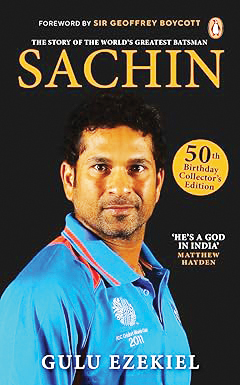
As the renowned England batsman Geoffrey Boycott writes in the Foreword, "Over 50 years of playing cricket and commentating on TV and radio I have been lucky enough to watch and enjoy a few great batsmen from many countries… But through five decades I have been also lucky enough to see four extraordinary batting icons or legends whose performances have been exceptional.” He includes Sachin Tendulkar along with Garry Sobers, Vivian Richards and Brian Lara in this category. Boycott has admired Tendulkar ever since the talented Indian was a shy 14-year-old playing for Yorkshire.
A veteran, this is Ezekiel’s 13th book on sports (12th on cricket) and he appears to be hungry for more.
Every chapter starts with a quote from a famous personality. The former great Indian spinner Bishan Singh Bedi describes Tendulkar as "the greatest Indian alive.” Adds Ezekiel, "One of Tendulkar’s many admirers was the greatest of them all, Sir Don Bradman.”
Ezekiel brings out the modesty of Tendulkar who the cricket world idolizes. When an Indian journalist asked Tendulkar, "Are you God?” he replied, "I don’t think anyone can become God or even come close to it.” When queried, "What are the advantages of being Sachin?” he replied, "I would like to be humble, be polite to everybody and would like to give respect to my elders.”
He added that Sunil Gavaskar and Richards were his heroes. Apart from Tendulkar’s modesty, Ezekiel brings out his courage even as a schoolboy. When asked how he developed an aggressive outlook despite injuries, he responded, "There have been worse injuries than mine… Even if I broke my nose, I decided on staying there and not be bothered about fast bowling.” To be hit on the field brought the best out of him. Thus the book is not just about the runs he scored but also about his philosophy on the pitch.
Tendulkar was cheered lustily not only by the home crowd but also by partisan Pakistani spectators. His masterful batting during the tours of England impressed eminent British journalists including David Frith and Scyld Berry of Wisden fame. "Hail the boy king,” wrote Frith praising his "creamy elegance.”
In 1989 R. Mohan wrote in Sportstar, under the headline "The Wonder Boy is here to stay” that "This is no young man who will model his batting on Sunil Gavaskar’s. He may go beyond that and think of becoming a Viv Richards. He is a born stroke-player.” How true his prophesy turned out!
Pakistan’s famous leg spinner Abdul Qadir was thrashed by the teenage cricketer in 1990. Rather than get annoyed, Qadir said, as quoted in Ezekiel’s book, "The lad is a genius. He is going to take bowlers apart in international cricket for a very long time.”
The legendary Australian batsman Neil Harvey was so impressed by boy Tendulkar’s batting that he said, "He is the best player I have seen for ages.”
Ezekiel’s book is full of such praise from opponents. I found the chapter "The Brian and Sachin Show” (in which the author compares Lara and Tendulkar) highly illuminating. In 1996, when Bradman had famously said that Tendulkar’s batting "reminded him of his own,” the latter felt honored but protested that Sir Don was unfair in making the comparison.
The author also mentions Tendulkar’s bowling and fielding. In the Lord’s Test against England, Allan Lamb was batting at his best. When he clouted Indian spinner Narendra Hirwani, Ezekiel wrote, "Tendulkar raced across from the wide long off boundary past the sight screen where the ball was heading. It was a 40-yard dash worthy of a Carl Lewis. As the ball dipped seemingly out of his grasp, he thrust out his right hand and the ball stuck in his palm.” The book is full of such mental pictures. Indian cricket commentator and journalist Harsha Bhogle eulogized in mid-day, "It was the greatest catch I have ever seen.”
Tendulkar was the first sportsperson to receive the Bharat Ratna, India’s highest civilian honor. He dedicated the honor to his mother Rajni and millions of mothers across the country, says Ezekiel.
Sachin Tendulkar; top: Gulu Ezekiel
The book is not all about Tendulkar’s magnificence with the adoring crowd chanting, "Sachin! Sachin!” There is a chapter titled "Down in the Dumps” which includes his occasional struggles to score runs. That makes him a human and not merely a super star.
We learn a lot about his happy family life from this book. "Wife Anjali, daughter Sara and son Arjun are the center of Sachin’s existence, just as his parents and siblings were when he was growing up,” writes Ezekiel. Sachin’s passions are friends, family, food (particularly seafood), cricket and music.
From this attractive book one learns all about this amazing man — magnificent and modest. There are 16 pages of color photographs extending from his schooldays to Test fame.
KERSI MEHER-HOMJI
A research virologist, Meher-Homji has written 16 books on cricket including The Waugh Twins, Nervous Nineties, Six Appeal, Cricket’s Great Families and his latest From Bradman to Kohli.