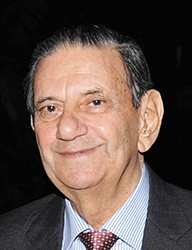
Died: Jamsheed Gulfram Kanga (pictured), 88, distinguished officer of the Indian Administrative Service (IAS) who had worn different mantles during his illustrious career — as municipal commissioner of Bombay, industries commissioner, chairman of the Export Credit Guarantee Corporation — among others, and erstwhile trustee of the Bombay Parsi Punchayet (BPP); on June 25, 2020 at The B. D. Petit Parsee General Hospital in Bombay, following a mild cerebral stroke and subsequent complications.
"Endowed with a spontaneously genial, warm and helpful disposition, Jamsheed had easily endeared himself to one and all.
Deeply committed to high moral and intellectual integrity among civil servants, he was truly a role model for his Service colleagues. Kind and supportive towards juniors in the Service in particular, Jamsheed had a genuine concern for them and not only believed in and espoused their mentoring but also actively practiced it,” noted a tribute from his IAS colleague D. M. Sukthankar who too had served as the municipal commissioner of Bombay.
"In recent times, his anguish over the migrant labor issue was truly touching and he carried on a long debate with his colleagues, sometimes to the point of distraction, on the initiatives that should be taken by the government in partnership with the private sector to provide succor to these most unfortunate victims of the pandemic,” noted a communication from his junior IAS colleague B. N. Makhija circulated by the Retired IAS Association.
Inducted into the IAS in 1956, Kanga started his distinguished career in Poona as supernumerary assistant collector, according to his life profile. On multiple occasions his postings brought him to Poona where he earned goodwill and respect of leading industrialists and politicians when discharging his duties with honesty and integrity. He was collector of Poona in 1972 when Poona was struck by famine and he was in charge of scarcity relief measures. As registrar of cooperatives cum commissioner for cooperation, he further honed his skills in public relations.
Since his Poona days he had established ties with the Tatas, Birlas, Kirloskars and other business groups that were further strengthened when he was secretary to the Industries department and later to the Revenue Department. His postings had taken him to the remoter regions too when he was chief executive officer of Parbhani Zilla Parishad in Marathwada and assistant collector in Satara. To travel to distant villages within his sub-division, in Satara he had kept a horse for commute but unfortunately a fall from the horse had resulted in a back injury. It was in Satara that he first met Firoza, from the prominent family of Cooper Engineering Works, whom he wed in 1963.
"Parsis must be encouraged to go out of Bombay. Staying in Bombay in such large conglomerations has bred a ghetto mentality,” Kanga had conveyed in an earlier interview with Parsiana (see "A wonderful opportunity…” May 1985).
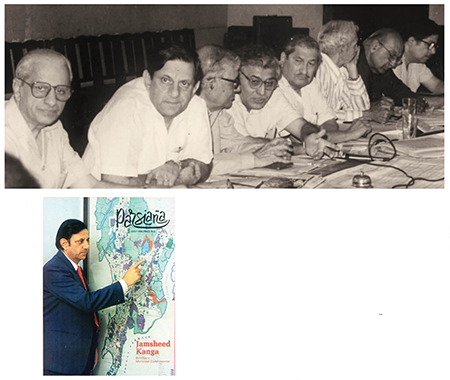
Top (from l): Minoo Shroff, Jamsheed Kanga, Dr Aspi Golwalla, Keki Gandhi, Jamshed Guzder,
Homi Bodhanwalla, Lt Gen Adi Sethna (retd), Eruch Desai at a Federation meeting, 1991;
Above: Kanga as municipal commissioner
Having known him for over four decades, lawyer Berjis Desai recalled the time in 1978 when he was covering the World Zoroastrian Congress in Bombay for The Bombay Samachar. Then secretary to the Department of Atomic Energy, Kanga had impressed the audience as an "intelligent and compassionate speaker…” A few years later when Kanga along with lawyer Dadi Engineer, industrialist Noshir Sidhwa and others formed the Committee for Electoral Rights (CER), Desai worked with them until Kanga was elected a trustee of the BPP. "Unimpeachable integrity. Great credibility. Not the slightest arrogance or ego. Genuine passion for the community. One of the finest civil servants in recent times. He was our hero; a whiff of fresh air…” commented Desai.
The CER galvanized all sections of the community into involving themselves with the premier Bombay Parsi institution by constructively channelizing the disaffection with the BPP’s functioning and especially the antiquated electoral system. The aftereffects of that social and political revolution initiated by Kanga continued till universal adult franchise was introduced for BPP trusteeship elections in 2008.
"He has done a tremendous amount of good for our community both in his days as a trustee of the BPP and subsequently, but because of his innate modesty he rarely spoke about his myriad achievements,” remarked Homi Khusrokhan, erstwhile managing director of Glaxo India Limited and Tata Chemicals. The duo had conjointly taken up cudgels on behalf of the two ‘renegade’ Bombay priests who were banned by the BPP from reciting prayers on their properties. "Jamsheed and I bonded and complemented each other because, I was the ‘die-hard pragmatist’ and he was always the ‘impatient activist.’” Of all the wonderful qualities he was blessed with, Jamsheed had an unquenchable thirst for wanting to set right anything that he felt was wrong or unfair. ‘Causes’ to Jamsheed were like nectar to a honey-bee... He minced no words and always spoke his mind,” added Khusrokhan.
Describing him as "a visionary… (who) held many important positions in his lifetime,” Dinshaw Tamboly, chairman of The Prayer Hall Trust, appreciated that Kanga was "one of the individuals instrumental in setting up the Prayer Hall at Worli where the first four-day obsequies are performed for those opting for alternate mode of disposal of their mortal remains.” Whilst Kanga maintained that community members should have the right to opt for cremation, his body was consigned to the Towers of Silence.
His contribution in obtaining necessary sanctions for the Punchayet that paved the way for the creation of Godrej Baug was acknowledged by then BPP chairman Dr Aspi Golwalla. Kanga made time to attend meetings of the Federation of the Parsi Zoroastrian Anjumans of India, representing BPP intially and Satara in later years. "I always feel one should not stick to the chair if one is unable to contribute substantially… It’s only fair that someone else should have the chance to contribute to the community,” Kanga had maintained when his multifarious responsibilities led him to resign as BPP trustee in 1995 after more than a decade of serving the community trust (see "Too much welfare has sapped us,” Parsiana, April 1995).
After his retirement from the IAS, following a short stint as member of the Maharashtra Public Service Commission, Kanga worked for the Tatas in an advisory capacity. He was also chairman and managing director of Tata Housing Development Company.
"I am a small town boy,” Kanga had earlier told Parsiana. Born in Nagpur where his father worked as an executive with the Empress Textile Mills, after his early schooling in the town he studied at the Boys’ Town Public School in Nasik. He completed his BA from the Hislop College and his LLB from the Government Law College, both in Nagpur. He then competed for entry to government service and with his high rank would have qualified for the foreign service but the drive to serve his own country made him opt instead for the IAS, mentioned his Delhi based sister Ava Khullar. He was selected for a Fellowship at the Harvard Kennedy School of Government from where he earned an MA degree in public affairs. T. N. Seshan who was later to serve as the chief election commissioner in India was a Fellow with him, and Subramanian Swamy who subsequently became member of parliament was an assistant professor there.
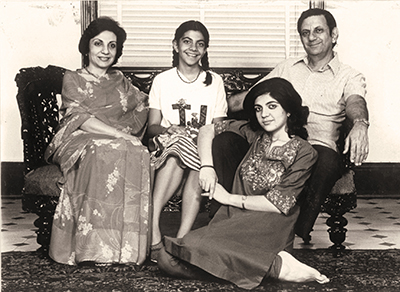
(From l): Firoza, Fareeda, Shireen and Jamsheed Kanga Photos: Homyar Mistry
With his varied interests and commitment to improving Bombay’s civic, social and cultural life, in later years he initiated and involved himself in different pursuits. He was among those instrumental in formulating for the first time the Mumbai Heritage Conservation Regulations in 1990 to halt the activities of mercenary builders and politicians. An executive committee member of the Urban Development Research Institute, he assisted in the planning and policy formulation as well as infrastructure growth of Bombay. "He always focused on the fact that cities should be designed keeping the environment in mind,” cultural theorist Ranjit Hoskote was quoted in the mid-day of July 7.
Kanga had also played a key role in launching the annual Kala Ghoda Arts Festival. Founder chairman of the Kala Ghoda Association, "the first major intervention he undertook was the renovation of the façade of Elphinstone College, and the first edition of the Kala Ghoda Arts Festival,” stated current chairman Maneck Davar. Valuing the "guidance and inputs” Kanga provided even after stepping down as chairman, Davar noted, "The lasting impression that he left on all of us was a man of integrity and good intentions. That the Association has become an institution so identified with Mumbai was his contribution and that of Shirin Bharucha who also worked tirelessly with him.”
Amidst his manifold commitments he also made time to serve as chairman of the National Association for the Blind’s Home for the Aging Blind in Lonavla.
To the "educated and intelligent (yet)…lazy” Parsi community, Kanga had recommended (see "The duty of every Zoroastrian,” Parsiana, March 21, 2006), "do (y)our own research to discover the truth… It is not in our interest to allow the community to get wiped out just to satisfy the ego of bigots and false scholars. We need out-of-the-box thinking for our survival. Wake up…”
The activist and administrator is survived by his wife Firoza, daughters Shireen and Fareeda, sister Ava Khullar and brother Jal.