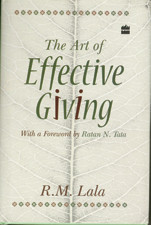
The Art of Effective Giving by R. M. Lala. Published in 2011 by HarperCollins Publishers India, A-53, Sector 57, Noida, Uttar Pradesh 201301. Pp: xxxii + 136. Price: Rs 299.
R. M. Lala’s latest book, The Art of Effective Giving comes at an appropriate time. The world, as we know it today, has moved on from charity to philanthropy and now venture philanthropy. The number of high net-worth individuals (HNIs), especially in Asian countries, including India, is booming. The number of millionaires in India has surged to a record high of 1,53,000 in 2010, making the country’s HNI population the 12th largest across the globe. The increase in India’s HNI population has also helped Asia-Pacific overtake Europe as the region with the second highest number of millionaires, as per the annual World Wealth Report of Merrill Lynch Wealth Management and Capgemini.
Russi Lala: compassionate concern
However, the question remains: does more wealth automatically lead to increased giving? Conventionally, this has been true. Edsel Ford and Andrew Carnegie ‘gave’ only because they had the wealth in the first place. But, wanting to give is easy; it’s giving wisely that’s challenging. In The Gospel of Wealth (1889) Carnegie observes, "It is more difficult to give money away intelligently than to earn it in the first place.”
Today, philanthropists are not just looking for the feel good factor. They are looking for measurable impact and a sound return on their social investment. They are looking for innovation and are willing to provide risk capital. And, most important of all, they are looking for credible NGO (nongovernmental organization) partners. They are looking out for NGOs which have systems of accountability and transparency and are governed on the basis of shared values.
In this slim but sleek little book, Lala weaves a rich tapestry of engaging thoughts and inspiring stories about wealthy people and how they have used wealth constructively for the weal of humanity. The book is split in two parts. The first part deals with philanthropists of the old and new world — from Carnegie to Azim Premji; while the second part deals with issues around individual giving and how the circle of philanthropy can be widened.
Stories about the work of Bill and Melinda Gates or more closer to home the vision and mission of Premji have been told and read over and over again in the past. Nonetheless, Lala skillfully manages to pour old wine into a new bottle and add new flavors that leave a refreshing aftertaste.
But of special significance is his personal testimony of running a foundation (Sir Dorabji Tata Trust). He recollects his mentor, Prof R. D. Choksi telling him that working for the trust "is a service. It means you are a servant of those who come to you for help. Those who work in the heat and dust are equal or greater than officers who work in air-conditioned offices.” Lala adds, "Acceptance of this basic point coupled with love for people helped me approach those who came to us for funds with respect.” Many a trustee or trust officer could borrow a leaf from this astuteness. There are horror stories we often hear from young merit students who face humiliation at the hands of petty trust officers when they are approached for scholarships or people who are rudely shunted from pillar to post when they apply to trusts for medical assistance. Some trustees tend to treat the trust they are meant to serve as their personal fiefdom and petty officers often behave as if they are obliging rightful beneficiaries by dispensing grants from their personal or family wealth! Being a trustee or a senior officer of a trust is no doubt a position of power. But as Lala says, it is a power vested in you "to do good.”
Though a pioneer, almost a rebel, of his time, Lala would be seen by some as a fossil in today’s age of hard-nosed business-driven philanthropy. This reviewer had the privilege of working closely with Lala for over a quarter of a century and what was liked and admired most about his style was his thinking through the head but always giving through the heart. Those were the days when grant-making trusts and foundations still had a soul. Harsh as this may sound, excessive professionalization has taken the soul out of philanthropy and philanthropic trusts and foundations. Not every initiative can be strategized and scaled; not every output and outcome can be measured. Like in the West, foundations in India are getting excessively inflexible and hard-nosed, often putting unnecessary pressures on partner NGOs to drive their own and often unrealistic agendas. Impact assessments are good but how does one measure the happiness quotient? At the end of the day, is philanthropy only a game of numbers with flow charts and pi charts and glossy annual reports that few bother to read or an exercise in making the world a happier place?
Also, foundations today like to invest only in popular and dependable projects. They are not always ready or willing to let compassion prevail over static policies. Foundations rarely talk about bad grants — naturally, it does not look good in the annual report. And here, Lala says, "Sometimes when we were in doubt about the merits of a proposal, Prof Choksi would say, ‘On compassionate grounds, let us give it.’” Now that’s the true essence and spirit of philanthropy!
Lala recounts the pressure he worked under to restrict giving only program grants — "no money to be given for brick and mortar or for corpus. Only few select fields of operation.” However, as an empowered director he did not succumb to the pressure, believing that the trust whose destiny he was entrusted to direct was multipurpose and "the founder’s wishes must be respected.” He believed that in a developing country like India where we do not have a social structure to support our people we should be open to all concerns of the needy. He rightly goes on to chastise what he calls the blinker of no corpus grant. "It is cruel to deny a corpus grant if the work of an institution has no possibility of creating its own income. Philanthropists who insist on a project being self-supporting within two or three years go contrary to the spirit of philanthropy,” he avers.
The author feels, "They who serve people are not always accustomed to raising money” and goes on to recount his experience with the head swami of the Ramakrishna Mission. Knowing that trusts are usually interested only in funding programs and projects, even before sitting down, the swami said that he had three projects for consideration. Wisely Lala responded: "Swami, forget the projects, what is the thing you would like to do, what do you feel most for?” Indeed that was a time when people like Lala took time out to listen to people’s needs rather than tell them what they needed to do.
This book should be read by everyone in the philanthropy space, especially those heading or managing family or corporate foundations. At a time when new age philanthropists are attempting to make an all head and no heart science out of giving, this book puts the soul right back into the art of effective giving. A timely and benevolent gift of wisdom from one who headed one of India’s oldest and premier trusts for almost two decades.
NOSHIR H. DADRAWALA