"No encroachment has taken place inside our agiary premises,” clarified Rajkot Zarthosti Anjuman trustee Khushman Tamboli, in conversation with Parsiana on February 18, 2019. Tamboli was responding to our questions about the premises being "battered by encroachments from nearby residents, causing irreparable damage to the 145-year-old (Anjuman Daremeher) structure,” as reported by The Times of India (ToI) dated February 2. The trustee stated that the intrusion is in the "public street adjacent to us… About five toilets that have been constructed just outside the boundary wall of the compound that houses our building… The toilets are constructed illegally… It is obvious that no community would permit even a single toilet near their sacred place of worship, and here we actually have five toilets come up right near our (dadgah)… The (dadgah) has way more power (spiritually) to be affected by such nuisances, but then too every Parsi is duty bound to not let such nuisance survive near their place of worship,” he communicated in an email.
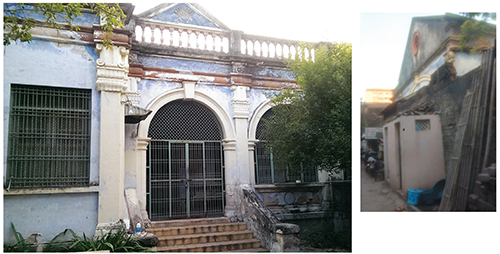
Above left: Anjuman Daremeher, Rajkot; above right: toilet blocks and material outside boundary wall
The sewage from the illegally constructed toilets has desecrated the agiary well. "It can’t be used by us anymore, until it is cleaned and the sewage flow has stopped. Our only alternative is to use municipality supplied water for every purpose… We have approached the local authorities and are awaiting their... response,” he wrote.
Tamboli has kept Udvada high priest and member of the National Commission for Minorities Dastur Khurshed Dastoor informed of the local developments, adding that "everyone is welcome to help in any way they can.”
Tamboli explained that the compound has, in addition to the main dadgah building, a priest’s house and a dharamshala, both of which are closed "due to financial constraints.” There are two garden areas, one in front and one at the rear, where the well is located. "All the structures were originally made out of old (stone blocks) and later covered by plaster...Our gardens in the past had many types of plants, but as of now we have limited amount of species, as our agiary caretaker himself has to manage everything,” Tamboli said.
The Anjuman has approximately 50 members on their register now, though there are not more than 15-20 permanent community members in the city, stated Tamboli. The dadgah has infrequent visits from Parsis travelling to and from places like Jamnagar, Somnath and Veraval for business or pleasure. With no permanent mobed or behdin pasbaan, Tamboli stated that co-trustee Kersi Khansaheb doubles up as caretaker. Jehangir Kasad is the third trustee.
In his book Global Directory of Zoroastrian Fire Temples, researcher Marzban Giara noted that the dadgah was built at a cost of Rs 2,900 and consecrated in May 1875, with "the band of the local Seventh Regiment in attendance.” Local priest Ervad Burjordaru Avasia had brought the sacred fire to Rajkot from Surat (nearly 450 kms away) on foot, Giara stated.
"We intend to undertake repairs and renovation work.... The last renovation was taken up a very long time back. If any humdin wishes to contribute to the cause, they are free to contact us on
khushmantamboli@yahoo.com,” Tamboli wrote, adding that funds are also needed for day-to-day maintenance.