Club culture had come surprisingly early to Navsari. Although history had been made at a nearby beach at Dandi in 1930 when Mahatma Gandhi picked up salt during the Civil Disobedience Movement, no English officer had ever been posted in the area. In the absence of the English, it was left to the Parsis to take a lead to establish gentlemen’s clubs where, unlike the Ripon Club in downtown Bombay, ladies were soon admitted. However, till the early 1970s, conservative Parsis did not approve of club culture. Playing rummy for money was frowned upon (even though the ladies played Bezique in the privacy of their households and marked score over tiny cardboard watch-like dials); and for male members, hitting the shuttlecock wearing thick cotton duck trousers further complicated by uncomfortable loin cloths masquerading as underwear made badminton a torture. Though, until the Bombay Prohibition Act of 1948, the clubs in Navsari served alcohol, those who indulged were termed scoundrels. Navsari had coined a wonderful phrase for such libertarians: "Taddan haath thi gayach (They have crossed all limits)!” For most residents of ultraorthodox Seervai Vad, becoming a member of a club was not an option.
Rustomji, who had successfully exorcised Hirabai’s demons (see "The hug,” Navsari Tales, Parsiana, January 21-February 6, 2020) and was a crusader for preserving semen (his own and that of others, only for procreation), would not even attend his paternal cousin, the penisless doctor’s somber tea meetings at the latter’s ancestral orchard at Lunsikui, Navsari’s most upmarket locality. "Diva batti na vakhaté, ghéré bèsi né bhanvanoo; nahin ké khakha-khikhi karvanoon (One must pray and not frolic at sunset),” he would say. Not that people really frolicked at the good doctor’s impromptu club. More like a condolence meeting. Sense of humor had passed away anyway. Tea was sipped in funereal silence and there were enough pregnant pauses to fill a maternity ward. Until one memorable evening Erach, a regular, brought along his cousin, a man called Behram. According to our original system of classification of Parsi caricatures (fituri, haando, lahuvo, kaklaat and pallonji (see "Of lahuvas, haandaas, fituris and kaklaats,” Bawa Musings, Parsiana, April 7, 2017), Behram was a classic lahuvo, that is a boorish lout.
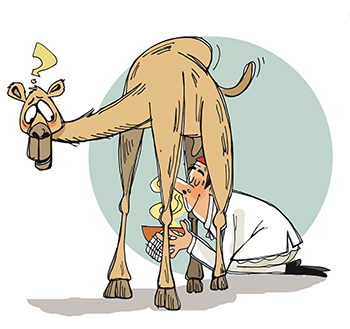
Illustration by Farzana Cooper
He was known throughout Navsari by his nickname, Bai Bai Karasyo (BBK). The muktads, an 18-day period then, was the Navsari Christmas. Homes and agiaries were cleaned, scrubbed and decorated. Each home had a muktad table on which German silver karasyas (vessels) were placed. No fancy silver vases had then arrived. In the more affluent households (a relative term for poor Navsari), temporary help was engaged to clean and maintain the prayer area a fortnight before the period began and a few days after. Not only Khordad Saal but Amardad Saal was also celebrated with equal gusto. Only men and menopausal women were employed for the job. Behram earned his year’s income during this period with a lot of energetic running about.
A 55-year-old childless widow was his favorite client, as she tipped liberally and served him sumptuous meals. Behram therefore endeavored his best to please his employer. On one occasion the good lady, while sitting on her haunches in the so-called toilet (the pot opening into a little woven grass basket which at times was, without any warning, whisked away from underneath by a service provider), suddenly remembered that she had forgotten to place her father-in-law’s karasyo on the table. Horrified at this lapse, she exclaimed, "Behram! We forgot Puppa no karasyo (father-in-law’s vessel)!” Immersed in some chore, Behram heard only the word karasyo and thought that the lady required water in a vessel to clean herself. In his over enthusiasm, he rushed there with a brass karasyo filled with water, banged open the toilet door, extended his hand carrying the karasyo and shouted, "Bai! Bai! Karasyo (Lady, here’s your vessel)!” Thereafter, two versions were hotly discussed by Navsari: one said that the lady was outraged, the other that Behram’s fortunes dramatically improved. In any event, the nickname stuck to him perpetually.
The staid gentlemen of the doctor’s tea club, which boasted the occasional presence of the venerated High Priest himself, were shocked to see BBK sitting at the table and grinning. A hallowed precinct had been defiled. When the grumpy doctor arrived, BBK foolishly greeted him by asking, "Dactur, mané olakhyo ké? (Doctor, did you recognize me)?” The doctor gave a dirty look to Erach who was regretting his indiscretion. Over tea, which he slurped while noisily crunching upon large drum shaped batasa biscuits from a Surat bakery, BBK violated a cardinal rule of the club never to ask for a second helping. He then aggravated the situation by letting out a resonating burp. Erach tried to divert the attention of the doctor by asking him about a remedy for a persistent cold. Before the doctor could reply, BBK loudly said, "There is no medicine for a common cold. However, I know one traditional method which always works.” They all looked at him with polite disgust. BBK did not disappoint. "Oont ni gaan nichhé, hing no vaghaar (fumes of asafoetida heated under a camel’s rectum),” he announced. There was a deathly silence. "Doctor Saheb, guaranteed to open any blocked sinus. And no worry about the animal kicking you! The camel’s legs are tied,” he smiled. Behram then proceeded to narrate the standard operating procedure for imbibing these divine fumes into one’s nose, which was required to be strategically placed, with the greatest of precision, underneath the desert animal’s ample posterior.
BBK never understood till his dying day why Erach lost his membership of the doctor’s tea club. And what sacrilege he had committed by advocating a harmless nature cure.
Berjis Desai, author of Oh! Those Parsis and The Bawaji, occasionally practices law.