In the desolate desert British outpost
the Parsis strove to establish their customs
and religious institutions
Itamar Toussia Cohen
When Merwanji Sorabji Khareghat first disembarked on the shores of Aden, what he saw was a ramshackle, nearly abandoned town. The few inhabitants lived in thatched huts, while the only stone structure standing was the al-‘Aydarus mosque — housing the grave of Abu Bakr al-‘Aydarus, the patron saint of Aden. For centuries, the al-‘Aydarus mosque provided the Muslim community of Aden a place to congregate, and provided shelter for the town’s inhabitants during emergencies, such as during the naval battle which saw Britain conquer the ancient port in 1839.
The town’s 250 Jewish inhabitants had their synagogue, and even the 50 Hindu banias residing in Aden had a temple of their own to meet their spiritual needs. Khareghat — a second generation and long-standing servant of the Bombay Commissariat Department, and a devout Zoroastrian — realized that for the Parsi bureaucrats, merchants and entrepreneurs who would make their way to the nascent settlement in the coming years to forge a community, they would need a place to fulfill the enjoinments of their religion.
Khareghat was one of the first two Parsis to land at Aden, summoned to serve as head clerk of the newly established Aden Commissariat Department. In 1842, he wielded his significant influence with the Political Resident, Capt S. B. Haines, and the government at Aden to secure the purchase of a 200,000 sq ft estate in Aden Town (commonly known as Crater), where he built Merwan Baug. Khareghat, the most prominent Parsi philanthropist in the early years of the settlement, spared no expense in providing his fellow co-religionists the means to fulfill their communal and spiritual needs: he sunk a well and built the first agiary in Aden on the grounds of the Baug; he summoned a mobed, Ervad Erachji Cowasji Gara, to reside in Aden and conduct rituals and services. In 1847, Khareghat donated Merwan Baug in perpetuity to the Aden Parsi Panchayat.
During the early years of the settlement, the Parsi community did not number more than a few dozen individuals. Most early Parsi merchants resided in Aden but kept their families in Bombay, travelling back and forth when possible. The weather at Aden was considered "disagreeable to the Indian constitution,” and in sickness Parsis opted to return to Bombay. Thus, when Ratanji Sorabji Khareghat — Merwanji’s older brother — passed away, he was the first Parsi to do so in Aden. As there was yet no Tower of Silence in the settlement, Ratanji’s body was interred in the ground, much to the dismay of his brother. Merwanji took it upon himself to construct a Tower of Silence for the community, and on April 2, 1846, the cornerstone was laid on the western edge of Merwan Baug.
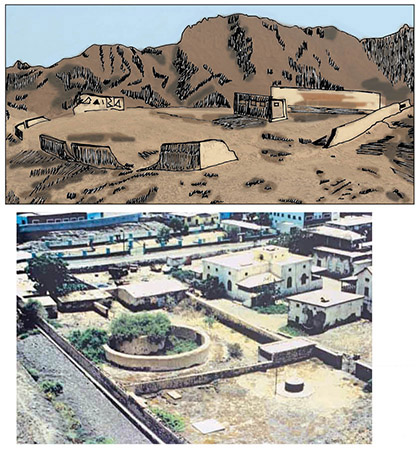
Top: Aden’s first dakhma at Crater; above: the later dakhma on the hill (Sketch by Nivedita Potdar)
Mindful of the conspicuous nature of sky burial, Parsis have always taken pains to construct Towers of Silence in remote, secluded, elevated areas. Despite being surrounded by an imposing stone wall, the barren backdrop of Aden’s desolate landscape could hardly provide appropriate shelter for the dakhma from the prurient curiosity of onlookers. Luckily for the community, in an act of now legendary ingenuity, Merwanji had imported trees from Bombay to cover the grounds of the estate. To overcome the matter of Aden’s hard, rocky ground, he ordered his assistants to buy up all the soft, red earth that Arab sailors used to weigh down their dhows as ballast when returning from Bombay, and replaced the dry earth of the estate with fertile soil.
It is unclear from the sources whether Merwanji undertook this venture before or after construction of the dakhma was underway. One way or the other, on April 2, 1847, the tower was consecrated, tucked away behind a screen of lush vegetation on the grounds of Merwan Baug. Ratanji’s body was exhumed and his remains placed in the tower to be consumed by vultures. Five years later, in 1852, Merwanji returned to Bombay, where he died at the young age of 36.
From the old to the new Tower
Aden Town is situated on a plain in the crater of an extinct volcano (hence the name, Crater) on the eastern side of the Aden Peninsula, open to the sea and enclosed by precipitous mountains. In the first decades of British rule, both the garrison and the civilian community were concentrated in Crater. But the settlement was growing exponentially: in 1839, its population numbered around 1,000 individuals; by 1856, that figure had swollen to over 20,000. Thus, in the early 1860s, the government of Aden decided that the unchecked disposal of corpses in the town both took up precious space and posed a health hazard — particularly concerning the spread of cholera — and decreed that every community must establish a cemetery outside of Crater. Less than 10 years after its inauguration, the Parsi community of Aden had to abandon the Tower of Silence at Merwan Baug.
On April 12, 1865, the Aden Parsi Panchayat assembled at the house of its chairman, Edalji Maneckji Colabawalla — a wealthy merchant and former head clerk of Bombay’s Town Hall, who upon the departure and passing away of Khareghat in 1852 assumed the leadership of the community. During the meeting, the priest, Gara, delivered a lengthy address, stressing the importance of dakhmenashini to the community’s spiritual wellbeing and the necessity of erecting a new Tower of Silence. Moved by the priest’s compelling words, the assembly resolved to find an appropriate location for the new dakhma as soon as possible, and appointed a committee to oversee the process.
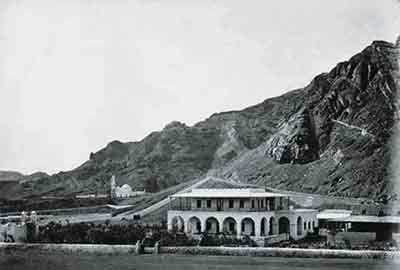
Four months later, the Panchayat reconvened at Colabawalla’s house. The chairman announced that a suitable location had been found at the top of a mountain overlooking Merwan Baug. The Political Resident had approved the sale of the land and agreed to grant the community exclusive rights to the road leading up to the mountain, on the condition that the Panchayat would build a new road for the benefit of the general public. The assembly calculated that ceremonial paraphernalia, a wall to surround the compound, and a road would cost Rs 25,000 to 30,000.
On August 1, 1865, the Panchayat met again, this time at the house of Sorabji Cowasji Kharas, a wealthy merchant whose family had made its fortune in the lucrative China trade a few decades earlier. Chairman Colabawalla addressed the group: "Members of the assembly, me and a few of the gentlemen gathered here have visited the hill location for the new dakhma three times, and it is highly praiseworthy. I hope that upon seeing it, you gentlemen will like it, too. Once the assembly ratifies the location, a tip will be established to which every charitable heart will contribute a good sum, from which the dakhma’s construction will be undertaken.”
The assembly unanimously voted in favor of the mountain location, and appointed a committee to collect and manage the fund. The committee included the most prominent members of the community: Colabawalla, Kharas, Mancherji Edalji Sopariwalla, and a young Cowasjee Dinshaw Darjina — eponymous founder of the Cowasjee Dinshaw and Bros concern and progenitor of the famous Adenwalla family.
The assembly decreed that the committee would collect donations from its members first and from the rest of the community afterwards — including Parsis from communities outside of Aden as well — stressing that "any minimal donation will be accepted honorably.” Once sufficient funds were collected, the assembly directed that a report, including each donor’s name, the sum of their contribution, and the proceedings of the committee would be printed in pamphlets and distributed in both Aden and Bombay. The expenses for maintaining the Tower of Silence, the committee further decreed, would be borne by the Panchayat’s general fund until a sufficient sum was collected to cover maintenance costs, including a monthly salary for two pallbearers.
On April 20, 1866, the Panchayat met for the fourth time, at Dinshaw’s house. The assembly scribe, Sorabji Pestanji Mehta voiced a concern on behalf of some members of the community, suggesting that "since the dakhma is uncovered, birds will discard carrion of body parts outside, and people will be shocked to see it under their feet.” He went on to suggest that, "just as the old dakhma was covered with a lattice screen, some gentlemen think the new dakhma should also be covered in the same way.” A proposal by Kharas was seconded by Cowasji Maneckji Vaccha, and the assembly unanimously passed a resolution to build a lattice screen for the new Tower of Silence.
The range of donations to the "Aden Dakhma Fund” varied from as high as Rs 2,100 to as low as three rupees, suggesting that regardless of one’s financial means, the imperative to partake in spiritual and communal charitable ventures applied to the community as a whole. All in all, 51 Parsis donated to the fund, raising Rs 8,054. A further five donors from London and Bombay contributed Rs 1,250, bringing the total sum to Rs 9,304. As was made known to the communities in Aden and Bombay, the most generous donors to the "Aden Dakhma Fund” were Colabawalla, Dinshaw, Kharas and Sopariwalla. Colabawalla, being the leader of the Panchayat and the Parsi community’s most prominent philanthropist, took it upon himself to cover the expenses of sinking a well and acquiring a ceremonial brazier, as well as building a new road for the benefit of the general public at a total expense of Rs 10,000.
Both Merwan Baug and the second Tower of Silence were in use for over a century after the latter’s inauguration, servicing the communal and spiritual needs of the Parsi community right up to the sudden evacuation of Aden in 1967. While the atash padshah of the Adenwalla Agiary at Aden had been incredibly airlifted back to India, the Tower of Silence remains standing in the same spot to this day. Hidden in the mountains towering above Aden Town, the dakhma serves as a secluded stamping ground for Adenese youth and a curious attraction for tourists to marvel at. Dilapidated and abandoned, the Tower looms as a specter of a once flourishing community.
 Itamar Toussia Cohen is a DPhil candidate at Oxford University. As a historian of the Middle East and the Western Indian Ocean, his work ties together the cultural, material and devotional histories of peoples, communities and societies in the Levant, South Arabia, Western India and Eastern Africa. From ice-making machines on the streets of Aden to carrion-eating vultures in the skies of Bombay, Cohen is interested in the role of human as well as non-human agents in animating the motivation, rhetoric and actions of human beings in multi-ethnic and multi-devotional societies across the Indian Ocean littoral.