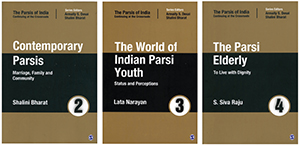
The Indian Parsis. Themes Old and New edited by Shalini Bharat and Armaity Desai. Published as a four-volume set under The Parsis of India: Continuing at the Crossroads in 2017 by SAGE Publications India Private Limited, B1/I-1 Mohan Cooperative Industrial Area, Mathura Road, New Delhi 110044; webside: www.sagepub.in. Pp: xliv+383. Price: Rs 9,900 (as a four-volume set).
TISS director S. Parasuraman in his foreword to the books emphasizes that "such (a) body of work that delves into existential issues of a minority community is not meant to be an academic pursuit alone and to merely land up on library shelves. It is also meant to inform the affected community about possible solutions and guide community-led interventions. I hope these volumes will serve the larger purpose.”
Cama who initiated the study which was mainly funded by the Sir Dorab Tata Trust and Bombay Parsi Punchayet (BPP) reiterates the sentiments in her foreword: "It is hoped that these publications will foster not just debates but also community decisions as well as a desire on the part of the individual Parsi to take responsibility for his or her own life and achievements, in order to keep alive a heritage of humankind.” The prime motivation in publishing the studies is "stemming the demographic decline and achieving the means to save the descendants of this ancient religion from extinction.”
The books are dedicated "to the Parsi Zoroastrians of the world,” and refers to the "alarm bells” about the declining population sounded by Sapur Desai, a former erudite secretary of the BPP and Armaity’s father in his book, A Community at the Crossroads (1948).
Volume one which is being reviewed in this issue of Parsiana contains 10 chapters, four of which are written by Desai. The opening chapter on "The Rise, Prominence and History of the Parsis” by scholar Jesse Palsetia provides a comprehensive and compact history of the Parsis in India. It serves as a sound reference point for someone searching for historic background as versus relying on other histories that are replete with hearsay, misconceptions and half-truths.
Parsi charity was magnanimous, states Palsetia, an associate professor of history at the University of Guelph in Canada. "From the 1830s to the 1930s, over 400 schools, libraries, hospitals and medical facilities were built or funded, principally for Parsis, with over 200 additional projects and funds going to various non-Parsi causes inside and outside India... Parsi charity took account of events in Europe. One of the earliest recorded donations by a Parsi was for 250 rupees, to provide famine relief in Ireland in 1822. Parsis gave over Rs 10,000 in relief during the Great Potato Famine 25 years later. The United Kingdom was the chief center for Parsi charity to non-Parsi concerns outside India with donations going to various causes from patriotic funds to educational and medical endowments.”
Aside from the two male hereditary functions, the priesthood and corpse carrying, Palsetia notes, "Parsis did not form any link between caste and occupational specialization.” In industry and business, "The Bombay Chamber of Commerce started in 1836, with 10 of the original 25 members being Parsi... The cotton mill industry in Bombay emerged as western India’s leading industry, dominated by an elite oligopoly of Indian firms, with Parsi firms controlling 34 out of 95 mills up to the 20th century.”
In the chapter "A profile of the family, youth and the elderly,” Desai demolishes the myth that women are more educated than men. "While females had an edge over the males on the general postgraduate degrees, the men went in for professional degrees such as engineering, medicine, chartered accountancy and management… Both are equally educated at higher levels, although their selection of the course streams has more to do with their career options.”
As for the erroneous perception about Parsis seeking employment over other avenues, Desai notes, "the fact is that more than a third were in the professions, while over one-quarter each were self-employed and (in) the service sector.” In the chapter, "Beyond the crossroads,” Desai further debunks the notion that "Parsi youth have no aspiration… 25.2% aspired to head the department in which they worked and 23.8% respondents aspired to establish their own business, showing that a sense of enterprise is very much alive… Unlike the generation of the elderly, none were in government jobs, defence or the police as these no longer attract the youth of today, except in groups which have a tradition of entering such jobs or do not have other channels to further their careers.”
In the chapter "Issues and concerns,” the "family study showed that almost 59% felt that religion in life was very important and 38.3% felt that it was moderately important, while an infinitely small percentage of 2.6% felt that it was not at all important.” Of the older respondents, 63% gave importance to religion compared to 35% of the young. Desai terms this "significant, as it means a definite decline in its importance in the life of the youth… the younger members need to be heard and remedies sought or the religion will be lost for the future in India.”
Women considered religion more important than men (60.1% compared to 57.6%). Over "83% said they wore the sudreh and kusti” while "82.6% recited the prayers while wearing the kusti.” However the study revealed "a majority never recited … prayers such as Srosh Baj 47.6%, Atash Nyaish 64.3%, Doa Naam Setayesh 77%, Tandarosti 78.6% and 101 Names of the Prophet 74.8%… Believing in a cosmic effect of prayers, said in a particular language and in a particular manner, might not have much impact on an educated community, which cannot even use the Gujarati script to read the prayers… There is no community worship as such which promotes greater emotional bonding of worshippers. These may be some of the explanations for turning to other religions in the current context.”
Desai notes that idols of other faiths are more prevalent "in urban locations in Gujarat… and in various parts of India (average 80%)… compared to Bombay and the rest of Maharashtra (average 67%)… The holy books of the Hindus are in 12% of homes, the Bible in 9.9% and the Quran in 3.4%.
The most popular idol is Ganesha (56.7%), followed by Sai Baba (54.6%), Goddess Lakshmi (43%) and Jesus (31%).
In the chapter "Marriage, family, reproduction: Implications for demographic decline,” Desai notes that the "willingness to live with the joint family of in-laws was acceptable for 30.7% for daughters, and 24.35% for sons.” As many as 57.5% "were emphatic that their sons and daughters marry within the Parsi community;” 13% were open "to a partner from any community… while no expectations of the child’s marriage partner” hovered between 18% to 19%. "This means that a substantial minority are open to the marriage of their children outside the community… (however) parents are more apprehensive about the son marrying out of the community as compared to their daughter.”
Of those married out, the survey found 71.2% of males and 64.9% of females were married to Hindus; 13% of males married Christians, while one each chose Muslim and Sikh wives. "Among women, seven were married to Muslims, six to Christians, four to Sikhs, one to a Jew and eight to others,” Desai notes.
The major reason cited for interfaith marriages was "love” (81%).
Of the inter-married couples’ children "44% of the men said that they had done the navjote of their children against 15.5% of women.”
In the study on the family "74% youth also said that financial incentives would not persuade them to have more children, while only 13.5% felt that such a provision could.”
Remember the slogans of the 1970s and 1980s, "No spouses without houses?” In the chapter "Issues and concerns: Community perceptions” Desai states, "In all the three studies, the family, youth and the elderly, there was not even a single case that said they married late or did not marry because of a lack of independent housing. Nor did a single case attribute the decision to have no children or fewer children to space issues. In fact, most of the married youth stayed in extended families but did not postpone marriage. Hence attributing marriage and children to lack of housing appears to be a partial myth, though in a few cases it may occur.” Marriages are delayed for education and career prospects, rather than accommodation. "As for number of children, the issue is more of restricting numbers as they want the best for their children and it is not a spatial issue,” Desai observes.
This may explain that though the community has built thousands of flats over the past 125 years, the Parsi population has continued to decrease in numbers.
In the chapter "Population dynamics: The demographic decline of the Parsis” by Raju and D. P. Singh, the often cited projection figures for the Parsis proferred by Unisa et al in 2008 showed three probabilities for 2011 ranging from 61,000, to 62,000. The actual census figure for the year is a depressing 57,264.
Desai explains "That external migration is a factor in the decrease of population, has been very much hyped, but our figures do not show percentages sufficient to decimate the Parsi population by as much as 10%... The major ages for migration appear to be between 20 and 30, and settling down thereafter in life causes the interest to wane... On average, about a quarter of the families seem to have a member who has migrated abroad, but the data is spread over a period of time.”
In the chapter "Lowest-low fertility (LLF) and the Parsis: Commonalities and differences with other LLF countries” by Bharat, the researcher notes, "The Parsi fertility decline is documented to have begun almost three decades earlier than the European fertility decline, that is, in the 1950s and currently at 0.94 is one of the lowest fertility levels in the world.”
In the chapter "The economically vulnerable Parsis: A study of beneficiaries of charity” by Drs Anita Rath and Rakhshandah Hani the authors note "not all poor Parsis have access to relief… Many poor families do not apply for help out of high self-esteem… such help brings with it some stigma (the stigma of pauperism) a sense of shame, which makes people reluctant to claim benefits or services. Poverty itself is seen as a negative attribute which is associated with other negative attributes (like dependency)… There is again a deliberate tendency to make the procedure of claiming relief unpleasant… Very nominal amount is offered as doles and it compels many to approach multiple institutions. It multiplies their effort and humiliation further… There are certain sections of the community that are being failed by the existing networks. Most of the Parsi punchayets/anjumans have a conservative outlook and they only address the concerns of those who strictly follow the religious prescriptions regarding marriage and family. They practice selective exclusion while administering relief. One group clearly excluded in the process are those who marry outside the community and their offspring... It is significant to note that hardly any of the surveyed households have benefited from government schemes. Many of them are not even aware of any government schemes.”
In the chapter "Issues in studying a minority community: Field notes from studies on Parsi youth and elderly,” writers Narayan and Raju observe: "The directories of the Parsi associations also indicated the manner in which Parsis were defined in each city. For example in Madras, Delhi and Calcutta, those who had married outside the community were included in the community directories, while in Bangalore, Valsad and Navsari, those who had married outside the community were not listed.”
In the chapter "Dynamics of charity in the Parsi community” Rath notes there are "strict conditionalities attached to define the recipient group, which is in terms of the race, that is, Parsi and not the followers of religion, that is, Zoroastrian(ism).” (However) the rejection rate of applications has come down to five percent in recent times from about 35% in the 1940s...
"There was considerable uproar regarding the need for a clear distinction between the ‘deserving’ and ‘undeserving’ poor. In fact, these issues led to the constitution of a ‘Central Investigation Agency,’ which subsequently culminated in the formation of The Liaison Committee for the Organization of Parsi Charity in 1946, for stringent ‘means testing’ which carefully scrutinized the financial life of the applicants of charity. There was a demand for transforming a narrow and unprogressive view of charity to scientific charity…
"Developments in England and other parts of the world regarding poor relief might have intensified the segregation of deserving and undeserving poor. By the 1850s, the call for a strict moralistic distinction between worthy and unworthy poor had brought about a huge gulf between the benefactors and beneficiaries and led to an emphasis on efficiency and organization of charity. This was reflected in the poor laws of England and elsewhere. This contributed to a belief among the philanthropist that poverty is an individual failing and not a structural problem.”
Will the TISS studies bring about any meaningful change in community thinking or approach to issues? It could. But there are major hurdles. As Narayan and Raju observe, "A major challenge when researching the Parsis was the community leadership’s acceptance of some of the data and findings. Hence, validity of specific data collected is questioned and may not be accepted as reliable, and there are those who go as far as to deny the quantitative facts in order to present the community in a positive light. The disputed data largely related to those issues and concerns where the community had strong divided opinions. In some sections of the Parsi community, the belief that there is no population decline is so strong that no amount of empirical data proves the opposite of what they believe as the truth.”
While a reader cannot but be awed by the meticulous scholarship and humongous effort put into the publication a few minor errors have crept in. Desai mentions that Jerbai Wadia was the first to establish Parsi colonies. The foundation stone for the first Parsi colony was laid on Falkland Road in 1889 by the Garib Zarthostiona Rehethan Fund.
As the research was done several years ago some current developments are not covered for example in the chapter "Issues and Concerns” Desai refers to the Jam-e-Jamshed and Parsiana as "two publications… most popularly known.” There is no mention of the five-year-old Parsi Times. Parsiana is erroneously referred to as a weekly (it is a semi-monthly, 24 issues in a year).
The series introduction also quotes the oft repeated phrase purported to be by Mahatma Gandhi about the Parsis: "In numbers beneath contempt, in contribution beyond compare.” According to historian Dr Dinyar Patel this quote is not to be found in any of Gandhi’s papers.
The authors note that "Parsi women married out are excommunicated and their children denied navjote.” There is no excommunication amongst Parsis and the children of women married to non-Parsis can, and do, have their navjote ceremony performed. The children however are barred from entering a fire temple or availing of any trust benefits earmarked for Parsi Zoroastrians. If the out married woman has a civil marriage and continues to profess the Zoroastrian faith, she can avail of all the benefits. Only in Valsad the anjuman passed the resolution barring out-married Parsi women from entering the local fire temple and the doongerwadi. This matter is now before the Supreme Court.