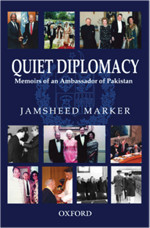
Quiet Diplomacy — Memoirs of an Ambassador of Pakistan by Jamsheed Marker. Published in 2010 by Oxford University Press, Great Clarendon Street, Oxford, OX2 6DP. Pp: xii + 448. Price: Rs 995.
A picture is worth a thousand words. A thousand pictures could also illustrate a single word, a powerful one, an adjective with several shades of meaning — quiet. The Oxford Dictionary defines it as "calm, undisturbed, informal, unostentatious, without bustle or restlessness, peaceful, gentle, inoffensive ...” The word applies to Jamsheed Marker, the distinguished Ambassador of Pakistan, and to his memoirs which he aptly entitles Quiet Diplomacy.
Jamsheed Marker: showered with honors
Consider the many photographs that are an added attraction to his memoirs. His is an "open” face, a proud Parsi nose, good-looking though balding, always smiling, with an almost benign expression — not a man to lose his cool or even raise his voice in the toughest of encounters with the high and mighty in the world. Presumably, as a young man he learned the power of being gentle and, besides, he had a solid background — a gold medallist with a honors degree from a Lahore college, his services as an official in the Royal Indian Naval Volunteer Reserve in command of a magnetic mine sweeper and then on combined operations in Burma. At war’s end he worked in his family pharmaceutical business in Quetta and served on the boards of various public and private corporations. In his spare time he functioned as a cricket commentator.
In 1965, he was appointed High Commissioner of Pakistan to Ghana and in the next 24 years he served as ambassador to 15 countries, including Romania, Bavaria, the Soviet Union, Canada, East and West Germany, Japan, France and Finland. As Stanley Wolpert says in his Foreword, each account of a new posting is "enriched with felicitously reported details of every country in which he served.” After each report, Marker adds "a useful summary which he calls ‘Meanwhile in Pakistan’ focusing on important changes back home.” All this makes Quiet Diplomacy a superbly structured book. No doubt there was a bit of controversy as to how a non-Muslim could be appointed to this important post in an Islamic country that was striving to bring its laws into conformity with the tenets of Islam. Marker’s own reaction was positive: his appointment showed the tolerance of Islam in the Islamic Republic of Pakistan.
Cupid was so charmed with Marker that he was twice blessed. His first wife, Diana, was not only beautiful but assisted him in his diplomatic work. Her untimely death when she succumbed to a dread disease devastated him. The love and care of his two children Nilufer and Feroza and of his youngest brother Minoo saw him through the crisis. But love springs eternal and, the mourning period over, he fell in love again with another beautiful and clever girl, Arnaz, who owned a hotel in New York where he first met her.
Officially, the highlight of his work in the United States (US) was the personal friendship he developed with President Ronald Reagan who exercised his tremendous powers in a largely benign manner, maintaining a persistent focus on major issues of principle. Reagan’s consistency and determination were "frequently disguised by his thespian charm.” His uncanny ability to feel the pulse of the American people earned him the media’s description as "the Great Communicator.” In the ambassador’s personal view, after Franklin Roosevelt, the two greatest American Presidents were Harry Truman and Reagan.
At a farewell lunch in Marker’s honor given by Francois Mitterrand, the French President appeared to Marker to have acquired "a Napoleonic aura of serene hauteur characteristic of other great French leaders.” Since his wife was out of the country, Mitterrand was gracious enough to suggest that Arnaz should sit at the head of the table. The other honor Marker received in Paris was the award of the Grand Officier de l’Ordre National du Mérite in recognition of his contribution to Franco-Pakistan relations.
After his appointment as ambassador, Marker was congratulated by the Pakistan President, General Ayub Khan. "This was my first meeting with Ayub Khan,” Marker recalls, "and it evoked a respect and admiration for him that has always remained with me.” Ayub Khan then was at the zenith of his power with an impressive and recognized record in the country’s all-round development. "The De Gaulle of Asia” was one frequently expressed appellation, regarded as he was a modern, moderate and progressive leader of a great Islamic state. By no means a highly intellectual man, Ayub Khan nevertheless possessed a liberal mind that was always receptive to new ideas and suggestions. When the Parsis in Pakistan organized a dinner in his honor, they made three requests — that citizenship be facilitated for Parsi girls who married Parsi boys in Pakistan, that licences be readily issued for the import of sandalwood for the ceremonies in Parsi fire temples and that owing to the shortage of priests in Pakistan, more should be allowed to come to Pakistan. The President agreed to all three requests with a deep chuckle and mischievous eyes: "Oh idiots! You don’t know how lucky you are! Here we are trying to keep these blighters away and you want to bring them in.”
The fall of Ayub Khan and the end of his era was, according to Marker, the failure of Pakistan on four fronts — the failure to create and abide by the institutions of modern democracy: a constitution, the rule of law, the independence of the judiciary and the media, and the acceptance of a change in government through the ballot box. "Sadly, this major deficiency persists to this day,” comments Marker. In Ayub Khan’s successor, General Yahya Khan, Marker perceived behind the bluff and hearty manner coupled with an earthy, soldierly bearing, an intelligent and highly perceptive mind. Yahya Khan’s imposition of martial law was eventually welcomed because it imposed law and order after a disruptive phase of political agitation.
(Above) Jamsheed Marker (second from r) with Leonid Brezhnev and Zulfikar Ali Bhutto; and (alongside second from l) with Benazir Bhutto
Owing to constraints of space, only two out of Marker’s 15 posts as ambassador are mentioned in this review — the Soviet Union, which Winston Churchill defined as a "riddle wrapped in a mystery inside an enigma” and, in vivid contrast, Japan. The ambassador’s immediate concern in the USSR was to conclude negotiations about the first and only steel mill in Pakistan, for which the formal agreement with Russia had been signed by foreign secretary S. M. Yusuf in January 1971 — for which the Soviet Union was to provide 180 million roubles (US $ 200 million) credit for the construction of a million tonne annual capacity steel mill at Karachi, together with technical assistance and training facilities in Pakistan and the USSR. Facilities for expansion had been incorporated in the Soviet blueprint and Moscow would purchase any surplus production from the plant at Pipri, 40 km east of Karachi.
In the subsequent three years, Marker was to visit "the formidable and fascinating edifice of the Kremlin” frequently, in all seasons and at all hours of the day and night. He met and became quite friendly with the power denizens of the Kremlin, Leonid Brezhnev and Alexei Kosygin. The ubiquitous and regulation photographs of Karl Marx, Friedrich Engels and Vladimir Lenin were the only adornment on the walls. The more disagreeable of the meetings were scheduled for shortly after midnight in a bitter Moscow winter — a tactic which the ambassador suspected was standard Soviet intimidation operation procedure.
Marker used to take his little cocker spaniel Simeon with him wherever he could. On one occasion the ambassador was leaving the VIP lounge with Simeon when an obviously new security guard asked to see the "import papers for the dog.” Two other security officers seated at a desk at the other end of the hall shouted out to their colleague: "No! No! No! That is not a dog. That is Simeon!”
Jamsheed Marker with Zia-ul-Haq in Cuba, November 1979
There was a perpetual shortage of food in Moscow and the quality was always poor, with one exception — the ice cream Sever, which was deliciously rich. So was the cultural life of the city, including the artistic manifestation of the Russian Orthodox Church. These were the happiest moments and memories of the ambassador and his wife Diana — galleries like the Hermitage and the Tretyakov, and the superb performances of the opera and ballet. His association with Ilya Glazunov, a leading young painter, and his wife who was a cousin of the distinguished actor Peter Ustinov, was the most rewarding of all. Foreign minister Andrei Gromyko’s famous observation about the importance of the USSR was no idle boast and was reflected in the frequency of regulatory visits by the heads of government from all over the world.
Japan’s foreign minister Kiichi Miyazawa and vice foreign minister Hachiro Arita who received ambassador Marker gave him an early glimpse of the formidable prowess of Japanese diplomacy. They almost never expressed an outright refusal to a suggestion or proposal but in due course the ambassador was able to discern the polite prevarication that conveyed dissent.
Two interesting events occurred after his arrival in Tokyo — one was the defection of a Soviet air force officer who landed his MiG 25 jet fighter at the civilian airport in Hokkaido and sought political asylum which was immediately granted by the Japanese and US authorities. The Soviets were particularly embarrassed by the fact that the Americans had obtained an intact model of their most frontline aircraft. The second event was a political crisis within the ruling Liberal Democratic Party, a crisis of major political ramifications which in any other country would have shaken the edifice of the state. In Japan, however, all the institutions of the state remained unruffled and continued to function as quietly and efficiently as ever.
Above (L to R): Jamsheed Marker, Barbara and George Bush Sr and Arnaz Marker; (alongside) Jamsheed, Arnaz and Feroza Marker with Ronald Reagan
The presentation of credentials to Emperor Hirohito was a ceremony "overlaid by protocol” — bringing to mind the same presentation in the Court of St James in London. Ambassador Marker never had the opportunity of talking to the Emperor. He did have the honor, however, of hosting dinners for his brother Prince Mikasa and his son Prince Hitachi. But the Emperor was also a fine human being as Marker discovered — after World War II ended, he refused to permit the reconstruction of the Imperial Palace destroyed during the war until the homes of all his citizens had been rebuilt. A less well-known story about Hirohito that appealed to Marker even more was an account of an early post-war visit to an industrial enterprise where the workmen, many with communist affiliations, called out to their former Emperor demanding that since he was no longer a deity he should come over and shake hands with them. Ignoring his escorts who were afraid of some disrespect to their former Emperor, Hirohito walked up to the workers and suggesting that they greet one another in the Japanese tradition, went into a deep bow. The immediate response, in Marker’s words, was a large collective bow.
At the time, the ambassador was deeply concerned about Diana’s health and wanted a specialist to give her a check-up. Japanese officials were most helpful and arranged an appointment with Professor Nakayana, one of the world’s leading oncologists. He studied her records, gave her a thorough clinical examination and pronounced her to be in complete remission. "Our relief was enormous, but alas, would prove to be sadly short-lived.”
Kofi Anan meets Marker (above); Nelson Mandela autographs his book for Marker
Meanwhile in Pakistan, Zulfikar Bhutto’s motives and actions from being authoritarian were becoming downright repressive. The man who had saved Pakistan’s honor in the Simla Agreement with Indian Prime Minister Indira Gandhi was transformed into a tyrant whom Zia-ul-Haq dismissed from office. But Bhutto’s fate was a matter of great concern in Pakistan. The dramatic proceedings in the Lahore High Court and later in the Supreme Court aroused world-wide interest and concern. Pronounced guilty by a majority of judges, there followed pleas of mercy from all over the world. The London Observer reported President Zia as saying: "If the Supreme Court says ‘Acquit him,’ I will acquit him. If it says ‘Hang him,’ I will hang him.” On April 4, 1979, Zia proved to be true to his grim promise. After eight years of his stifling puritanical rule, Zia’s death in an air crash led to more turmoil. Benazir, Bhutto’s daughter, became prime minister and there was a measure of calm. But these events are a part of history and do not strictly belong in a biography.
Suddenly in Pakistan, out of a bright blue July sky, there came "a thunderstorm of biblical proportions.” A Canadian citizen Arshad Pervez had been arrested for illegally attempting to export maraging steel to Pakistan. This was a highly sensitive item used in the nuclear industry and the ambassador feared that it would lead to the immediate stoppage of all forms of assistance to Pakistan. When President Zia telephoned him and Marker expressed his fears, Zia responded, somewhat lamely, that there was no official involvement in this transaction and that he should convey this to the US authorities. "What we left unsaid on the telephone,” admits Marker frankly, "was that he knew, and I knew, that we had been caught with one hand in the cookie jar.” The public outrage was ferocious, with the New York Times publishing an editorial titled "Punish Pakistan’s Perfidy on the Bomb.”
Fortunately for Pakistan, there was Zbigniew Brzezinski (US national security advisor to President Jimmy Carter) who, while reprimanding the Pakistan ambassador saying: "You have done the stupidest thing possible,” had the good sense to point out that if America cut off all aid to Pakistan, it would mean the end of Pakistani opposition to the Soviet presence in Afghanistan. It would also mean the fall of the Pakistan government, bringing the Soviet Union on the border of a weak, destabilized Pakistan in possession of the bomb anyway. Ultimately, after frantic negotiations, the US House Appropriations Committee proposed a draft bill that approved the "earmarks” for Pakistan’s civilian and military requirements as requested by the administration, but subjected it to crippling caveats such as requiring presidential reports on Pakistan’s uranium enrichment levels and actions on the prosecution of Arshad Pervez.
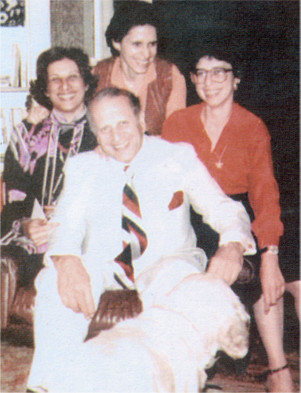
The Marker family (from left) Arnaz, Feroza, Niloufer, Jamsheed (seated) and Lady
Like so many others, Henry Kissinger (national security adviser to US Presidents Richard Nixon and Gerald Ford) became a close friend of Marker’s. On one occasion, they were having lunch at an elegant New York restaurant. "I like this restaurant,” Kissinger declared. "Some of the prettiest girls come here.” One of these greeted Kissinger with a smile and a wave of her hand, which he acknowledged with equal charm. Then he turned to Marker and whispered: "I don’t recognize her. Maybe I am getting Alzheimer’s.” Marker reassured him: "Dr Kissinger, I don’t think you should worry too much about her. The time to worry would be if she doesn’t recognize you.” Turning and nodding to him, Kissinger said in his deep, heavily accented style: "You’ve got a point.”
Soon it was time for the brilliant Marker to retire. But even after retirement he was called upon by the UN secretary general to become his personal representative for East Timor and conduct negotiations between Indonesia and Portugal and the East Timorese leaders, thus ending a 10-year-old conflict, leading to the independent Timor state. "I am delighted,” secretary general of the United Nations Kofi Annan remarked, "to have this opportunity to express my heartfelt recognition and admiration for my good friend Jamsheed Marker and for the outstanding way in which he performed the task with which I charged him.”
Awards were showered upon this diplomat of diplomats by the governments of Pakistan, Bulgaria, France and Colombia.
Quiet Diplomacy is a fascinating and memorable account of the art of diplomacy as practised by an expert over a long period of time, a Parsi who did Pakistan proud.