Spending school vacations in Navsari provided
a sound grounding in Parsi culture, customs, rituals, cuisine
Berjis Desai
Perhaps immodestly I can claim to have had a most optimal upbringing as a Parsi Zoroastrian. In almost laboratory conditions, I was given a comprehensive crash course in Parsipanu. The great white Zoroastrian hierarchy provided all the ingredients required for baking the perfect bawaji biscuit. What then subsequently did go so terribly wrong? wonder my orthodox friends. That is another story for another day. Today I will discuss the recipe for raising a bonny bawaji.
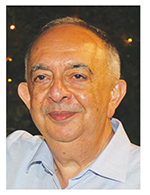
Not a single juddin boond (drop of non-Parsi blood) on either side of parentage; all from pristine, pure Navsari with its impeccable orthodox credentials. First memory, at three years of age, being dressed up in a tiny white dagli over a blood red legho (trademark of the terribly stuck up Navsari Desai clan where to smile was déclassé) at an aunt’s wedding celebrated over six days, not four, of feasting involving lots of goat meat at every meal. Both sexes moving in circles singing bawdy garbas (Gujarati folk songs) with funereal music provided by a group from Surat called takorkhana whose leader behaved as if he was Freddie Mercury.
My cousin who worked with the Bombay Telephone Company timed his entry into our home on the basis that I would be tucked in bed on the dot of 7.30 p.m. only after I had recited a Din No Kalmo prayer to the satisfaction of my stentorian grandmother and had finished my Spartan and unchanging dinner of a scrambled desi egg made with Parsi Dairy milk with two stolid boiled new potatoes thrown in. Until the age of 25, I thought broccoli was the name of an Italian heroine.
There were month long dress rehearsals for my navjote. The date was finalized only after I could recite all three kusti prayers without a single mispronunciation. Not wearing a legho could be forgiven but to be without sudreh kusti was a cardinal sin. When I complained about having to recite the kusti prayers twice a day, I was told how lucky I was that I was spared doing so each time after visiting the washroom. Religion was an integral part of the upbringing. Although my father was not orthodox, he prayed twice daily, for half-an-hour each time.
Then one evening our grandmother casually informed us that I had to learn by rote 72 Has (the 72 sections of the Avesta religious texts), later truncated to 21, for the navar ceremony (initiation into the priesthood) at Navsari. The training was imparted at an agiary where I learnt the most memorable and yet unprintable limericks from old priests along with some original abuse which would make Dadar Parsi Colony louts blush. At 10, after completing both navar and maratab training, I was licenced to perform navjotes, funeral ceremonies and marriages. These were the late 60s and the lights had not yet gone off in Parsi Navsari where I spent many school vacations, gathered much bizarre gossip and learnt many secrets of a seemingly prudish town, later to be recounted in "Navsari Tales.”
My grandmother was a repository of Parsi culture, customs, rituals, cuisine which I lapped up in the absence of television. Later she told me that she had made a mistake by educating me in several matters as she did not realize that one day all these tales would be made public. My journalist father shrewdly refrained from narrating them to me as he perhaps realized the trouble-making potential of his son.
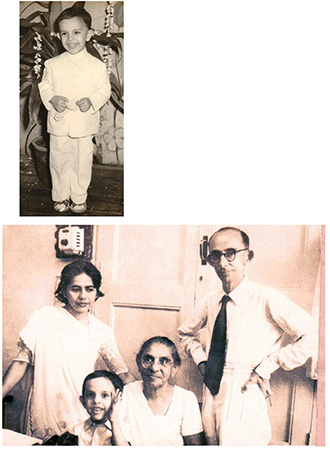
Top: Berjis Desai today and as a child; above with his parents and grandmother
I was taught Gujarati at the age of four and devoured the Jam-e-Jamshed, Kaiser-i-Hind (with Queen Victoria on its masthead much after Independence), the Parsi Prakash as well as the Parsi Tari Aarsi columns my father penned for the Mumbai Samachar of which he was the editor. I read Parsi comedies in Gujarati such as Minoo Nariman’s Hitler Saathé Mulaakat (My Meeting with Hitler) where a Navsari dowager was responsible for ending World War II by feeding the Nazi German dictator unbearably spicy dhansak which compelled the tyrant to commit suicide; and bawdy plays by a playwright known as Ratanji Cut (his wife would shout "Cut, Cut,” to expunge the steamy scenes) including a play titled Chatai pur sooteli Najai (Najai reclining on a mat).
Parsi New Year’s eve meant a visit to the Anjuman Atash Behram and the Banaji Limji Agiary followed by dinner at Olympia, an Irani restaurant on Colaba Causeway. It comprised mutton biryani with humongous onion rings soaked in eye- watering vinegar and finally washed down with Cassata icecream. New Year’s evening inevitably entailed going to an Adi Marzban Parsi comedy at the Birla Matushri Sabhagruha theater.
Despite being an only child living in a cosmopolitan building with few Parsis, the Bharda New High School with its legendary Parsi teachers imbued in me the Parsi way of life. Some strange destiny made me greatly interested in Parsi matters and every facet of the pros and cons of Parsi culture. The realization that one day in the foreseeable future this culture will be erased makes my eyes moist.