Becoming Farah: A Life in Bombay, 1943-1986 by Farah Rustom. Published in 2023 by Notion Press Media Pvt Ltd, No. 50, Chettiyar Agaram Main Road, Vanagaram, Madras 600095. Pp: 264. Price: Rs 499.
Farah Rustom’s Becoming Farah: A Life in Bombay, 1943-1986 is an engaging and frank memoir of, as the title suggests, Farah’s life in Bombay before she migrated to the USA. The memories pour forth over these 43 years moving backward and forward in time rather than in chronological order which would have detracted from the charm of what she calls an "epistolary (written in the form on a series of letters) memoir” as it germinated from a series of emails exchanged with her friends. At times heart-wrenching, the memoir is suffused by a courageous and humorous account of her life during this period. In spite of the several problems she faced, there is no trace of self-pity or sentimentality.
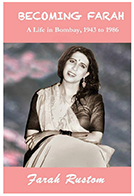
What comes through from the very first few pages is Farah’s loneliness and isolation. She was born Farokh Rustom, the second son in what she terms was a dysfunctional family, but always believed she was a girl trapped in a male body. Though Farah draws a sympathetic portrait of her father who she states was an inveterate gambler and who would bring her a sweet even when he lost heavily at the races, he did nothing to conceal the fact that he doted on her elder brother; this elder brother treated Farah "like dirt” she claims, and her mother allegedly never showed the least iota of love for her since her birth. "…This complete rejection by the three most significant people in my life instilled in me a lifelong hunger for love.”
Her mother confessed that the labor she suffered during Farah’s birth was much less than what she had undergone when her brother was born: "It was the first nice thing my mother had ever said to me… It was unfortunately the last.” She had nothing to do with Farah who was an unwanted child: after two previous illegal abortions, her mother was unable to risk a third. "I could not get rid of you… You were determined to be born.” When, at the age of six, Farah ran to the balcony with the intention of jumping off, her mother, she claims, made no attempt to stop her. Termed a quarrelsome person, her mother fought with everyone — Farah’s teachers, the neighbors — and this probably isolated the child even more. When Farah joined St Mary’s High School, her mother made it clear that she would not let her enter the house if she failed to come first in all her examinations. All through life Farah did everything to "get even one drop of love from her.” Farah installed ceiling fans, paid the electricity bills and supported her parents as soon as she had earned the means to do so. Her mother never appreciated the fact that Farah was a gold medalist Fellow of the Trinity College of Music, London, had started Western music classes and had performed as a pianist in several concerts.
That she was a gifted child, even a prodigy, is evident. At the age of 11 Farah had her first piano lessons and never looked back. In six months, she passed the first grade exam of the Trinity College of Music, London, skipped the intervening grades and passed her grade five exam with Honours. She passed her Licentiate Examination at 19 and the Fellowship at 22. The report from the examiner said, "Both technically and musically, (her) performance, completely from memory, was masterly.”
Farah describes the pecuniary economic condition of her family and their crumbling apartment. To support herself and help her family, she started teaching at the age of 16 soon after passing her Senior Cambridge school leaving exam. By the time she was 18, she introduced three boys, a year senior to her at Elphinstone College, to western classical music. One of them was Kumar Sahani who later became a well-known director of Indian art films. By 1966 she was teaching English, French and Western classical music appreciation at the Indo-American Society. Amongst her students were Maharajas and Maharanis, a former English Chief Presidency Magistrate and members of the Somani family of industrialists. She even conducted a course for the American Women’s Club and had the honor of being chosen to go to Ethiopia in 1967, at the age of 24, as Head of Piano, in their music department.
Farah draws sympathetic portraits of several people who touched her life. She writes with great affection and sympathy about her friendship with Neville Chinoy who at the age of 12 played a piano concerto with Zubin Mehta, and who tragically lost his life in an air crash while in his teens; Dr Homai Shroff, an inspiring professor at Elphinstone College, who played an important part in Farah’s life, encouraging her to apply for a scholarship which she won — The Bhabha Memorial Scholarship — an award which was granted once a year to just one student in Bombay University; Jer Jussawalla who was "warm and vibrant and friendly and full of enthusiasm.” She was a superb speaker and probably influenced the quality of Farah’s own lectures. Their friendship continued even after Farah left Bombay and settled in the USA. Prof (Dr) Mehroo Jussawalla managed to obtain a ticket for Farah to hear Arthur Rubinstein when he performed in Bombay in 1966. The eccentric Bapsy Sabavala gave her an opportunity to play with the Bombay Chamber Orchestra, at a fund raiser for a beggars’ home. Bapsy bought dolls in a shop in Japan, some of which accompanied her to The Taj Mahal Hotel for dinner and one was sent to Farah as a "cure” for her sore throat! Farah speaks frankly of her several crushes: Christopher Hudson, an English professor and singer she met in Ethiopia, Mansoor Laljee whom she met at St Mary’s and Aijaz Ahmed who ran a home for homeless children, to name a few.
In 1976 at the age of 32, Farah came across Jan Morris’s autobiography Conundrum in which the author wrote on her 10-year transition from man to woman. The book created a formidable impression and changed the direction of Farah’s life. She corresponded with the author and learnt about female hormone therapy. Farah describes the process of her transition to a woman in great detail. She stopped shaving, waxed her arms and legs and had to have recourse to electrolysis to rid herself of facial hair. With the hormones, her hips broadened and she began to look like a woman, "filling out in all the right places.” But she knew she was not a woman "down there” and realized that she would need surgery at some point of time. She learnt about a Dr Manohar Hariram Keswani who had trained to perform transgender surgery in the USA.
Farah describes the thorough psychiatric examination she was subjected to before the surgery. She was finally operated on a month later at the Masina Hospital in Bombay. One wonders at her grit and single-minded determination to go through what seems like an excruciatingly painful process. The operation lasted six-and-a-half hours, she was on a liquid diet for 10 days and a "mold” was inserted into her vagina for over six weeks to keep it open. On the fourth day, she hemorrhaged profusely and required fresh stitches to stop the bleeding. After 10 days, when she was allowed to walk to the bathroom her blood pressure plummeted. She was reborn as Farah on October 30, 1976. She was finally a woman and frankly confesses she lost her virginity to a young man whom she calls "Prem” and with whom she was madly in love. She went to Zaveri Bazar, exchanged gold buttons and cuff links for chains and bangles, sported a bindi on her forehead, had her nose pierced and wore "chandelier earrings” which suited her long slender neck.
To make both ends meet, she wrote for several magazines describing her experiences and received a host of letters in return. Her replies helped several persons in distress. She gained fame as a well-known person in the public eye and the book carries many photographs of her taken with several Bollywood stars who became lifelong friends.
Her observations on Bombay and the changes which took place during her years in the city are accurate and perceptive. Farah has always been fond of travel and there are several sensitive descriptions of journeys made to various hill stations and cities in India as well as a hectic tour of Europe. However, these accounts as well as several historical details could have been less lengthy as they tend to slow down the pace of the memoir. One detail is worth rechecking. The depiction of her grandmother’s funeral seems erroneous as she describes the priests saying prayers for three days and the funeral taking place on the fourth day.
The memoirs are extremely touching, frank and what is heartening to know is that after all the unpleasantness she faced from her family and the pain of the operation she can still hold her head high and assert: "I have never regretted becoming Farah for one fleeting second.”
The book ends with Farah relocating to the USA; one can only wait with bated breath for the next installment of her memoirs. F. G.