Demonstrating once again their ability to stay the course over long years, veteran athletes Khushru Patel, Prochy Mehta and Rohinton Mehta picked up eight medals at the 13th Asian Masters Athletics championships at Bangkok in December 2004. Over 1,200 athletes from 17 countries participated in the meet, most being their own country’s national champions.
In the men’s 65+ age bracket, Patel clocked an impressive 32.02 min to be awarded silver in the 5,000 m (5 km) walk. In the women’s 50+ bracket, it was a six-medal haul for Prochy Mehta — a gold in the long jump (3.8 mt) and silvers in the 100 m (15.63 sec), 200 m (32.82 sec), 400 m (67.77 sec) as well as a team gold in the 4 x 100 m relay (67.38 sec) and a silver in the 4 x 400 m relay (6:28 min). Hurdles specialist Rohinton Mehta strode smoothly to gold in the 400 m hurdles (66.26 sec) despite a painful right hamstring.
Though the Bangkok meet was very well organized, a counting error during his race cost Patel dear! "The gold was awarded to an athlete who had actually walked one whole lap less in the 12½ lap race. It was not the athlete’s fault at all. As I began my final two laps, I heard the official shout ‘two more’ to me and ‘one more’ to him,” Patel explains. "I was getting mad as I was pretty sure he had two more rounds to go as well. I was considerably behind him at that stage, but there was a possibility that I could have caught up with him as I am a strong finisher.”
Podium place at Bangkok Asian Masters: Prochy Mehta (top left, displaying medal); Patel (left) and Rohinton Mehta (right)
It was Rohinton Mehta standing on the sidelines who encouraged Patel to keep going. "As I walked, I kept telling him I’m quitting but he said ‘no, no, we will protest later,’” describes Patel who is past master at long distances. At the end of the race, there was not a single Indian official in sight to lend support. Communication was also a problem as the Thai officials were not fully conversant with English. "In any event, we did not lodge an official protest, but after listening to us and watching video replays, the Thais gave him first place but did not acknowledge his timing as a new record as it was of one whole round less!” Patel summarizes the scenario.
At an earlier edition of the Asian Masters in Bangalore, another official error had deprived Patel of podium place: "Races where there are errors should really be re-run, but it causes so much trouble in the reorganizing that it is often not done. At Bangalore, I was very angry as I lost out totally, having been placed fourth.” Walking, he avers, is more taxing than running: "Your knees are locked, the hips, back, arms, indeed the whole body takes the strain.”
The Bangkok meet crowned a virtual medal bonanza for Calcutta’s Prochy Mehta in 2004 as she had struck four golds at the 18th Malaysian Inter Masters Athletic Championship in August 2004 and four golds at the 18th Annual Open Championships in Sri Lanka in September.
"One unusual aspect of the Asian Masters in Bangkok was that the races started early in the morning. I would leave my hotel at 5 a.m. in pitch dark. At the stadium, however, it was like daylight! Everyone was warming up under floodlights,” she narrates. While the races were scheduled at the Rajamangala National Stadium "most of us did not know that Thailand has two national stadiums and quite a few booked their accommodation near the wrong one, entailing a one-and-a-half hour drive each way!” says the evergreen athlete (see "Veterans all,” Sports, Parsiana, February 2001 and "Track record,” Sports, Parsiana, April 2003) who turned 50 last December.
"This time there were many new entries in my age group (50+). The Japanese seemed to come out of nowhere in all sorts of numbers,” she chuckles. In the long jump, however, "less and less people go in for jumps in my age category.” There were a goodly number of entries, however, and "I won gold on my last jump.”
The newly introduced system of time trial (for the over 50, men and women) means that you run your heat, the timing is taken and the first three places awarded accordingly, she continues. "This is clearly a disadvantage as the athletes are not grouped as per their ability — slow in one group, fast in another — but at random,” she relates. The adrenalin - pumping final is not held which means you cannot make "that do or die effort” which leads to ribbons round the neck. It is also very difficult to get together four women or four men to run relays at masters’ meets. "The relays are not well-planned or well-practised as a group. Practically every country faces this problem,” adds the medallist.
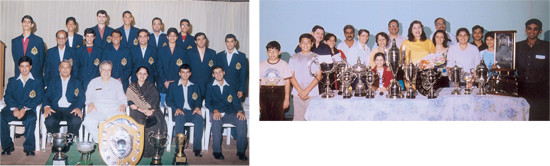
Capt Kayarmin and Gool Pestonji (seated center) presented blazers to the cricketers of the Zoroastrian Club of Secunderabad/Hyderabad in honor of the team winning the Jiji Irani Challenge Cup last November after a lapse of 12 years. Gusti Noria presented Asho Farohar lapel pins to the team which also received mementos from the Club at a special felicitation function.; Winners at the All Parsee Carrom Championship at Cusrow Baug in February 2005 with organizing committee and chief guest Ruby Lilaowala (center)
Turning on the power in the 40+ category, Bombay’s Rohinton Mehta ran a blistering first 300 m at the hurdles in Bangkok and then eased to win the gold by a huge margin of 2.17 sec. "The 400 m hurdles is one of the toughest of track events,” he asserts. "It tests your start, sprint and endurance abilities, as well as your technique. The last 100 m are very difficult to complete.” Knowing he had the Bangkok race virtually in his pocket because of the initial burst, Rohinton describes that he "went into safety mode” and glided over the last three hurdles to avoid further damaging his hamstring. "Otherwise I would have shaved off a second from my timing,” he adds.
Mehta also picked up a gold in the same event at the 26th National Masters Athletics championships in Madras in February 2005, clocking a faster 65.3 sec. "The athlete who stood second was Nagarao of Andhra Pradesh who as an open level athlete was ranked in the top two in hurdles in India. Honestly, I was not sure (of defeating him) but I did! This has given me a lot of satisfaction because the margin of win was large (he clocked 66.83 sec) and he is four-and-a-half years younger,” says the 44-year-old legal eagle who is in the management cadre with corporate giant ITC (India Tobacco Company) in their legal department (see "Master class,” Sports, Parsiana, May 2004).
"There has been too much work pressure of late, but that is a professional hazard I have to take. Running is my hobby. I would love to compete at the World Masters Games to be held in Edmonton, Canada in July, as well as the World Masters Championship in Spain in September, but I have to be fully prepared. I do not want to go as ‘baggage,’” Rohinton asserts, adding that Prochy Mehta and Patel are eligible to participate in these international meets as well. Both Prochy and Patel are currently off training (with a swelling on the leg and a heel pain, respectively) but are mending with treatment and rest.
Do the athletics federations provide the competitors with the India blazer when they participate abroad, we query. "For the Bangkok event, both Patel and I had paid Rs 5,000 each for the blazer and kit but did not receive them due to a mix-up. We now have to do the follow-ups for the refunds,” declares Rohinton.
At the National Masters in Madras, Calcutta’s Lily Khan walked away with silver in the 60+ category in the 5 km walk, representing West Bengal. Farokh Patel participated for Maharashtra in the discus/javelin throws, while Bombay’s Soli Karanjia was in bronze medal contention in the 5 km walk in the over 45 age group when he had to drop out due to a painful heel, Rohinton Mehta informs Parsiana.