Tracing the community’s love for and benevolence towards animals
Vikram Doctor
In 2013, soon after Cyrus Mistry’s unexpected appointment as the successor to Ratan Tata as the head of Tata Sons, I asked a gentleman who was close to both men what would happen to the dogs of Bombay House.
Visitors to the Tata headquarters were often unnerved to find several well-fed indie dogs lounging around the lobby. This was thanks to Tata’s love for them, which was well reciprocated. The dogs mostly ignored the many people passing through but would jump up when he came and stopped to play.
Would the new dispensation displace them? On the contrary, my contact told me, they were the one thing sure to remain. "The Mistry family are also big dog lovers,” he said.
In the event, it was Mistry who was moved on, but the dogs have prospered. In a recent revamp of Bombay House, a special room was made for them on the ground floor rear side. Around 12-15 indies live there, sitting on broad window ledges to look out at the street, or jumping around wooden compartments created for them to climb on or shelter under. The security staff doubles up as dedicated dog carers.
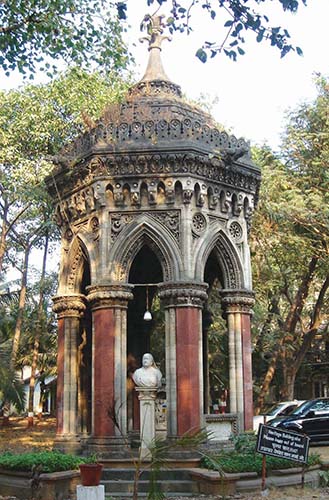
Canopied statue of Bai Sakarbai Petit on
the grounds of the animal hospital
The Parsi-Irani love for animals, and dogs in particular, is well known in Bombay. There was a time when every neighborhood seemed to have a Parsi aunty who fed the local strays and fought ferociously against attempts to remove them. Several Parsis have converted farms outside the city into animal sanctuaries, like Probably Paradise run by Roxanne Davur near Karjat, which cares for over 430 animals, including 250 dogs and 162 cats.
The city had legends of animal lovers like Bapsy Sabavala, mother of artist Jehangir Sabavala, who was famous for having tea parties for her dogs and who is said to have successfully persuaded the Taj Hotel to allow a horse to come up the stairs to their ballroom, as well as a pet pig with a bow affixed to its tail. Or Ruttie Jinnah, whose love of dogs converted her husband, Pakistan founder Muhammad Ali Jinnah, to keep dogs even after she died, to the consternation of his orthodox followers.
The Parsi love of dogs took tangible form in the monument to Jamsetji Tata’s family dog at Esplanade House in South Bombay. There is also a plaque commemorating a Rottweiler pup seen outside Koolar & Co, the iconic Irani restaurant at Matunga Circle, which has featured in several Bollywood films. The plaque was installed by Koolars’ Muslim owners following the death of the pup before it could complete five months. Close by is Dadar Parsi Colony which is sadly notorious as a place where dogs are regularly abandoned because someone is sure to rescue them there.
Many such abandoned dogs make their way to the Bai Sakarbai Dinshaw Petit Hospital for Animals in Parel, set up in 1883 by Sir Dinshaw Manockjee Petit, and named after his wife. It is run by the Bombay Society for Prevention of Cruelty to Animals (BSPCA) which has had many Parsi benefactors, like Naoroji Pirojsha Godrej, Daulet and Dhun Mehta and J. R. D.Tata, who was a past president. Ratan Tata has also been a past president, and is now setting up a new animal hospital which will take some of the burden off the BSPCA.
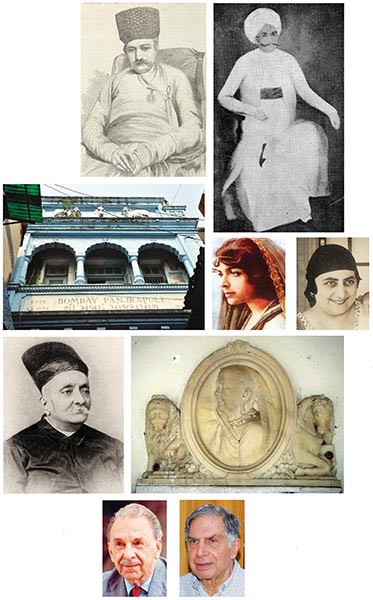
From l, 1st row: Sir Jamsetjee Jejeebhoy Photo: Wikipedia;
Cowasjee Patel Photo: Parsi Lustre on Indian Soil;
2nd row: Bombay Panjrapole Photo: Simin Patel;
Ruttie Jinnah Photo: Ruttie Jinnah; Bapsy Sabavala
3rd row: Sir Dinshaw Petit; Bai Sakarbai Petit relief
at the animal hospital;
4th row: J. R. D. Tata; Ratan Tata
Even before the Petit Hospital there was the Bombay Panjrapole. This still exists in Bhuleshwar, the heartland of Gujarati Bombay, in the middle of Madhavbagh, a building complex dominated by Hindu and Jain temples, and shops selling religious items for them. The Panjrapole is in the center, a serene enclave dominated by cow sheds with smaller enclosures for birds and other animals, and cats and dogs lazing around. The cows, combined with the religious establishments around, make it easy to overlook the Parsi history of the trust that runs it.
The Panjrapole was established after the riots of 1832 that were sparked by British attempts to kill stray dogs in Bombay. Parsis were central to the riots, which Jesse Palsetia, in "Mad Dogs and Parsis,” his study of the riots printed in the Journal of the Royal Asiatic Society (2001), links to the community’s special reverence for dogs: "Zoroastrian eschatology held the dog to be the guardian of the Bridge of Judgment, or Chinvat, before which every Zoroastrian is judged following death…” Some other Indian communities, by contrast, tended to see dogs as unclean and had little regard for them.
The British had been trying to control stray dogs for a while, but in June 1832 they took the step of offering eight annas (50 paisa today) for every dead dog. Inevitably, this incentive was abused: "Many of the dogs captured, however, were neither dangerous or loose, but snatched from private enclosures,” writes Palsetia. Parsis were the first to protest, but other communities soon joined in, and brought the city to a standstill. Two European constables were assaulted in "the first incidence of violence against British authority imputed to the Parsis,” writes Palsetia.
The involvement of Parsis shook the British. They had come to depend on the community in many ways, and their initial reaction was inclined to be harsh. But Palsetia argues that in time this "gave way to a more tolerant, if ethnocentric, understanding of the response of traditional society to interference with its customs.”
The importance of community leaders grew and it was one of them, Cowasjee Patel, who gave the land to create a shelter for animals, to prevent such problems in the future. The area is still called CP Tank after him. Two other benefactors, Sir Jamsetjee Jejeebhoy and Amichand Shah, endowed the trust with properties whose rent would support it, and even today the board of the trust comprises both Parsis and Hindus.
One angle Palsetia does not explore is whether the specific nature of the riots, around dogs, might have actually improved British perceptions of the Parsis. The early 19th century was a period of growing awareness of animal rights in Britain, with the Society for Prevention of Cruelty to Animals being formed in 1824. Princess Victoria became its patron in 1835 and in 1840, after she became Queen, she gave it Royal status.
Animal welfare became a popular cause, as Sir Dinshaw Petit must have known while endowing his hospital. The Parsi love of animals is very real. From the 19th century till today it has also helped build the broadly positive image that the community still enjoys. On Ratan Tata’s Instagram page which regularly carries posts on the plight of strays and abandoned dogs, a picture of him with his Bombay House dogs has over 12 lakh likes.