Monajats helped to bond families through music
Dr Shernaz Cama
Excerpts from a paper titled "Cultural Memory: Interesting Narratives in the Contemporary World” at the International Conference from January 12-15, 2013 on Celebrating a Treasure: 140 Years at the First Dastoor Meherjirana Library, Navsari.
Very little is known about the origin or creation of monajats. Persian, old Gujarati and Parsi Gujarati monajats are found in manuscripts at the Meherjirana Library in Navsari but their dates and authors are often omitted. A few are ascribed to a Dara Pahlon (Persian in Avesta script), some to the Dastur JamaspAsa family, Dastur Erachji Meherjirana (between 1840-1860) and some to Behdin Navroji Meherji Homji (1809). The latter are in Gujarati.
Some older Khordeh Avestas contain monajats, but not their music and ultimately the monajats that have survived as living heritage are the ones that have been regularly sung. Oral performance carries sophisticated linguistic techniques, motifs, figures of speech. As David Crystal says, its knowledge content can be enormous.
The monajat is the simplest form of Parsi oral performance. It is learnt in childhood as a fun filled part of the day, the oral equivalent of cultural transmission even before a child has learnt to read. It has no teacher or priestly guide. It is family centered, children absorbed it almost by osmosis. Above all, it is an experience which bonded families together in music. We learnt these songs on the large verandahs when the loban (incense) was taken around in the evening, and grandparents and great aunts began the singing as dusk fell. Today when the big verandah and joint families have been destroyed by urbanization this transmission too seems to be vanishing.
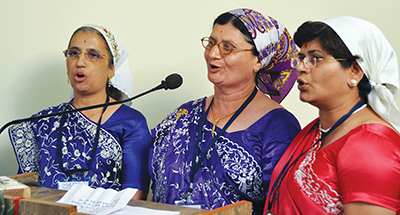
(From l): Jeroo Desai, Bakhtavar Minocher Homji and Rashna Palia singing monajats at Navsari
I will briefly examine a monajat to explain this oral transmission; it is based on Ashem Vohu, the first prayer a child learns:
Ashem vohu, Vahishtem Asti
Ushta Asti, Ushta Ahmai
Hyat ashai, Vahishtai Ashem.
It means: Truth is the highest good. Happiness comes to those who work with truth/ righteousness, for the benefit of others.
The Gujarati monajat says this much more simply.
Ashem Chhe Ashoi
Ashem chhe ashoi, bhalayi nu nan
Chhe servethi uttam, ne sukh no pegam
Kharu sukh aa jag ma te pame taman
Ashoi ne khatar asho jena kam.
This monajat tells the child about three cardinal beliefs, Asha or Truth/righteousness, kam or work/deeds and wisdom which comes when we work with truth. It is with such simplicity that a core message can be passed across generations. This short monajat interlinks centuries through memory. Other aspects of Parsi Zoroastrian material culture also become a story of intersections across time and space.
In prayer and song Spenta (bounteous) creation is revered, while responsibility and love for nature is inculcated through oral traditions. To serve nature is to serve God and reverence for nature was literally interwoven into daily life.
The monajat with which I end is a personal favorite. It is a blessing sung as a lullaby to children. Its soothing quality still reminds a child even as he goes to sleep that the core beliefs of manashni, gavashni, kunashni (Parsi Gujarati for good thoughts, good words, good deeds) will provide the path to enlightenment. The child sleeps with the promise that God will keep him safe all night and wake him to perform good deeds (bhala kam) in the new day.
Khudavind O Khavind
Khudavind o khavind, o parverdegar
Namu tari dadgah e hu khakhasar,
Thayo roj e akhir, sharu thai chhe raat
Tane raji karvathi, hu chu pachat.
Dayalu khudavind, o jag na re baap
Mane saaru dapan ne buddhi tu aap.
Ke bhulo sudharun, avey roj be roj
Bhalai vadhrun kari nitye khoj.
Ke tari madad thi, hu rakhu vivek
Manashi, gavashni, kunashni te nek.
Mane pasabani ma tari suvar
Bhala kam o karva, savarey uthar.
This monajat essentially means: "Great Lord, I bow at my household fire as night falls. Help me to achieve wisdom with obedience. Help me to correct my mistakes and increase my good deeds. Keep me on the path of wisdom — the path of good thoughts, good words and good deeds. Keep me safe in your care all night and awaken me to perform good deeds in the morning.”

Currently head of the Department of English at Lady Shri Ram College, Dr Shernaz Cama is honorary director of the Parzor Project on the Preservation and Promotion of Parsi Zoroastrian Culture and Heritage funded by UNESCO.
During the course of her PhD researches, she has worked at the British Museum and the School of Oriental and African Studies in London.