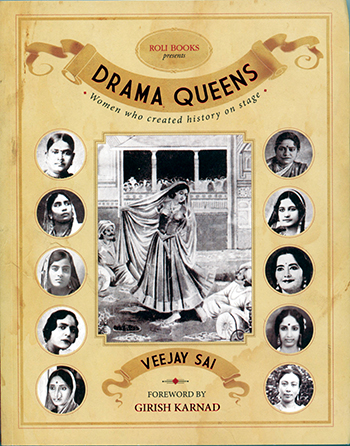
Drama Queens: Women who created history on stage by Veejay Sai. Published in 2017 by Roli Books, M-75, Greater Kailash II Market, New Delhi 110048; email:
info@rolibooks.com; website:
www.rolibooks.com. Pp: 208. Price: Not mentioned.
Can you imagine that in the early 1900s the Great South Indian Railway Company headquartered in London ran trains called ‘Balamani Special Express’ to ferry audiences from Trichy to Kumbakonam where the legendary Balamani was performing?
Or that Munni Bai, the biggest singing star of the Parsi stage, continued a performance despite a snake slithering into her flowing hair as the audience gaped?

Or that as early as 1898, Tara, a young girl from Rahmatpur, eloped with her ustad Abdul Karim, and they lived together in Bombay for a full year before settling into marriage?
These are the women whose lives Veejay Sai (pictured) documents in his well researched book Drama Queens: Women who created history on stage. It was an incredible age these queens lived in, when performances began at 10 p.m. and ended at dawn with petromax lanterns being the only form of stage lighting. It was also an age when female impersonators ruled and women on stage were scorned as cheap. Yet these feisty women held their own.
Sai faced a herculean task collating material, for little is recorded about women theater artists of the 19th and 20th century. Photography and recording, tainted with the superstition that an artist’s life would be cut short if they were photographed or lent their voices to recordings, led many to keep away from the new media. Piecing together fragments from press articles, autobiographies and oral narratives, Sai traces the lives of 10 women from traditional performing arts communities, tawaif, devdasi, veshya, who toured urban and rural areas extensively, spurned by elite society, yet patronized by royals for their talent at singing and dancing.
Sai’s women led rich, artistic lives challenging existing norms. Though she performed on Tamil stage it was Balamani’s exquisite rendering of original Sanskrit dramas that enchanted a bevy of admirers including French writer Pierre Loti and painter Raja Ravi Varma. Extremely professional in the approach to her craft, when the role in Tara Shashankam demanded a nude appearance, she daringly took it on despite triggering debates on morality and censorship.
Living life queen-style in a palatial bungalow with a swimming pool, marble fountain, peacocks and deer, the flamboyant Balamani rode into town in a silver chariot drawn by four horses. Yet her concerns remained humane. She hired women artists in her theater company taking in girls from impoverished families, training them in vocal and instrumental classical music, dance and mythology to give them a livelihood. At performances, she created separate ticketed space for women in the audience to encourage upper-class women to break away from their cloistered lives.
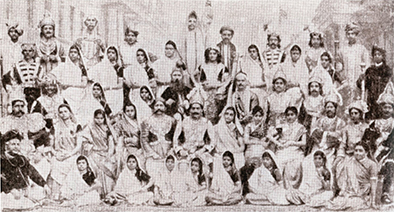
Khurshedji Baliwala’s Parsi Victoria Theatrical Company, circa 1900
Patience Cooper (left) and Munni Bai (center and right)
Jamshedji Madan (left) and Khurshedji Baliwala
Packed auditorium at Grant Road Theatre to see Munni Bai perform
Another performer Shyamabai, the favorite mistress of the Raja of Bharatpur, who should have attended performances only in a separate enclosure for devadasis, reserved prime seats for her entourage in the special very, very important persons (VVIP) class. Despite protests from the patriarchal audience, she and her friends refused to vacate their legitimately paid for seats. The spirited women had to be physically ejected by bouncers.
In an age when men played female roles, Bengal was among the earliest to introduce women on stage in 1874. Reviewing the first play without a female impersonator Amrita Bazaar Patrika wrote, "Women acting in women’s roles gives a completeness to theater but it is to be seen how it affects the community, whether it increases sin and depravity if women’s roles are enacted by social outcasts.”
To bring actresses into the fold of respectability, playwright Upendranath Das got his actress Sukumari married to her co-star only to have a hate campaign unleashed against them. While her husband escaped by fleeing to England, an undeterred Sukumari went on to pen an autobiographical play, becoming the first woman playwright of Bengal.
Into this milieu of feminist defiance came Parsi theater. An entrepreneurial community influenced by British theater, Parsis set about investing in entertainment to make it a profitable enterprise. Putting money into lavish sets, fancy lighting and vibrant costumes they initiated a new genre which caught the fancy of the audience. Under their stewardship, Grant Road in Bombay became a bustling hub of drama halls.
The first plays staged were classical mythologies — Ramlila, Raja Harishchandra, Indra Sabha — which could be counted on to draw audiences. In 1868, the Victoria Theatrical Company was established by Kaikushru Kabraji who also wrote a trilogy of Shahanamah based plays. When these plays toured rural areas, where lanterns were still used for stage lighting, local theater groups absorbed techniques from the spectacular musicals while urban plays picked up earthy folk idioms.
The most famous playwright of this generation, Agha Hashr Kashmiri adapted Shakespearean classics, but was unable to make a financial success of his Indian Shakespeare Theatrical Company. Finding employment with Cawasji Khatau’s Alfred Company he used Urdu prose set to Hindustani music, retaining Shakespeare’s strict meter to make a name for himself as Shakespeare-e-Hind.
By 1872 women were seen on Parsi stage, the first actress being Mary Fenton, daughter of an Irish soldier who went on to marry a Parsi and became Meher Bibi. Like the mainstream, Parsis had their conservatives and New Alfred theater held out longest against hiring women under the increasing influence of Victorian morality.
In 1911, Victoria Theatrical Company was invited to Delhi to stage Raja Harishchandra for the visiting King George and Queen Mary. The lead actress, Sofiya, better known as Munni Bai, received rave reviews calling her Sangeet Rani. Khurshedji Baliwala, the manager of Victoria Theatrical Company which Munni had joined at the age of seven, adopted her and later got her married to his nephew. Unlike other girls, Munni Bai continued acting and singing after marriage to become the highest paid artiste when HMV (His Masters Voice)started recording in Bombay.
In 1909, Jamshedji Madan, a female impersonator with the Elphinston Drama Club, set up Madan Theatre Company in Calcutta and produced the Urdu play Indra Sabha, a pageant of song and dance composed entirely in verse. They were among the first to produce silent films with the earliest films being stage plays shot on a single camera with Jewish and Anglo-Indian actresses taking Hindu or Muslim screen names. Madan Theatre grew into an extremely lucrative enterprise owning 135 theaters out of the 2,000 existing all over India.
By the 1920s, the entertainment scene was changing. As India’s freedom movement gained momentum, mythological dramas gave way to plays based on patriotic themes. Gramophone companies entered the entertainment arena with the first artistes to have their voices recorded coming from traditional performing arts communities. In 1931, Madan Theatres made their first talkie film Shakuntala but with the dawn of the talkie age, artistes who had survived the transition from stage to silent screen faded away.
This review cannot end without mention of the numerous images Sai has managed to collect from innumerable sources. These sepia tinted portraits, posters, scenes from performances with female impersonators looking incredibly like women, re-create the period they represent, adding flavor to a well-designed book.
Sai’s research is thorough and detailed but if his writing style was less pedantic, Drama Queens would attract more readers. It’s no mean feat to cover a span of almost 200 years unearthing lost lives, which is why the book deserves a wider audience than it is likely to get.
MEHER PESTONJI