The City Makers. How Women Are Building a Sustainable Future for Urban India by Renana Jhabvala and Bijal Brahmbhatt. Published in 2020 ay Hachette Book Publishing India Pvt Ltd, 4th/5th Floors, Corporate Centre, Plot No. 94, Sector 44, Gurgaon, 122003; website: www.hachetteindia.com. Pp: xiii + 194. Price: Rs. 399, UK £ 8.99, US $ 11.99.
This is a book of case studies about people who live hidden in plain sight in and around our cities.
We may get a glimpse of them from a height on an airline’s flight path as it circles around a megapolis before it lands on the runway. Very often the clusters of dwellings that go under the name of slums or jhuggi-jhopri or jhopadpatti or tcherrys, bustees or favelas in the vernacular, present a patchwork umbrella of plastic sheets in vivid blues and greens. It’s as if a large shiny insect had embedded itself on the land, its tentacles of thin black arterial roads and sewage that stretch in different directions.
Renana Jhabvala (l) and Bijal Brahmbhatt
At times these unorthodox human habitats have attained a certain measure of notoriety if not fame. This has been the case with Dharavi in Bombay. It may have started as a small island inhabited by fishermen, but it’s now known as the third largest slum in the world occupying 535 acres approximately with a total population of 1.2 million people. For those who are interested in statistics, Mexico leads with its Neza-Chalco Itza, followed by Karachi’s Orangi. Dharavi also has a reputation as the best educated slum in the world, whatever that means, with a gamut of manufacturing units from garment making to pottery, leather, steel utensils located in what has been described as single unit factories. There’s even a Dharavi cookbook that describes its composite culture. One estimate reckons that Dharavi has an annual income of USD 650 million (Rs 5,316 crore), but very few toilets — one toilet for every 1,450 people on an average. Films such as Slumdog Millionaire or Gully Boy or the earlier musical West Side Story add to the mystique of slums being part of a vibrant counter culture.
Toilets, or the lack of them, are a major preoccupation in the studies presented by Renana Jhabvala and Bijal Brahmbhatt, two advocates of women empowerment. Between the extremes of aversion and adulation the authors suggest "advocacy” for and by the women living in these urban clusters finding the means to empower their lives and those of others.
To quote from the preface: "A roof over one’s head, running water and a toilet at home, clean and healthy surroundings — a widely accepted definition of housing — is a vital indicator of the quality of life.” Bridging the gap between the aspiration and the reality is a part of what the authors are trying to convey. Towards the end of the book, they spell out what they mean by "advocacy.” Part of their intention in documenting the stories is to show how change is possible using the methodology that has evolved under their watch.
"Advocacy is the act of seeking support for the changes one wants to recommend.” Their role appears to be to train women to be the owners of their own narrative, whether it is to hold the patta (landholding) rights to their own room or space where they can work, a right that has traditionally been that of the dominant male; to build a toilet and have access to clean water and equally a healthy environment. Or, as the authors put it, "At the center of this advocacy is the call to recognize the urban poor as citizens who have human rights equal to every resident of the city” (Epilogue). There’s also an extensive bibliography that could serve those who want to know more about how to tackle specific issues related to the subject.
We learn from the brief introduction at the beginning that Jhabvala, a Padma Shri recipient in 1990 is the chairperson (since 2001) of SEWA (Self Employed Women’s Association) Bharat, a federation of women-led institutions providing economic and social support to women in the informal sector, amongst many other distinguished posts in allied fields in the last four decades. Brahmbhatt, to quote from the same introductory text, is the director of the Mahila Housing SEWA Trust since 2009. A civil engineer by profession, her expertise is in the area of providing affordable housing for the urban poor, notably women. Amongst her many awards was the recognition given to her by a group in Switzerland that felicitated her on being one of the "Women Change Makers” in 2013. Her core interest is in devising simple solutions for sustainable energy that could be replicated by the empowerment of women. In each case, it takes one woman to come forward and take the first step. Ideally, by a process of social osmosis, her success provides the lever for reaching out to others in her immediate group and making the difference.
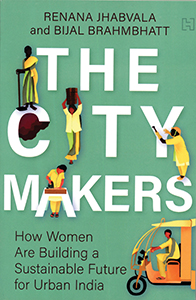
The cover illustration features small images of women engaged in building activities. Some of the drawings depict a woman holding a pickaxe, or a hammer, carrying bricks on her head, or driving an auto, with a wheelbarrow and plumb line suggesting other tools needed to underline the title — that these are the hidden "City Makers.” It also reminds the reader of the era when artists like Maqbool Fida Husain painted colorful village women working on a construction site passing on headloads of cement and brick like human conveyor belts. Part of the Jhabvala-Brahmbhatt thesis is how these activities have now been replaced by superior construction modes of automated and pre-fabricated components and mega construction corporations that have replaced the earlier more local systems of building and construction models.
There is also a certain urgency as some of the case studies reveal how the very real issues posed by global warming and the uncertainty of changing weather conditions, extreme heat during the summer months, or excessive and sudden flooding during the rainy season, affects the slum dwellers in a much more aggressive manner. One of the most inspiring episodes is related to how a woman named Radhikaben devised a simple method of warning people in her commune to take shelter from the elements during the monsoons. As she says preventive measures can best be taken by a joint ownership of the problem: "Only we can reverse the damage that we have done.” Radhikaben says philosophically: "We must heal the earth and help it sustain itself again.”
If there is a motto that defines the approach of both Jhabvala and Brahmbhatt it could be "Teach. Outreach. Empower women.”
There is enough ammunition in the collection for both the specialist and the lay-reader. GEETA DOCTOR
Doctor, a longtime contributor to Parsiana, is a writer and critic.