The contribution to Britain by Indians residing there during the colonial period is related in photographs
Kusoom Vadgama’s book India in Britain: The Indian contribution to the British way of life published in 1984 is a labor of love. The 256-page black and white tome is "a mainly pictorial account of the activities of Indians in Britain between 1852 and 1947” and took the former ophthalmologic optician 14 years of research. "Indians who came to these shores brought with them something of their rich and variegated culture, which made an impact on British life, high and low. The establishment of the day, the politics of the time, the society of the period, the sports of the season were all enriched by the Indian connection: India was, and remained, the brightest jewel in the crown…
"My purpose is to put the record straight and thus provide a corrective to arrogance and to the delusion that one race is superior to another,” states the author in the introduction.
In a message Prince Charles wrote on August 2, 1982: "A book such as this, which relies chiefly on photographs, has the ability to convey atmosphere and impressions in a way that words very often fail to do… There may be no more princes or Indian orderly officers, but the culture of India can still enrich and expand our lives in many different ways.”
Kusoom Vadgama: recording the raj
Then Prime Minister Indira Gandhi noted in her message dated May 4, 1982: "Countless books have been written on the years of British rule in India. The Company and Raj were served by a large number of articulate recorders. Less well known is the story of Indians in Britain — not only those who showed off their wealth but those who battled for large causes, intellectual and political.”
Vadgama who resides in London states on the book’s inside cover blurb that "Britain is my home but India my homeland.” The pictorial history book was presented by the author to Parsiana last October when they visited the Asha Centre run by Zerbanoo Gifford (the first non-white woman to be elected to political office in Britain) and her family in Gloucestershire, England. Some of the rare photos of Parsis, textual extracts and captions are reproduced from the book:
"No hatred to a brown skin”
In the aftermath of the violence unleashed by both sides following the mutiny/uprising/independence struggle of 1857, Queen Victoria wrote to Lord Canning:
"The Indian people should know that there is no hatred to a brown skin, none; but the greatest wish on their Queen’s part is to see them happy, contented and flourishing.”
Not only did she wish relations to return to a state of mutual respect, she wished to emphasize that "We do strictly charge and enjoin all those who may be in authority under us that they abstain from all interference with the religious belief or worship of any of our subjects on pain of our highest displeasure.”
While the Queen never went to India, she arranged that India came to her. In all of her palaces, most especially at Windsor, which she increasingly favored, many of her personal servants were Indians.
Her diaries recall that when two young men, newly arrived from India, were presented to her she thought they were very fine, and we know that she rebuked Salisbury, her Prime Minister, for referring to Indians as ‘black men.’ Several photographs show the Royal children being cared for by Indian attendants — the Queen showing no preference for Hindu, Sikh or Muslim — and towards the end of her life she appeared to grow ever more dependent on her faithful Indian manservants.
Queen Victoria working on her papers outdoors at Frogmore, attended by an Indian servant whose tunic is decorated with a crown
Queen Victoria’s letters
Letter written regarding her visit to The Colonial and Indian Exhibition:
"A fine bright morning. At eleven we left Windsor. At Paddington the Duchess of Bedford, the great officers of State, etc met me. Immense and enthusiastic crowds. Got out at the entrance to the exhibition amidst great acclamation. We first went into a tent at the entrance of which stood two Indian boys, and after a few minutes proceeded to a large vestibule.
"Here all the commissioners were presented to me in a body and a procession was formed, passing through the Indian Hall and the Indian Bazaar, where the sides were lined with Lascars, who looked most picturesque. Then we passed between rows, two or three deep, of Indians of all kinds, in the brightest costumes, all connected with the exhibition and its exhibits, including the workmen. There were Parsis in white, with curious black glazed headgear, and numbers in turbans of every shade. We were warmly greeted with salaams, an old man of 100 held out a carpet for me to touch, and others held out their hands with pieces of money in them for me to touch.”
"The Golden Link”
Dadabhai Naoroji was born in Bombay in 1825, and was one of the first batch of students to attend Elphinstone College. While there he became assistant to the mathematics professor, the first Indian to hold such a post in a government college. He came to London in 1855 at the age of 30 as a partner in the first purely Indian firm to be established in the City of London, that of the mercantile Cama family. In his later years he was venerated as a sage, both in India and Britain.
Far left: Queen Victoria with Mustafa and Chidda, 1896; Alongside: Prince Edward, Prince Albert and Princess Mary with Abdullah at Balmoral in 1898
Parsiana reproduces from India in Britain Naoroji’s maiden speech delivered in August 1892 at the age of 67 in the British Parliament:
"It may be considered rather rash and unwise on my part to stand before this House so immediately after my admission here; and my only excuse is that I am under a certain necessity to do so. My election for an English constituency is a unique event. For the first time during more than a century of settled British rule an Indian is admitted into this House as a member for an English constituency. That, as I have said, is a unique event in the history of India, and, I may also venture to say, in the history of the British Empire. I desire to say a few words in analysis of this great and wonderful phenomenon. The spirit of the British rule, the instinct of British justice and generosity, from the very commencement, when Parliament seriously took the matter of Indian policy into its hands, about the beginning of this century, decided that India was to be governed on the line of British freedom and justice. Steps were taken without any hesitation to introduce Western education, civilization, and political institutions in that country; and the result was that, aided by a noble and grand language, in which the youth of that country began to be educated, a great movement of political life — I may say new life — was infused into a land which had been decaying for centuries. The British rulers of the country endowed it with all their own most important privileges. A few days ago, Sir, you demanded from the Throne the privileges which belong to the people, including freedom of speech, for which they have fought and shed their blood. That freedom of speech you have given to us, and it enables Indians to stand before you and represent in clear and open language any desire they have felt. By conferring those privileges you have prepared for this final result of an Indian standing before you in this House, becoming a member of the great Imperial Parliament of the British Empire, and being able to express his views openly and fearlessly before you. The glory and credit of this great event — by which India is thrilled from one end to the other — of the new life, the joy, the ecstasy of India at the present moment, is all your own; it is the spirit of British institutions and the love of justice and freedom in British instincts which has produced this extraordinary result, and I stand here in the name of India to thank the British people that they have made it at all possible for an Indian to occupy this position, and to speak freely in the English language of any grievance which India may be suffering under, with the conviction that, though he stand alone, with only one vote, whenever he is able to bring forward any aspiration, and is supported by just and proper reasons, he will find a large number of other Members from both sides of the House ready to support him and give him the justice he asks. This is the conviction which permeates the whole thinking and educated classes of India. It is that conviction that enables us to work on day after day, without dismay, for the removal of a grievance. The questions now being discussed before the House will come up from time to time in practical shape, and I shall then be able to express my humble views upon them as a Representative, of the English constituency of Central Finsbury. I do not intend to enter into them now. Central Finsbury has earned the everlasting gratitude of the millions of India, and has made itself famous in the history of the British Empire, by electing an Indian to represent it. Its name will never be forgotten by India. This event has strengthened the British power, and the loyalty and attachment of India to it, 10 times more than the sending out of one hundred thousand or two hundred thousand European soldiers would have done. The moral force to which the right honorable gentleman, the Member for Midlothian (W. E. Gladstone) referred is the golden link by which India is held to the British power. So long as India is satisfied with the justice and honor of Britain so long will her Indian Empire last, and I have not the least doubt that, though our progress may be slow and we may at times meet with disappointments, if we persevere, whatever justice we ask in reason we shall get. I thank you, Sir, for allowing me to say these few words, and the House for so indulgently listening to me, and I hope that the connection between England and India — which forms five-sixths of the British Empire — may continue long with benefit to both countries.
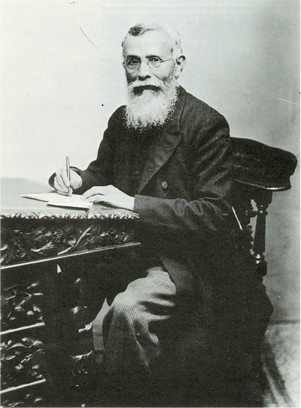
The first Indian Member of Parliament Dr Dadabhai Naoroji
"Versatile and practical”
The man who followed Dadabhai Naoroji in the House of Commons in 1895 was Sir Mancherjee M. Bhownagree, a brilliant organizer and negotiator both inside and outside politics. He was one of the key men to put together the highly successful Colonial and Indian Exhibition of 1886 in South Kensington, London. As a national memorial to Queen Victoria’s Golden Jubilee the following year, the exhibition was made permanent in the shape of the Imperial Institute — now the Commonwealth Institute.
The second of the three Indian MPs to sit in the House of Commons, Bhownagree was the only one of the trio to walk the corridors of Westminster for more than 10 years. He was elected twice for the East London seat of Bethnal Green North-East on the Conservative ticket, having majorities of 160 in 1895 and 379 in 1900. In fact these figures are not as small as they may seem nowadays, since his electorate was a mere 7,431. He stood again in 1906, but the tide had turned against him and he was not reelected.
Sir Mancherjee Bhownagree (above) and (left) at the House of Commons
Son of a Parsi merchant in Bombay, Sir Mancherjee Bhownagree (1851-1933) came to Britain at the age of 30 and was called to the Bar by Lincoln’s Inn in 1885.
For more than 40 years he was the most prominent figure amongst the Indians who had settled in Britain and was the only Indian to sit in the House of Commons continuously for 10 years. A most versatile and practical man, he impressed the House by the vigor and eloquence of his speeches on Indian subjects. He also fought for the rights of Indians in South Africa. During the war he wrote a booklet The Verdict of India to crush the German propaganda detrimental to the British connection in India.
Sir Mancherjee was one of the first Indians to press forward the need for technical and vocational education in India as well as the need to raise the educational standard of women to the same level as that of men. He was also deeply interested in the education and welfare of students in London. As the chairman of the Northbrook Society he was in helpful contact with the Indian student element.
He was also the chairman of the Indian Social Club in London and vice chairman of the council of the East India Association. For a very long time he dominated the Parsee Association of Europe. To the Imperial Institute, he contributed a corridor in memory of his only sister, named the Bhownagree Corridor.
Lady Mancherjee could not stay in London as a permanent resident — the British weather was not suitable for her health — but she visited her husband frequently. Their only son died young, on the threshold of a promising career, and his only daughter married Dr Bahadurji. She was widowed quite young leaving a daughter who later became a barrister.
Shapurji Saklatvala addressing the crowds at Trafalgar Square in London
A fiery revolutionary
The third Indian member of the British Parliament, Shapurji Saklatvala was twice elected for Battersea North. In 1922 he had a majority of 2,021 on the Labour ticket, but he lost his seat in the following year. In 1924 he stood again, this time as a Communist and won by 542 votes.
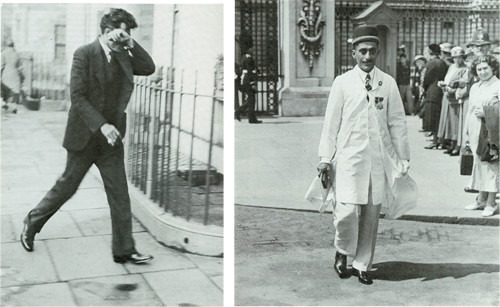
Infamy and investiture. Buck Ruxton (left), born Buckhtyar Rustomji Ratanji Hakim, and Khan Saheb Aspindiar Coverjee Jassawalla (right) were contemporaries but could not better illustrate the extremes of action which bring men into prominence. Ruxton, who was a doctor, killed his common-law wife, Isabelle, in a fit of jealousy, and then the nursemaid who witnessed the murder. After surgically removing all distinguishing marks from their bodies, he drove to Scotland and hid them in a gully, but they were discovered and Ruxton, shown here hiding his face, was executed in 1936. One year later, his fellow-countryman was appointed to be a Companion of the Imperial Service Order for services rendered at Army headquarters and he is seen here leaving Buckingham Palace after the investiture by King George VI.
Shapurji Saklatvala was born in Bombay in 1874, the son of Dorabji and Jerbai Saklatvala, who later moved to Manchester. His mother was a sister of J. N. Tata, who, with his brother, had founded the Tata Steel Works in India.
After an early education in Bombay, Shapurji went on to study law and became a member of Lincoln’s Inn in London. He joined the British Socialist Party and was actively engaged in forming the People’s Russian Information Bureau, as well as the Communist Party of Great Britain, following the revolution in that country.
He first entered the British Parliament in 1922 as Labour member for North Battersea. He is also the last Indian to enter the Parliament at Westminster.
(Left) The Duchess of Gloucester with two Indian volunteers at India House, London, who are engaged in packing parcels for Indian POWs; The family pictured here is that of Sir Jamsetjee Jejeebhoy, head of the Parsi community of Bombay. Cowasjee Cursetjee was the fourth Baronet (1852-1908) to hold the title since it was created in 1857 for his great-grandfather, a wealthy and generous merchant born in 1783. An act passed in 1860 stipulated that each holder of the title must relinquish his own name to take that of the first Baronet, Sir Jamsetjee Jejeebhoy. Seen here in 1902 with his son and daughter, he visited the House of Commons to be entertained by the Rt. Hon. Jesse Collings.
Saklatvala was a founder member of the Worker’s Welfare League of India which aimed at equalizing European and Indian labor standards. In 1923, he stood again as a Labour candidate but lost his seat. In the 1924 election he stood as a Communist and won with a majority of 554 votes. In the following year he was appointed a member of an inter-parliamentary delegation to visit America but his visa was revoked on the grounds that the United States did not admit revolutionaries.
In 1926 Saklatvala was imprisoned for two months on a charge arising out of a May Day speech he made in Hyde Park. He was a strong critic of the Indian National Congress and of Gandhi’s methods in the freedom fight.
In 1927 he returned to India and when he arrived back in England, his permit to reenter India was cancelled at the request of the Indian Government. He lost his seat in the House in the 1926 general election.
Saklatvala was known as a revolutionary and a fiery figure. He was also extremely critical of the continuance of British rule in India. He was married to Sheri, daughter of Henry Marsh of Derbyshire, in 1907 and had three sons and two daughters, who were initiated to the Zoroastrian religion — for which he was censured by the Communist Party.