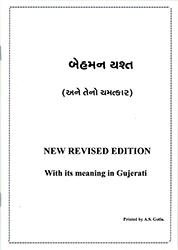
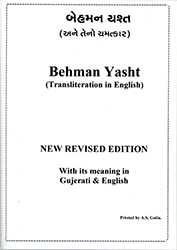
Behman Yasht (Transliteration in English) by Aspandyar Sohrab Gotla. Published in 2021 by the author, B-9, Anand Vihar, St Martin’s Cross Road, Bandra (West), Bombay 400050. Pp: 99. Price: For free distribution.
Aspandyar Sohrab Gotla (pictured) has published a Yasht dedicated to Bahman Yazad, translations of which in English and Gujarati are contained in this booklet, meant for free circulation. In the preface he has written: "The original Behman Yasht is lost;

what we still have and pray is the thought force of the original in the Pazend/Pahlavi language… reconstructed during the Sasanian times.” Hence versions of this prayer differ widely, according to Gotla who claims that the rendition published in this booklet is relatively authentic and was constructed by one Dosabhai Aibada in 1955.
After the Gathas composed by the Prophet himself, it was Aadarbaad Marespand, a celestial being who had incarnated to serve, who composed most of our prayers, including the Bahman Yasht, in the early Sasanian era. There was a very strong oral tradition of priests maintaining the prayers for generations. Even after the assassination of the last Persian Emperor Yazdegird Shariyaar (by one of his own subjects, a necklace thief, in 651 AD, while he was on the run from Arab armies), the retreating Zoroastrians zealously guarded the prayer traditions. Those who later sought refuge in western India did likewise. Hence, Gotla’s theory of a lost Yasht due to its misuse for wrong ends, and its reconstruction by Aibada in 1955, sounds a trifle far-fetched.
Ahura Mazda follows the parliamentary system of government in which the prime minister is the first among equals. His seven-member council of senior ministers comprises himself and six other ameshaspands assisted by various yazads like Srosh and Bahram. The deputy prime minister, after whom the second day of each month and the 11th month of the Zoroastrian calendar are named, is Bahman or vohuman, the right or good mind. He was the first creation in the universe and is permitted to sit on a golden throne next to the Lord’s, unlike any other celestial being in the Zoroastrian cosmogenesis.
While, according to the Zoroastrian protocol, Bahman undoubtedly occupies a position next only to Ahura Mazda, the junior ministers, Srosh and Bahram have captured the public imagination. The former is the guardian of souls (if one misses Tehmul’s paidust, one goes for his Sarosh prayer) while the latter, mushkil aasan, eases hardships (more so on Bahram roz and Fridays, when one lights a lamp and reads the story of his miraculous powers while shelling roasted chickpeas). In contrast, Bahman is dreaded by hard core meat-eaters for the 30-day abstinence from flesh required during the month dedicated to him.
The right or good mind is central to Zoroastrianism. One decides or selects for oneself how one will act. One creates one’s own karma by one’s thoughts, words and deeds which affect both this and the afterlife. Hence, Bahman confers upon one the wisdom and grace to select correctly.
The book promises that if a person recites the Bahman Yasht with a pure heart, mind and body (no meat, no sex, no lies, mandates the booklet) for 40 continuous days, particularly in the 11th month, the devotee’s noble desire or aspiration will surely fructify. (Are juddins permitted to recite our prayers? Maybe not, according to the purists, but one can’t do much about it, can one?) Bahman is the guardian angel of animals and birds (not fish which, as during the Christian period of Lent, may be consumed by the devout). Why sexual abstinence? The book does not clarify.
On Bahman parav (corrupted version of parva meaning annual festival), in Navsari there was a tradition where young boys and girls went around to all the houses, Halloween style, to collect rice and grains and lentils which were later cooked and eaten as khichri kohru (yellow rice and pureed pumpkin) with bhujélo (roasted) papad and pani nu achaar (raw mango preserved in brine). Vegetarian fare can be delicious too.
However, Gotla’s booklet is not about merriment at all. According to the English translation of the Yasht, a 9,000-year-long bad era is predicted when people will move around without wearing the sudreh-kusti and will not concentrate on prayers but indulge in irreligious practices; the condition of fire temples will deteriorate and aliens waving black flags will desecrate holy places. Until such time as a savior emerges to restore matters.
The orthodox theory is that every word, every syntax of our prayers has been composed to ensure that, when correctly intoned, it will generate colors and vibrations on the various planes of existence — physical, astral and causal. Its literal translation may sound banal, even puerile at times. It matters not. As long as one prays with devotion and concentration and without thinking of the price of Tata Steel on the National Stock Exchange or the pink complexion of Piloo next door, whether one understands the exact meaning or not, the prayers will do their job. In any event, most prayers are allegorical and cannot be grasped literally. If so, publishing a literal translation may serve little purpose and may even put off the young.
Many have sponsored booklets on the popular Bahram Yasht or the much prayed boon bestowing Avan Yasht or the potent prayer formulae of the great healer king, Shah Faridoon. Hence, Gotla’s effort needs to be lauded at least for making the most exalted Bahman Ameshaspand better known and more user friendly to Zoroastrians.
Lastly, the Bahman Yasht, like most other prayers, states that Bahman Ameshaspand "has made immortal those who made efforts to propagate” the Zoroastrian faith. But we mustn’t take these words too literally, must we?
BERJIS DESAI
Desai is a lawyer in private practice and a part-time writer.