This extract from Sir Rustom Masani’s book Folklore of Wells: Being a Study of Water Worship in East and West (1918) shared with Parsiana by scholar Dr Simin Patel deals with quaint Parsi beliefs regarding deities residing in wells.
Close to Nowroji Wadia’s house was a well, a habitat of spirits. The owner of the house, a Parsi lady, was asked to cover the well. In view of the sad experience of the fate of the owner of the neighboring house she was reluctant to do anything that might offend the spirits, but the Malaria Department was insistent. She therefore first implored the presiding deities of the well to forgive her as she had no option in the matter before consenting to cover the well provided a wire gauze trapdoor was allowed so as not to interfere with worship of the water. I understand that on every full moon eve she opens the trapdoor, garlands the well and offers her devotions there.
Further down the same street, once renowned for the abodes of Parsi sethias, is a house belonging to a well-known Parsi family. A well in this house was, and still is, most devoutly worshipped by the inmates of the house. I hear from a very reliable source that whenever any member of the family got married it was the practice to sacrifice a goat to the well spirit, dip a finger in the blood of the victim and anoint the bride or bridegroom on the forehead with a mark of the blood. Once, however, this ceremony was overlooked and, as fate would have it, the bridegroom died within 40 days.
Limji Banaji Agiary in Nanabhoy Lane
Photo: Jasmine D. Driver
This practice of besmearing the forehead with the blood of the sacrifice is a survival of primitive ideas concerning blood-shedding and blood-sprinkling, the taking of the blood from the place where the sacrifice was made being regarded as equivalent to taking the blessing of the place and putting it on the person anointed with the blood. Thus, when an Arab matron slaughters a goat or a sheep vowed in her son’s behalf, she takes some of its blood and puts it on his skin. Similarly, when a barren couple who has promised a sacrifice to a saint in return for a child is blest with the joys of parenthood, the sacrifice is made and the blood of the animal put on the forehead of the child.
Remarkable as is the survival of this primitive ritual in Bombay and its prevalence amongst people such as the Parsis, there is nothing very extraordinary about it. This little patch of savagery, as it appears to be in the midst of fair fields and pastures new of western culture, it merely affords an illustration of the fact that localities preserve relics of a people much older than those who now inhabit them. It also shows that various systems of local fetishism found in Aryan countries merely represent the undying beliefs and customs of a primitive race which the Aryans eventually incorporated into their own beliefs and rituals, for it will be seen as we proceed that in India as in Great Britain the entire cult of well-worship was imbibed rather than engendered by Aryan culture.
What, however, is most extraordinary is that of all the communities in Bombay the Parsis show the greatest susceptibility to these beliefs. Amongst the Hindus worship of water is, no doubt, universal.
Almost all the old wells in the Maidan (Azad Maidan, initially known as the Esplanade) were in this way believed to be the haunts of such spirits who claimed their annual toll without fail. Thus it was believed that the well that stood in the rear of the Bombay Gymkhana must have at least three victims, and sure enough there were at least three cases of suicide in that well during a year! However, so far as domestic well-spirits are concerned, while almost all the wells of a Parsi house were until recently, and many of them still are under the protection of a baba, or sayyid, or pir, or jinn, or pari, or other spirits, one rarely comes across such wells in Hindu households.
Well at Dadysett Agiary in Fort Photo: Homyar Mistry
Wells are worshipped by the Hindus no doubt, without exception, but it is the sacred character of the water that accounts for the worship, not the belief in the existence of well-spirits. Again, as a result of my investigations, I find that the worship of wells amongst the Parsi community is in some cases much cruder and more primitive than amongst the Hindus. What can be the explanation for it? Is it simply a continuation of their own old beliefs in the land of their adoption? Is it merely old wine in new bottles?
Water worship was, no doubt, a general cult with the Parsis in their ancestral home. Of the antiquity of this worship amongst them we have ample evidence in their scriptures. In the Aban Yasht the spring is addressed as a mighty goddess, Ardevisura Anahita, strong, sublime, spotless, erroneously equated by some authors with the Mylitta of the Babylonians and the Aphrodite of the Greeks.
Most of the guardian angels of their wells point to a Mahomedan origin, and yet amongst the followers of Islam well worship is conspicuous by its absence. They have, no doubt, their sayyids and pirs in abundance, almost every shrine of theirs has its presiding saint, but they scarcely believe in any spirit residing in wells. In fact, one may safely say that well worship amongst these people has died out, if ever it did exist before. During my investigation I have not come across a single case of such worship amongst them and all the Mahomedans whom I have consulted testify to the absence of these beliefs. How, then, do we account for the Mahomedan patron saints of the wells of Parsi houses? It clearly cannot be a case of preservation of old wine in new jars. The intensely local coloring does not warrant any such assumption. There are distinctly non-Parsi ingredients in it. From whom and how did they get these? Well spirits, like tree spirits, form no part of any tribal cult. They are essentially local in nature and the subject needs careful research in the localization of beliefs and the genealogy of folklore.
A well of which I heard during my childhood several thrilling stories of a somewhat singular nature was situated in a house in Nanabhoy Lane, Fort, opposite the Banaji fire temple, which belonged to my great-grandmother. It was believed to be the abode of a kind-hearted sayyid (Mahomedan saint) who used to watch over the health and fortunes of the inmates of the house. Women in labor preferred for confinement no other place to this auspicious house always mercifully protected by that guardian angel. It is said that he used to come out of the well regularly and that his presence was known by the ecstatic possession of a Parsi woman who used to live on the ground floor. A big basin of malido (confection of wheat flour) was offered to him by the ladies. It was emptied in a few moments.
The inmates of the house related all their difficulties to the saint and each one got a soothing reply and friendly hints through the lips of the medium. A young lady used to suffer from constant headache. Her grandmother one day asked the sayyid what to do to cure the ailment. He gave her a betel nut and told her that it should always be kept by the girl with her. This was done and she never suffered from headache again. An old inmate of the house was once seriously ill. All hopes of recovery were abandoned, but the saint came to his rescue and advised the relatives as to what they should do to propitiate the sea furies who wanted to devour the man. After the furies were propitiated as advised, the man recovered.
One or two more stories of Bombay wells known after the names of the saintly spirits residing in them may be noted. The Gunbow Lane is known after the famous well in the locality. It is generally believed that the well was sacred to the Saint (baba) Gun who resorted to it. The Bombay City Gazetteer, however, informs us that "the curious name ‘Gunbow’ is probably a corruption of ‘Gunba,’ the name of an ancestor of Jagannath Shankersett.” Old records show that Gunba Seti or Gunba Shet settled in Bombay during the first quarter of the 18th century and founded a mercantile firm within the Fort walls. This Gunbow well was so large that it was believed that a man could swim from its bottom to another well in the compound of the Manockji Seth Wadi about 500 ft away. Report has it that swimmers even used to find their way as far as the wells on the Maidan beyond Hornby Road. When it was proposed to fill in the well, strong representations were made to the effect that an opening for the well spirit should be kept, and a portion was left open for years. This too has now been covered over, but people still take their offerings to the site. In the same way, a well in the lane by the side of the Manockji Seth’s Agiary leading to Mint Road, which has been covered over, is seen strewn with flowers and other offerings.
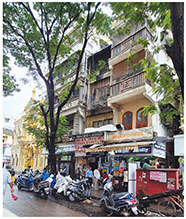
Perin Nariman Street where stood a well
Photo: Jasmine D. Driver
Nanabhoy Lane at Fort
Photo: Jasmine D. Driver
Another well in Ghoga Street was believed to be the dwelling place of a Mahomedan saint, Murgha Bawa. "Murgha” is believed to be a corruption of Yusuf Murgay, who owned houses in the street which was also known after his name as Murgha Sheri. An esteemed friend, who used to reside in the house containing this well, tells me that the well was held in great reverence by the Parsi families residing in the locality. Various offerings were made, the principal of which was a black murgha or fowl, the common victim of such sacrifices. It was believed that in the still hours of the night the saint used to come out of the well and move about in the house. His steps were heard distinctly on the staircase and his presence was announced by the creaking sound that was heard round about. But my friend, who used to burn the midnight oil in that house during his college days and who has since been wedded to science, is inclined to think that the footsteps were those of the rats infesting the house and that the creaking sound was made by the wooden book cases!
A Parsi lady who lived in the same house says that people from various parts of the town used to take offerings to the spirit of the well, amongst which were big thalis (trays) of sweetmeats. Children were asked not to touch these, but one young lady freely helped herself to those sweets. Another friend who took similar liberties with the offerings was Jamsetji Nadirshaw. He used to live in Mapla’s house in old Modi Khana. The well of this house was adored by people and young Jamsetji pilfered a lot of sweets offered to the gods. Sir Dinsha Edulji Wacha, who lived in the house during his childhood, informs me that his mother and grandmother used to tell him many a thrilling story of the queer ways in which the guardian spirit of the well would divert them.
A friend living in Karwar Street (Modi Khana) says that the well of his house is sacred to a Mahomedan pir and that to this day vows are offered to the saint and his blessings sought whenever the tenants are in difficulty. On full moon day the well is decorated with flowers and the saint is implored to cure cases of illness which defy the doctor’s skill. Needless to say, these offerings and prayers are speedily followed by the recovery of the patients.
Another well in Parsi Bazar Street is also believed to harbor a beneficent pir. Only four years ago, a friend was informed that when doctors despaired of curing a patient, a Parsi carpenter suggested that the well spirit should be implored to save the patient. He brought certain people versed in the art of propitiating spirits and asked them to try their skill. They gratified the well spirit by placing grain and other offerings on the surface of the water and by remaining in the water for days together, muttering incantations. The patient was thoroughly cured and, no wonder, he attributes the cure to the grace of the water saint.