Rani Bagh: Mumbai’s Heritage Botanical Garden — 150 years. Veermata Jijabai Bhosale Udyan & Zoo edited by Hutokshi Rustomfram and Shubhada Nikharge. Published in 2012 by the Bombay Natural History Society, Hornbill House, Dr Salim Ali Chowk, Shaheed Bhagat Singh Road, Bombay 400001; email: info@bnhs.org; website: www.bnhs.org; National Society of the 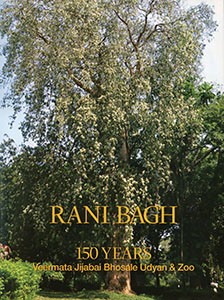 Friends of the Trees, Union Cooperative Insurance Building, 3rd floor, 23, Sir P. M. Road, Fort, Bombay 400001; email: friends@friends of treesindia.org; website: www.friends of treesindia.org; Save Rani Bagh Botanical Garden Foundation, Mazda House, Behind C. I. D. Office, L. B. S. Marg, Ghatkopar (W), Bombay 400086; email; info@saveranibagh.org; website: www.saveranibagh.org; co-published by Oxford University Press, YMCA Library Building, Jai Singh Road, New Delhi 110001; website: www.oup.com. Pp: 158. Price Rs: 1,800 (hardcover).
Formerly known as Victoria Gardens and Zoo, now renamed Jijabai Udyan and referred to popularly as Rani Bagh, Bombay’s zoo is located at the Mount Estate at Byculla. It was opened to the public in 1862 and since then has become a must visit attraction, especially for the young and also students of botany because of its rich collection of Asian and African flora. Several imposing monuments were introduced to augment the grandeur of the botanical garden spread over 53 acres. In 1890 a small zoo was added to the gardens. This volume celebrates 150 years of existence of the botanical garden — home to an astonishing 853 plant species that provide a thriving habitat for a variety of birds, insects and small mammals.
The chapters in this volume, written by well-known environmentalists and conservationists — Bittu Sahgal, Dr Mariam Dossal, Vikas Dilawari, Marselin Almeida and Prof Katie Bagli — present various facets of Rani Bagh. The garden’s early history, planning and design, which are of continuing relevance, are related here in interesting detail along with tributes to its enduring legacy that has enriched the lives of people in the city over a century and a half. A substantial chapter provides a tantalizing taste of the botanical wealth to be experienced there, while another features the fascinating denizens of this rich habitat. With close to 221 illustrations, the book ends with an account of the recent struggle to preserve the garden’s unique heritage — natural and built — for future generations.
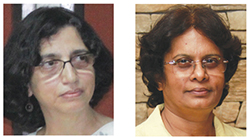
Hutokshi Rustomfram (left) and Shubhada Nikharge
Gateway to an aboreal Eden Photo courtesy: Shubhada Nikharge
The book opens with several messages from prominent citizens including the governor and the chief minister of the state of Maharashtra. Naturalists and conservationists have also contributed their thoughts. A Foreword by the former governor and municipal commissioner completes the first few pages of this important and informative book.
An aerial photograph of the 48 acres of the gardens clearly shows that Rani Bagh is under threat from high-rise buildings and urbanization fueled by the extremely high prices of land and real estate in Bombay.
I was totally impressed with the chapter on "Nature’s Treasure, Mumbai’s Heritage — The Botanical Garden’s Early Years” by Dossal. The photo of the entrance arch with two baobab trees standing guard on either side before it throw light on the historical past not only of the gardens but also of Bombay (as it was called then) itself. The baobab trees are found in some quarters of the old city wherever African slaves (called Siddis) had landed bringing the baobab seedlings with them as a reminder of their homeland. This chapter is full of extremely good photos of botanical specimens and also documents the efforts of some Englishmen such as Drs George Birdwood and George Buist who championed the cause of the botanical gardens in the heart of the city. Governor of Bombay Sir Henry Bartle Frere also played his part together with Lady Frere to set up the gardens. The city of Bombay is in dire need of open space for its populace to breathe and yet land sharks and developers have their eye on this verdant piece of land worth billions. If not stopped by the citizens of the city, spearheaded by the Save Rani Bagh Botanical Garden Foundation, even this piece of heritage land could be swallowed up.
For quite some time the condition of the zoo, much in contrast to the botanical gardens, has been in a sad state. Elephants in an enclosure much too small for their size lolling from side to side, tigers and lions pacing up and down endlessly and the hippopotamus standing silently with its mouth open for small pieces of food. But I digress. This is about the botanical gardens. No course in botany at the Bombay University colleges is complete without a day long trip to Rani Bagh as well as the trail to the Tungareshwar National Park and Temple in Thane district.
By 1863 the old town had spread over the lands reclaimed through constructions of causeways and it is from this date we can see the rise of the modern city of Bombay. In 1864 a fountain was to be erected in honor of Frere at the Victoria Gardens by the Agri-Horticultural Society of Western India. It was built at a total cost of Rs 47,000, Rs 20,000 of which came from the purse of Cursetjee Fardoonjee Parekh.
Somehow the plans were changed, nobody knows why, at the last moment and the fountain, named after the Greek goddess Flora, was placed in the center of the city on what used to be known as Hornby Road at exactly the same spot where the Church Gate of the original British fort once stood. Curiously, no plaque was placed on the fountain to commemorate the name of the governor in whose memory it was supposed to have been erected although the name of the Parsi donor is mentioned. This loss to Rani Bagh was to be mitigated with the arrival of the statue of Queen Victoria, which once stood where the Tata Communications building stands opposite the Bombay Gymkhana. Then the "Kala Ghoda” statue of King Edward VII astride his steed was added to the Rani Bagh collection.
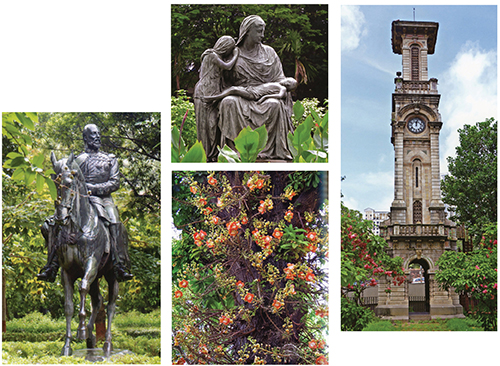
Clockwise from top center: Sculpture of Mother with Two Children installed in the roundabout;
the 67-foot-high Italianate Sassoon clock tower; flowers of the Cannon Ball Tree (Photos courtesy: Shubhada Nikharge);
the Kala Ghoda statue has been in Rani Bagh since the 1960s (Photo courtesy: Dhiman Chatterjee)
But the book stands out for the excellent professional photos of the rich diversity of plant life and the detailed information on the same. Some of the photographs for which alone the book is recommended to fans and supporters are those of the interior of the Dr Bhau Daji Lad Museum, renovated with financial support from foundations created by industrial houses such as Bajaj and Godrej. I still have childhood recollections of the de-activated World War II ocean contact mines that were placed at the entrance to the Museum and the one piece granite elephant (brought from Elephanta Island) that stood in mute silence gazing at one and all who passed. The photos of the Triumphal Arch, constructed with financial support provided by Sir Rustomjee Jamshedji Jeejeebhoy show great detail which visitors may otherwise miss altogether.
The Chapter "Rani Bagh’s Incredible Botanical Wealth” and its lovely photographs are testimony to the tireless malis (gardeners) of the place. Working with devotion despite lack of implements and modest pay, these keepers of the trees and plants deserve recognition. The photo of Hawaiian skirt flowers of the cannon ball tree, on page 76 is my favorite. Several exotic trees that are native to other lands find pride of place at Rani Bagh. Their history and introduction often tell a good story. Birds and insects that thrive on these trees are also seen in beautiful photographs. The book concludes with an account of the recent struggle to preserve the gardens’ unique natural plant life and heritage buildings from the greed of developers. It warms the heart of this reviewer to see a photo of the students of the Sir J. J. College of Architecture take a candle-lit pledge to preserve the botanical garden. There is hope for Rani Bagh yet. This book forms an excellent companion to the volume Sen’trees of Mumbai edited by Sharad Chaphekar, Chandrakant Lattoo and Mugdha Karnik. I would recommend Rani Bagh — 150 Years to all lovers of the city of Bombay, tree and greenery aficionados, and students of botany. It maintains a permanent record of one of the city’s greatest landmarks.
ARDESHIR B. DAMANIA