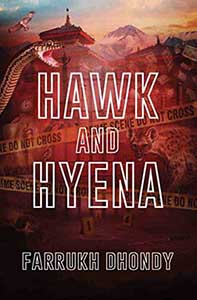
Hawk and Hyena by Farrukh Dhondy. Published in 2021 by Copper Coin Publishing Pvt Ltd, L5/903 Gulmohur Garden, Raj Nagar Extension, Ghaziabad, 201017; e-mail: cuprumcoin@gmail.com. Pp: 143. Price: Rs 399.
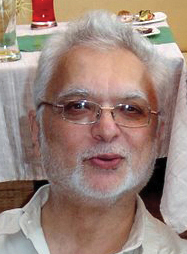
What makes Charles Sobhraj fascinating to so many writers and filmmakers? In addition to three books, a novel and a television series titled The Serpent, a co-production of BBC One and Netflix, in Hawk and Hyena Farrukh Dhondy (pictured) has written a lucid and extremely readable as well as personal account of Sobhraj whom he has known personally and whose movements he has tracked across the world.
Dhondy wonders at the source of Sobhraj’s magnetism that compelled so many women to be attracted to and seduced by him. Chantal, his girlfriend and later his wife, whom he abandoned in a prison in Kabul, gives up a comfortable life in the USA to return to him 20 years later. Sobhraj was not particularly handsome, rich, intelligent or creative, and had "no cultural or artistic allure.” It could not be the power over life and death he exercised, as the murders were cowardly and repulsive. Dhondy felt he was a common, ordinary person you would come across, to whom you would not even deign to give a second glance. However, he does admit that "there was something in his gaze which was vaguely compelling…a look in his eyes that would draw your attention.”
Sobhraj contacted Dhondy in 1997 when he was a commissioning editor for British Broadcasting Corporation’s Channel 4. Sobhraj had learnt about him through his cousin Ram Advani who had been a fellow student and a cub reporter with Dhondy in Poona. Sobhraj, on Advani’s advice, had come to London to consult Dhondy on the book he had written — a "truthful” memoir of his years spent in jail. Dhondy agreed to introduce him to his agent Giles Gordon, who read the book and found it was badly written, a "banal account” in which Sobhraj depicts himself with pride for having manipulated the entire Indian media and speaks of "being respected as a top criminal.” But he says nothing about the crimes he has committed.
On account of his murders in Thailand, under Thai law Sobhraj would have to face a firing squad if he ever went back to that country. Much has been spoken about his escape by drugging the staff at Tihar Jail and his subsequent arrest in a restaurant in Goa. But Dhondy describes how both were staged. As his prison term in India was coming to an end, he wanted to be re-arrested and have his sentence extended thereby remaining in the country and avoiding being extradited to Thailand. It was imperative that he remain an Indian prisoner for, under Thai law, after 20 years the statute of limitation would come into effect and Sobhraj could no longer be prosecuted.
Dhondy narrates several incidents to throw light on the workings of Sobhraj’s mind. In Tihar Jail, he offers protection to Masood Azar, a Pakistani terrorist who is being savagely treated by other prisoners. However, he has no qualms about betraying Azar to serve his own purposes. Sobhraj notices Azar’s unease on learning about a successful raid on terrorists in Kashmir and offers him his personal cellphone to make calls to his friends and relatives to ascertain if they were safe. Later that night, he self-inflicted a wound and demanded to be taken to hospital from where he insisted on speaking to the Prime Minister Rajiv Gandhi on a "matter of national security.” He narrated his story to officers from the Research and Analysis Wing (RAW) who were sent to meet him and offered to give them the numbers with which Azar had communicated in exchange for a promise that he would not be extradited to Thailand.
Dhondy narrates several instances where, over the years, Sobhraj came to either ask him for assistance with some crazy scheme or to inform him about it. At Sobhraj’s request, Dhondy introduced him to someone from the Central Intelligence Agency who told him confidentially that although he could be ideal material for a TV show he was a "bad connection” and was playing a "deep and dark game.” Sobhraj was willing to act as an intermediary in the hijack of the Indian Airlines flight to Kandahar (through his contact with Azar) and wanted Dhondy’s help to put him in contact with union minister Jaswant Singh.
He wanted Dhondy to be a front and acquire property in London, ostensibly to open an antique shop but in reality to sell armaments illegally; armaments which he was sourcing from former Soviet country dumps. Sobhraj wanted some information about the "red mercury” which could be used as a nuclear trigger, so Dhondy arranged a meeting for him with former British Prime Minister Boris Johnson. Dhondy later learnt that Sobhraj was in a shady deal between former Soviet countries and some middle eastern nations. Another of Sobhraj’s mad schemes was to smuggle drugs and purchase arms and ammunition in exchange. When imprisoned in Kathmandu, Sobhraj requested Dhondy to find an Indian company which makes hot air balloons as he felt crossing the Indian border from Nepal would be easy.
Dhondy shows Sobhraj’s dishonesty in financial matters, especially his love for gambling. Sobhraj once called him at midnight asking for his help to rescue him from the Victoria Casino; he had lost all his money and did not even have enough to retrieve his car from the parking lot. He borrowed 600 francs to ostensibly return to Paris, a sum which was, of course, never returned. Sobhraj even sold a piece of property, which Chantal had inherited, for £ 40,000 and gambled it all away.
Dhondy is surprised to note Sobhraj’s genuine sympathy for the soldiers who were treated like cannon fodder and lost their lives in World War I. Without "irony” Sobhraj commiserates with victims of "some accident, an earthquake, a terrorist attack in Jerusalem…and pronounces it terrible.” However, he seems to show no sympathy for the large number of innocent people he had robbed and murdered.
The epigraph consists of lines from two poems. Dhondy asks the question whether Sobhraj was a hawk: "I kill where I please because it is all mine” (Ted Hughes) or a hyena: "…waiting /for the foot to slide … for the leaping sinews to go slack” (Edwin Morgan). He leaves it for the reader to decide.
Gandavia holds a doctorate in English literature and is a retired chartered accountant. He is a compulsive reader of fiction.