The arias sung by soprano Ariana Vafadari revived memories of the gruesome murder of her father, Prof Kasra Vafadari two decades earlier
Davood Rahni
Inspired by the uplifting TED talk on "Tehran Women,” which was accompanied by the sublime operatic solo performance of soprano Ariana Vafadari, I remained in awe seated in my nook on a gloomy, frigid autumnal day amid the Covid-19 pandemic. As I gazed at the dusk silhouette of the clouds high above in the sky of the lower Hudson Valley of New York, I found myself in a twilight zone at the crossroad between space and time.
In the hope of snapping out of my somber melancholy and the accompanying heart-wrenching emotions, I once again listened to Ariana’s divine songs. While her Gathas, inspired by the ancient Zoroastrian poetic hymns of Iran in the Avestan language performed in D-Minor was immensely sad, her Anahita, named after the goddess of water, mother earth and fertility was jubilant, leading the listener’s soul to a transcendence to the ultimate source of inner consciousness. As I woke up from my trance-like state induced by Ariana, after nearly 20 years of having remained timidly silent about when it all began, I found in myself the impetus to eventually share what had happened in France on that fateful day.
.jpg)
Her video is the latest in a series of Ariana’s artistic expressions that I have watched with mixed melancholia and euphoria since her father Prof Kasra Vafadari, a leading professor of social studies, history, Iranian and contemporary western studies and law was beheaded most horrifically in Paris in 2005. Whether or not her father’s slaying was, as surmised, due to a family feud or instigated by a third party assassin, or by both, is irrelevant to this piece. Humanity should, while remaining sympathetically compassionate to them, learn much from Vafadari’s two daughters, Ariana and Afsaneh who, despite despair stood up again, and are navigating the rough terrain of life.
Five years after the heinous crime, in 2010 a French court convicted an Iranian national of the despicable killing of Kasra. He was jailed for life, with no parole or clemency, France having banned the death penalty.
Kasra was an outspoken civil activist scholar defending human rights, due process and the rule of law, especially when it concerned the indigenous people of his native country and the Zoroastrian community to which he belonged. A forthright human being, his professorial, pontificating style of oratory frequently crossed the line of social decorum. When frustrated, he used vulgarity and disparaging or pejorative remarks to put his point across, a trait that eventually cost him his life. The Persian proverb "Never mind his barracuda face; instead, see his Persian cat heart deep down,” fittingly describes the expression of his emotions.
For Ariana, as the child of a Persian father with a secular Persian/Zoroastrian culture and her dominant French mother Laurence’s ethos, to have her bourgeois comfort zone interrupted by her father’s grotesque death, and yet achieve such a deep level of Persian Zoroastrian consciousness, is remarkable.
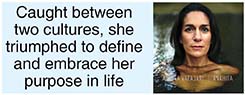
She fled Iran along with her family at the age of five. Caught between the two cultures, she triumphed to define and embrace her purpose in life, moving far beyond the myriad ordeals and injustices. The loss of her father led to an epiphany. Drawing from her Persian Zoroastrian ethos and her innate and acquired artistic talents, she composes divinely sublime and humanistic operatic music.
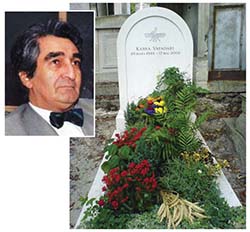
Top: Ariana Vafadari; inset: Prof Kasra Vafadari and his final resting place (above)
Ariana’s outreach to the very essence of human consciousness vividly conjured up memories of my journey home to Iran back in early 2000s. A dozen of us expatriate Iranian professors and physicians from across the globe were serendipitously fortunate to get to know Kasra with whose scholarship and legacy we were rudimentarily familiar. We literally lived together for that week, giving lectures in several universities in Shiraz, Esfahan and Tehran while visiting archeological monuments in Iran and also attending music concerts. Kasra had resided mostly outside Iran since the age of 10, with the last 25 years in Paris, the bastion of "humanity, liberty, fraternity and solidarity.” As a result, the expression of his state of mind and actions came across to many as "flamboyantly eccentric.” Though well intentioned, his righteous candor while speaking to large audiences quickly threw people, especially the authorities, peers and students in Iran out of their comfort zones. Consequently, his orations came across as too radical.
This notwithstanding, Kasra was well-read, well-groomed, well-dressed and bow tied. He was a prolifically published scholar having studied half a dozen languages of classical and contemporary literature and culture on the three Nordic countries. Although forward-looking, he lamented with melancholic nostalgia, the loss of the past glories of ancient Persia, as perhaps most Iranians innately do. The Zoroastrian heritage in Iran has dwindled, though a respectable degree persists since the last 3,000 years, not only in the over 100,000 Zoroastrians worldwide, but also among the nearly 84 million Iranians. Kasra’s heritage from the isolated Zarathushti community complemented his scholarship on pre-Islamic through modern Iran, and instilled in him a calling to pursue and promote Persian culture and heritage. After all, the Persian ethos was embedded in him as in others (one could wish the same for all humanity) and had ethically influenced him to refrain from futilely cursing the darkness and instead choosing to shine the torch of enlightenment and truth to counter it.
The Vafadaris had for the most part raised and nurtured their children in a universal, humanistic and Persian culture and ethos, anchored in Zoroastrian spiritualism. Their lifestyle resonated well with French humanistic liberalism. A number of siblings, uncles, aunts and cousins, scattered over three continents in the northern hemisphere, have survived Kasra. The trials and tribulations endured by Ariana’s Zoroastrian family remain inexorably unbearable; nonetheless, one should realize that their ordeals are similar to the fate suffered by five to six million Iranian expatriates in the past few decades.
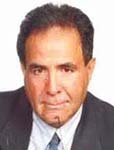
Davood Rahni, professor of chemistry at Pace University, New York, is passionate about reading, learning, sharing and writing across many genres of literature and history, the arts and cultures, archeology and languages. He has been extensively published in the sciences, environment, forensics and medicine.