Legendary banker and columnist, the late Savak Tarapore
always championed the cause of the common person
Lekha Rattanani
His image seemed tailored for his profession: serious, resolute, thoughtful. His persona radiated the stickler that he was. But to those who knew him, there was another side: a genial banker with a well-grounded point of view, offered with a laugh or a fund of quirky, humorous tales. Everyone knew and understood that he was one of a kind, rather special, with an old-world charm that makes life itself so meaningful and special for everyone around such a person. Here’s a small tale: He retired as deputy governor of the Reserve Bank of India (RBI) on October 10, 1996. He came out of that modern day headquarters building opposite Bombay’s Horniman Circle, hailed a taxi and went home. The official car was not to be used that evening because he had retired earlier in the day and the car was no longer his to use; it was duly and immediately returned.
Savak Sohrab Tarapore was one of India’s most outstanding career central bankers. He joined the RBI in 1961, and rose to become the deputy governor, a position he held from 1992 to 1996. He sat in high office, served on many committees and panels with distinction and made his mark the old fashioned way — quietly, almost unnoticeably, behind closed doors and in private meetings where he stood tall as a champion for the ordinary citizen. The higher he rose, the lower he looked and the more fiercely he fought for the cause of the common man, two words which he wrote with a capital ‘C’ and a capital ‘M.’ (see "A banker one can bank on,” Parsiana, September 21, 2014).
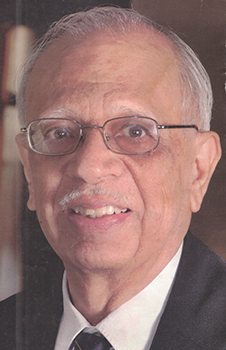
Savak Tarapore: at the Reserve Bank of India,
the higher he rose, the lower he looked
It is a tribute to the depth of his knowledge, his well-articulated point of view for the common man and the expansiveness of his heart that four years after he passed away, Tarapore’s words and writings continue to shine through and offer light and wisdom even today.
Former RBI governor Dr Y. V. Reddy said it well in his tribute when Tarapore passed away in 2016: "I have lost one of my best friends, philosopher and guru.” (See "Legendary banker,” In Memoriam, Parsiana, March 7, 2016).
Consider some of what Tarapore wrote, words that have become legendary and stand out to be quoted again and again.
Writing as the chairman of the Committee on Procedures and Performance Audit on Public Services, Tarapore noted: "The banks’ offerings are generally opaque —what is not charged is mentioned, but what is charged is not mentioned — high hidden costs appear rampant and unjustified, thus banks enjoy undue enrichment. If a small customer goes to a bank and has a technical problem, anecdotal evidence suggests that he runs into enormous difficulties. The Committee notes with some sadness that there is substance in the widespread impression among the small depositor community that one needs to know someone higher up for getting his/her job done. Intense depositor loyalty is the only plank on which the Indian banking systems is surviving. The banks providing poor customer service have to understand that depositors are at the end of their tether.”
Who speaks in this clear and succinct voice today?
To get this insight, Tarapore had visited bank branches wearing, yes, a torn shirt, to mimic the poor who are often shunned at bank counters. He was treated as shabbily at the counter as the poor are treated by the banks. He told this writer that the so-called bankers warned him: "Don’t be seen here again.” He was literally thrown out. This is the story of one banker or one branch treating one poor person, or one in the garb of a poor person in this case. But it is also the story of the glitz and glamor of India — the shining India — treating the India that is of grime, dust, and dirt, very differently. The class divisions that in some ways define us, break us, and pull us apart have made our growth story as unmanageable as some fear it has become.
Tarapore often spoke clearly and loudly on the need to beat and fight inflation which is a burden on the weakest and the poorest. In a column dated November 13, 2014, he wrote, "The history of India’s inflation is replete with instances of taking the foot off the brakes just as the RBI is about to slay the ‘inflation monster,’ thus giving it a breather to claw at the entrails of the economy.” For Tarapore, it was a case of war against an enemy called inflation. As he went on to say in the same column: "I will never tire of repeating ad nauseam the telling statement made by economist P. R. Brahmananda, a former president of the Indian Economic Association: ‘Not caring about inflation is like going into battle without caring about the wounded, the dying and the dead.’”
What is the significance of this legacy in our current troubled times?
What lessons does Tarapore hold for a new generation that must deal with even more complex issues of banking at a time India is at one level said to be poised for growth but at another has an underbelly that is as much if not more prone to exploitation over the last several decades?
And more importantly, what are the leadership lessons we might learn from the life of Tarapore?
For one, Tarapore lived a life of high achievement, fulfilment and contentment. He was fired by a purpose, he was anchored in humility, he always served the institution he worked for well and never failed to live up to first principles that he worked with. With such a high life, even the designation mattered little. For his hundreds of columns, he signed off with the end-line that described him, quite simply, as an economist, not a former deputy governor of the RBI.
At the Reserve Bank, and in circles beyond it, he is remembered for his dogged honesty and integrity. In a tribute to Tarapore after he passed away in 2016, retired central banker K. Kanagasabapathy writing in the Economic and Political Weekly recalled "I was told Tarapore was a strict disciplinarian. Later, I realized that he was ruthless in applying discipline to himself. According to this legendary piece of information within the RBI and also outside it: Nobody dared to offer him even a pen as a gift.”
Evidently, this extended to his home where Farida Tarapore recalled that her husband didn’t appreciate anyone using anything that emerged from and "belonged” to the Reserve Bank, "even a pencil!” Amid many amusing tales in the warmth of the Tarapore drawing room emerged the concept of building a syndicate of columns that would give voice to the ordinary person, to positions and perspectives less seen or heard in the media. It started from the idea of his own syndicated column and grew to the non-profit media organization that we now run from Bombay. The Foundation of The Billion Press was launched with the Union Budget of 2016, but sadly Tarapore who had supported it had passed away days earlier. (The author of this piece is the managing editor of The Billion Press.)
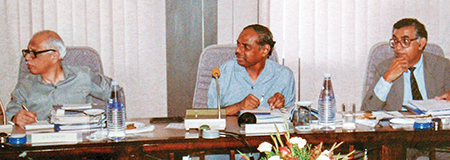
At the Central Board of Directors meeting in 1994 (from far l): Tarapore,
then RBI governor Dr C. Rangarajan, Yezdi Malegam
Till the end, he was a simple person with high moral values, clear conviction and unquestionable integrity. His position in monetary policy formulation will always be remembered. He remained steadfast against increasing government deficits and the RBI accommodation of them. He held price stability supreme as inflation hurts the poor the most. His thinking influenced many governors. Though he didn’t make it to the post of governor himself Tarapore didn’t mind, pointing out that when things went wrong, it was the RBI governor who took the fall!
His distinguished career at the Reserve Bank included a stint at the International Monetary Fund in the late 1970s and culminated in his appointment as RBI deputy governor in 1992. He headed or was at the controls during some of India’s most turbulent times. Among them, the emergency air-lift of gold as collateral, the steep devaluation of the rupee, interest rate deregulation, moving to market-determined rates for government borrowing, the Harshad Mehta scam and thereafter. They are all battles he led in some part. His sterling but solid and muted innings, as deputy to the captains of RBI, has been called a "Gundappa Vishwanath” (former Test cricketer known for his steady batting) role by RBI’s historian T. C. A. Srinivasa Raghavan. Not without reason!
To collate and recant Tarapore’s contribution to India, to Indian banking and monetary policy would require several tomes. Over the past two decades he duelled unceasingly for higher deposit rates, transparency on bank charges and for better services from banks. That was his unyielding war on behalf of the common man.
A rare person and an even rarer banker, India has never seen a central banker like him. And probably, may never see another Tarapore.