Even the day prior to his demise on March 20, 2025, he continued to retain an interest in the workings of Parsiana. Unable by then to type a message on the Editorial WhatsApp group, Farrokh Jijina had sent a voice message. His speech too was occasionally slurred in the last days when failing kidneys, advancing cancer and heavy medication was taking a toll on our 65-year-old senior editor. By then, we had reconciled ourselves to the fact that he would never be able to contribute his extensively researched articles although we continued to be optimistic that perhaps he may be able to review books, five of which remained on his list of priorities.
Farrokh Jijina: passionate and positive
Farrokh’s first article in Parsiana appeared in our March 7, 2015 Navroz issue. It was on the Zorabians and their broiler business. From the following issue his name featured on our masthead as contributing editor. Thereafter the Business and Food sections of the magazine continued to remain in his domain. As his engagement with the community, its culture and history increased, so did his responsibilities at Parsiana and by 2017 he was a senior editor.
His last cover story was on the Sir J. J. Garden in Udvada for our November 21-December 6, 2024 issue. Despite his frequent hospital stays he was determined to help out with the presentation of the photo feature for our 60th anniversary issue (December 7-20, 2024). His final contribution to the magazine was on the dance-drama series Waack Girls for our December 21, 2024-January 6, 2025 issue.
Jijina was always willing to accept new assignments and submit his articles at a pace that made us wonder whether he had any other commitments! If required to rework a piece though, disappointment was clearly writ on his face. His ability to read and understand Gujarati, better than any of the others on the editorial team, was a great asset for a community publication. From him we learnt of the Gujarati treasure trove Vividh Vani (assorted dishes), a two-part cookbook with 2,180 recipes compiled by Meherbai Wadia who succumbed to plague in 1897 (see "Vintage viands,” Parsiana, August 7, 2016). Thanks to his enthusiasm, knowledge of computers and familiarity with social media, we were able to expand our visibility on these platforms. Conscientious and astute, he expressed his views candidly and did not take kindly to shirkers or bombasters.
The editor of Parsiana, Jehangir Patel recalled his first interaction with Jijina at a dinner organized by The K. R. Cama Oriental Institute (KRCOI): "We were seated at the same table and while conversing he said he had been writing articles for a blog/website named Anonymous Writers. We asked if he would like to write for Parsiana and he readily agreed. Chartered accountants with a penchant for literature are not unusual. Professional, journalistic writing takes time to master but Farrokh persevered, writing and rewriting articles as required. When he took a particular interest in a subject or individual, he would put in considerable efforts to ferret out more details and background information. Though he had come to journalism late in life and for a pittance of what he earned at Deloitte, his qualities of head and heart made him an ideal candidate for the profession. He had imbibed a work ethic from his parents and kept his material requirements to the essential.
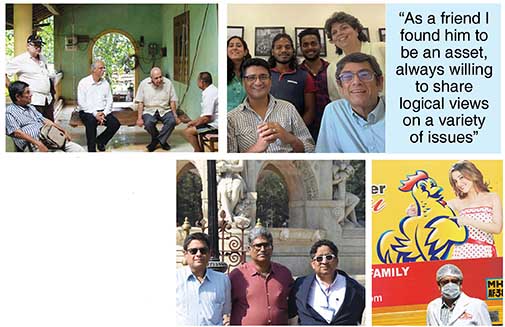
Clockwise from above l, seated: Jijina, Sarosh Daruwalla,
Dinshaw Tamboly reaching out to Zoroastrians in rural Gujarat;
Bharat Gothoskar and Jijina with Khaki Tours teammates;
Jijina on Parsiana assignment at Zorabians;
Dr Mustansir Dalvi, Vikas Dilawari and Jijina
"He attended office regularly till his kidneys began to fail and he had to undergo dialysis. After each session that lasted a few hours he was too fatigued to cover events. But one looked forward to his calls most mornings where he shared the community news he had picked up from his contacts the previous day. He was compassionate, caring and dedicated to helping those he believed were working to achieve their professional and personal goals as well as those who were disadvantaged or faced discrimination.”
Appreciated fellow senior editor Sherene Vakil, "Though Farrokh’s professional training and experience came from an entirely different field, he rapidly learnt the ropes and became proficient as a reporter and writer. His forte was networking; creating and maintaining cordial interpersonal relations with people from all walks of life both within the community as well as others. He could pick up the phone and call anyone for information or an opinion without hesitation, an ability I envied. He had once mentioned that he had studied law, and preferred to work in the legal department at Deloitte rather than do auditing. He had many and varied interests which included travel, art, culture, history, food, counseling and teaching. Knowledgeable about Zoroastrianism, he kept in touch with several priests from senior scholars and panthakis to young initiates.”
When conducting interviews for Parsiana, the rapport he would strike with his subjects resulted in their forming lasting friendships. Commented Dinshaw Tamboly, chair of the WZO (World Zoroastrian Organisation) Trust Fund, "It was my very good fortune to get to know Farrokh ever since he joined Parsiana. As a friend I found him to be an asset, always willing to share logical views on a variety of issues. I may have lost a friend in physical form but do know that true friends are always together in spirit which is how dear Farrokh will always remain.”
Jijina was regarded as "a pillar of strength for the Parsi Girls’ School Association (PGSA) management team” which manages Bengallee and Gamadia Girls’ Schools. Stated PGSA president Kersi Commissariat, "Farrokh would study any issue in depth before giving his opinion. Very polite and understanding, despite his health problems he would not shun his responsibilities.” Commissariat was further impressed by Jijina’s interview of his 98-year-old mother-in-law Jer Sarkari when he "showed remarkable patience!”
Jijina (circled) during his school days at St Xavier’s Photo shared by Chetan Zaveri
To Kersi Treasurywala, trustee of the Garib Zarthostiona Rehethan Fund, "Farrokh, my close friend of over 25 years, was much more than a bean counter. His interests were wide ranging. Reading and social history were just two of the subjects of common interest. He was my go-to person for interpretation of financial statements of institutions with which I was connected. With rapier-like efficiency he was able to break down the numbers and point out areas of fiscal concern.”
Yet another erstwhile colleague Tulsi Vatsal who had first met Jijina in the 1980s when as a fresh chartered accountant he joined CMC (Computer Management Corporation)’s finance department reminisced, "He was much younger than me, (with never-failing politeness, he always called me Mrs. V), but we enjoyed each other’s company. In that IT (information technology) dominated space, he was one of the few people with whom I could talk about books and history. Farrokh moved later to Ingersoll Rand (a leading manufacturer of commercial and industrial air compressors). He was known for his total integrity. ‘He refused to compromise with any financial or governance irregularity. He always called a spade a spade,’ recalls Daljit Mirchandani, a friend of mine, who headed the company at the time.’”
Referring to the sessions conducted by Jijina for the Centre for Advancement of Philanthropy, its chief executive officer Noshir Dadrawala and erstwhile Bombay Parsi Punchayet trustee acknowledged, "He was not only knowledgeable in matters of finance and human resource but also skilled at imparting knowledge in a fun way with wit and humor. He always had a mischievous smile or at other times a mischievous glint in his eye. He used to research deeply and write and speak with even greater passion. His articles in Parsiana were always well researched and he made it a point to always be factually correct.”
Author and translator Aban Mukherji described him as "a most unassuming person who bore his vast knowledge of Parsi culture and language lightly.” With his historical and literary interests he enjoyed covering talks and seminars organized by the KRCOI as he did serving as an ambassador and mentor for Khaki (Keeping Heritage Alive and Kicking in India) Tours.
Founder and chief executive officer of Khaki Tours and Khaki Heritage Foundation Bharat Gothoskar remarked, "Farrokh’s first tryst with Khaki Tours was as a guest on one of our walks. His knowledge of the city impressed us and we asked him to be part of the team. He agreed and started hosting walks for us, especially for kids. Training was something else he enjoyed, given his stint as an English educator under the Teach For India program. He also became a mentor to our Ambassadors of Mumbai, a guiding light to those who trained under him. However his most important contributions were to the Foundation, our NGO (non-government organization) which goes beyond walks and tours to heritage awareness, archiving and conservation. He helped the Foundation navigate the complex maze of compliances, bringing to bear his expertise and experience as a chartered accountant. He was the pillar of strength behind our Online Talks, an initiative he nurtured and nourished till his health gave way. We will dearly miss him.”
All those who knew him remarked on how stoically he bore his ailments without any moans or groans. When confined to the bed, he did not want acquaintances to see him in that vulnerable position. But among those who visited him in the final days was Parzor director Dr Shernaz Cama who in her tribute in the Jam-e-Jamshed of March 30, described him as "a gentle, quiet presence at Parsiana but WhatsApp messages at 6 a.m. to confirm a quotation, a date or an insignificant reference…showed an inborn desire for excellence in his work.” They shared reminiscences of Suvali, "a deserted village (near Surat) with beautiful Parsi bungalows but no people” which Cama had visited on a field trip. Jijina though associated it with his ancestral paternal grandfather’s multi-storied home with a beautiful sea view and green fields.
During the 10 years we worked with him, we knew little about his personal life. We noticed that he bit his nails, and smoked, though never in our presence. There was an implicit, unspoken professional-personal divide. We later learnt from his wife Dr Farah, a hematologist, that he was born in Bombay to Piloo and Bhikhaji Jijina, had studied at St Xavier’s School and graduated in commerce from Sydenham College before qualifying and practicing as a chartered accountant. More than his accountancy profession, he found fulfillment in volunteering his time and expertise with the Samaritans (suicide prevention helpline), Teach for India, Khaki Tours and committees of community organizations.
Acquainted with Farrokh from the time he proceeded on his first heritage walk eight years ago, Honoze Nekoo, an IT professional working at Oracle, recalled, "Over the years, we bonded over several heritage walks, trips out of town, community and cultural events… I have fondest memories of the times spent over meals and my afternoon ‘WFH (work from home)’ at his pleasant home (at Cusrow Baug) which always radiated vibes of positivity, calmness, orderliness and graciousness, much akin to Farrokh’s personality. His conversations were always laced with wit and humor in his inimitable style. Farrokh had an eye for finer details in figures and in language, and would often proclaim himself to be ‘an auditor by training and editor by choice.’ He excelled and left a significant mark in all he did, and all with whom he interacted. Through all his health adversities, he ensured he always stayed positive, remained passionate in his activities, connected with those dear to him, donated generously, and lived life to the fullest possible.”
The ardent researcher and writer is survived by his wife Dr Farah.