The small but strong and vital clan of Zoroastrians in Madras celebrated the centenary of the Jal Phiroj Clubwala Dar-e-Meher with joy and gratitude
Kainaz Amaria
"One thing about Madras is that our atash has been very good for our community,” says Mani Clubwala, trustee and honorary secretary of the Jal Phiroj Clubwala Dar-e-Meher, Madras’ only fire temple. "Every family has prospered here and we feel it’s because of our atash.” "This agiary means a lot to me. I was born in Madras. Almost everything I’ve prayed for has come true, it has hidden powers for me,” claims 27-year-old freelance graphic designer Urzana Irani. The agiary has been a silent witness to her happiest and most difficult moments, "when my dog died, when my dad had cancer, when my grandmother broke her hip, when my husband proposed… It really does mean a lot to me… I will teach my kids that if you want to speak to God, you can do it here.” Precisely for all these reasons the Parsi community in Madras enthusiastically banded together to host its most ambitious celebration to date. When Jal, the young son of the philanthropist Phiroj M. Clubwala died, the grieving family donated a fire temple in his memory. This fire temple in Royapuram was designed by Hormusji Nowroji (a road in his name still exists in Chetpet). The Jal Phiroj Clubwala Dar-e-Meher centenary celebration was a joyful three-day extravaganza complete with inspiring speeches, celebrity performances, numerous felicitations, two jashans and an endearing play with an eco-friendly message starring the local youth.
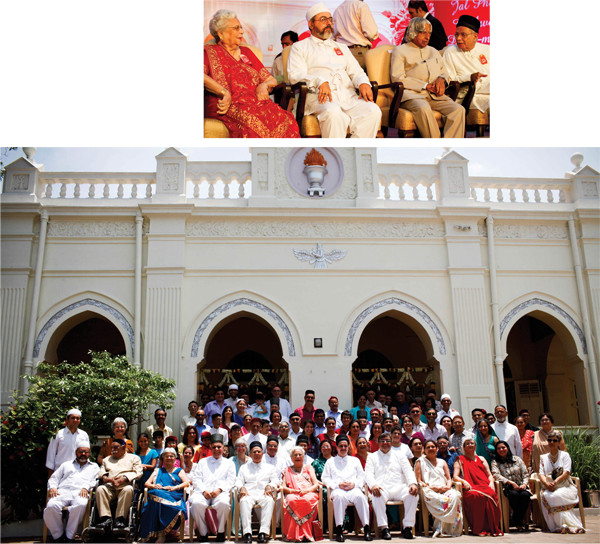
(From left) Mani Clubwala, Ervad Bomanshah Vazifdar, Dr A. P. J. Abdul Kalam and Dadiba Dalal; (below) gathering in front of Clubwala Dar-e-Meher after khushali-nu-jashan
Madras Parsis were in their best dressed well before 10 a.m. on the morning of July 10, 2010. As was the Phiroj Clubwala Memorial Hall with its red carpets, intricate chalk patterns, gold curtains and floral bouquets. The anticipation in the air was palpable and the security was strict for the arrival of chief guest Dr A. P. J. Abdul Kalam, former President of India, who graciously agreed to address the community and kick off the centenary celebrations.
Tehnaz Bahadurji and Kaety Dalal, heading the centenary celebrations hospitality committee, were on the front lines of receiving the former President. They were to perform the aachhu michhu ceremony upon his entrance into the hall. This also meant they were under close watch from inquisitive members of his security staff. Each element on the ses was carefully inspected. After the coconut, egg, flowers, betel leaves, and nuts passed, doubts arose with the kumkum used for Kalam’s tili. Security insisted it would have to be sent to a lab to be tested for poison. Bahadurji assured the guards that there was nothing to worry about, and applied the kumkum on herself as proof. Her quick thinking worked like a charm.
Kalam stepped out of his white Ambassador wearing a simple light-brown Nehru suit and a gracious smile. Press photographers clambered for the picture as Dalal and Bahadurji began the aachhu michhu ceremony. "One, two, three… I will count with you,” Kalam said emphatically with a gleaming smile as Bahadurji circled the egg, coconut and ses around his head.
"He was excited about the breaking of the egg,” said immigration consultant Neville Billimo-ria, who was instrumental in getting Kalam to speak before the Parsi community, "He was very much looking forward to the aachhu michhu.”
After hasty handshakes with the centenary celebrations committee, Billi-moria and Dadi Dalal, president of the Madras Parsi Zarthosti Anjuman and chairman of the Dar-e-Meher, escorted Kalam through the audience and onto the dais. He shared the dais with Zavera Shahuna, president of the Madras Parsi Association, Ervad Bomanshah Vazif-dar, Clubwala and Dalal.
The Madras centenary celebrations started officially with Kalam graciously lighting the divo followed by Vazifdar’s brief invocation. "We are greatly honored with your presence,” said Dadi Dalal to Kalam during his welcome address. "For over a century there was no place for Parsis to worship in Madras,” Dalal continued, noting the first stone laid for the Dar-e-Meher was in 1907, the only fire temple in Tamil Nadu. Dalal honored Kalam with a shawl and notable books on the community and the religion before inviting him to address the eager audience.
(Top) Ervad Bomanshah Vazifdar leads the khushali-nu-jashan; (bottom left) divas being lit in celebration of the centenary; (bottom right) Vahista Vazifdar walks by a painting of Zoroaster after the salgireh-nu-jashan
"I’m in the 79th orbit around the sun,” said Kalam, "and I can say in the last 50 or 60 years I have had abundant Parsi friends, great friends. Parsis are teachers, doctors, educators and entrepreneurs. I have lived and worked with them. It is a great community.” His speech titled, "What can I give?” highlighted the unique traits of the Parsi community specifically "entrepreneurship, courage and service to humanity.”
Kalam praised prominent Parsis in Madras and further afield for their contribution not only to their community but also to the larger Indian society. Phiroj Clubwala for his "philanthropy and establishment of the fire temple.” Mary Clubwala Jadhav for being "an outstanding social worker and devoting her life to the needy.” Cowasjee Dinshaw for "founding the modern port of Aden.” Dr Homi Bhabha for "stabling the Indian Atomic Energy Commission.” Sir Jamsetjee Jejeebhoy for "opening the sea route to China.” Fardunjee Marzban for "founding The Bombay Samachar, the first vernacular newspaper. Jamsetjee Tata for "founding one of the greatest group of companies,” the Tatas. And finally, J. R. D. Tata for "the establishment of India’s first commercial airlines in the form of Air India.”
Kalam’s contemporary knowledge of the community was equally impressive as his historical knowledge. He referred to Chief Justice Sarosh Kapadia as "another great contribution which the community has given the nation,” and quoted Kapadia’s recent address to the Parsi community during his felicitation by the Bombay Parsi Punchayet saying, "the address was beautiful and thought provoking.”
(From left) Lena Irani, Farzana Irani, Roshan Poncha, Kaety Dalal, Dhun Dalal, Mani Clubwala, Freny Byramshaw, Farzana Dastur, Shaheen Irani and Kashmira Daruwala line up after the gara fashion show; (bottom) Dr Abdul Kalam signs autographs and talks to members of the audience
On a personal note, Kalam talked about "a great writer with a heroic heart,” his friend Russi Lala whom he called a "man of great courage and perseverance.” In August of 2009, Kalam attended the launch of Lala’s The Thread of God in My Life, and read a passage from the book expressing how one can navigate through life’s troubles in order to achieve success. The audience applauded in emphatic agreement as Kalam impressed his listeners with his genuine admiration for their community.
After recounting the extraordinary life of Jejeebhoy, whom he called "one of the best known of our most illustrious sons of India — who rose from extreme poverty to fame and glory,” Kalam thoughtfully noted "in spite of Parsi society being an enlightened society, courageous society, there is always a feeling that Parsi society is shrinking in India. It is pertinent to find out the reasons. I visualize that the Parsi society will create more great human beings like Sir Jamsetjee Jejeebhoy, Homi Bhabha, the Tata family and Mary Clubwala Jadhav.”
Kalam concluded his message by reading a self-composed poem titled, Radiating message of giving.
"O my fellow citizens,
In giving, you receive happiness,
In body and soul.
You have knowledge, share it.
If you have resources, share it with the needy.
Use your mind and heart,
To remove the pain of the suffering,
And, cheer the sad hearts.
In giving, you receive happiness.
Almighty will bless all your actions.”
The audience graciously applauded as Kalam, with a gentle smile and unassuming demeanor, left the podium. After a spirited rendition of the national anthem, it was time for the chief guest’s departure.
Eager Parsis raced to shake Kalam’s hand, to get an autograph and snap a quick picture. Roshan Poncha was one of the lucky few able to speak with him for a few brief moments. Her husband, Cyrus Poncha had received the Dronacharya Award in 2005 for coaching India’s squash team; Kalam had presented the award. "He remembered my husband,” said Poncha as her eyes sparkled with glee, "it was an amazing experience to meet Kalam, he was so genuine.” Billimoria reflected on why he felt Kalam was the ideal chief guest, "He has become an inspiration and mentor to me… he is very down to earth and very easy to speak with. It is mainly for our younger generation who can get the aspirations to be big in life.”
Zarin Mistry, honorary secretary of the Madras Parsi Association since 1994, followed Kalam’s message with a slideshow titled, "Zoroastrians of Madras.” Mistry has been the community’s historian for the past three years and has personally sat with every family in the community listening to their stories. "We have had so many outstanding people whose lives we have not chronicled,” said Mistry, who one day hopes to compile her research in a book.
The centenary celebrations committee began planning the fete six months in advance. It was the community’s most ambitious project to date. Event manager Mithran Deva-nesen, a theater and lighting director of MTC productions, brought professional polish to the event. During his felicitation, he was termed "an honorary Parsi” by Dalal. Devanesen remembers working side by side with Clubwala in the early days putting on plays to raise money for the Parsis to build the hall. "For me, I am proud of being a Chennaite and Madrasi, to be a part of the centenary is the most important thing. It is a once in a lifetime event.” (Devanesen, suffering from lung cancer passed away a few days later. Referring to their 33-year-old friendship, Clubwala commended, "He has touched so many lives and spread happiness all around him.”)
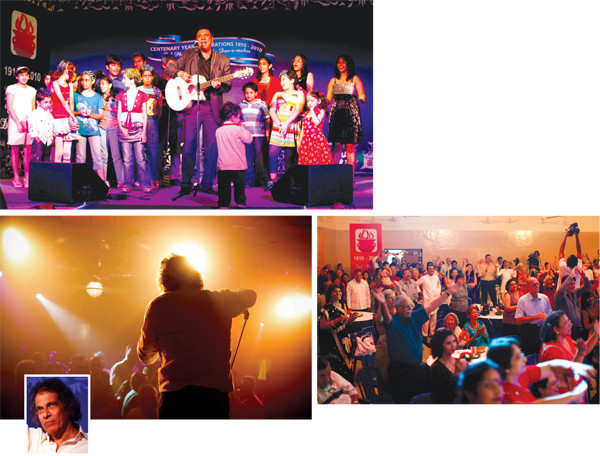
Boman Irani (above) and Gary Lawyer (bottom left) entertain and engage the enthusiastic Madras audience; (right) during the centenary celebrations. Irani asked the community’s youth to join him on stage for a rendition of Give me some sunshine from the film 3 Idiots
Nishad Ahuja, seven, sat on the edge of the stage mesmerized by Gary Lawyer. "He refused dinner,” said Dalal of his grandson, "and asked me if he (Lawyer) can come sing for his birthday.” Lawyer opened his performance with The Lady is a Tramp and had the crowd singing and dancing throughout the evening. Just as he was about to step off the stage, the crooner raised his glass and toasted the Madras community, congratulating them on their centenary and adding, "Just so you know, my name is Rohinton.” The crowd roared and cheered.
The festivities continued on the last evening when the entertainment included a heartfelt play, a gara fashion show and actor Boman Irani who had the crowd rolling with laughter as he joked and sang his way into the hearts of the Madras Parsis. "What do we Parsis do well?” he asked the audience. "We eat!” "We enjoy life” "Charity” voices in the crowd hollered out simultaneously. "And what don’t we do well?” asked Irani. The audience fell silent until a sharp-witted lady in the back yelled, "Make babies!” From then on the gut-busting laughter didn’t stop.
(Above left) Vahista and Niloofer Vazifdar (3rd and 4th from left) serve malido and fruit after the khushali-nu-jashan; (right) snacking and chatting; (bottom) Feroze K. Tarapore, 94, felicitated as the oldest Parsi male in Madras "with the spirit of a 24-year-old.” Tarapore raised funds from Godrej and Boyce for the celebrations
Irani was a gracious performer recounting his time as a budding photographer in his early thirties. He came to Madras as an apprentice and stayed at the Parsi dharamshala. "You people are part of my journey and being here is part of a full circle.”
It was an unforgettable three-day celebration to honor the Jal Phiroj Clubwala Dar-e-Meher, indeed a milestone for the Madras Parsi community. However, beyond the extravagance of the entertainment, food and festivities the true character of the community shone brightly in every smile, hug and words of encouragement. As the revelers left the hall on the final evening, there was one stop they had to make, and that was to say thank you to Clubwala.
I sat with Clubwala at the end of the night, enjoying the sweetness of a dessert she had specifically asked for. My questions were left half answered as one by one community members came by to express their gratitude. "Did you see how well your daughter danced,” Clubwala said smiling, with equal amounts of affection and exhaustion. In watching the scene I realized the answers weren’t in words but in the feeling of love she radiated to the community. When it was my time to leave Clubwala enveloped me in her arms and held me tight, "This is what I tell people,” she whispered in my ear, "koti karo (hug) and you feel all the warmth and love from one person to the next.”
Madras youth gathered to meet Kalam and put on a play with an eco-friendly message stating that "humans must listen to the voice of nature.” The play’s main actor was Arzaan Jila, sleeping on stage and Delshad Shroff as the chief monkey
An extended family
Spend a few hours with the Madras Parsi community and you begin to feel you have entered an extended family. They metaphorically and physically embrace new faces, perhaps because their own numbers are slim. According to Mistry, "We are 240 people not counting non-Zoroastrian spouses.” What the community lacks in numbers it makes up for in heart and allegiance to one another. "In Madras there is no age barrier, I can have a friend who is 30 and another who is 70, our elders are so young at heart, I found this aspect of our community to be quite special,” says Tehnaz Bahadurji sitting next to her husband Darius in their Vantage advertising offices.
Mistry’s father Dr Meherji Cooper arrived in Madras from Lahore in 1934 and became a legend in the Madras medical community as a renowned professor of anatomy. "All senior doctors in Madras have gone through daddy,” said Mistry with genuine respect for her father, who passed away in 2000. Mistry says of the Madras Parsis, "We have always been very peaceful, we’ve had a lot of harmony. There are very little ego problems; of course we have our disagreements but at the end of the day we leave as friends.” This reverence for the previous generation and respect for the current is the core that keeps the Madras Parsis a strong and vital clan.
After a nine-year run as the president of the Madras Parsi Association, Darius now enjoys the role of being the "patron of the Madras community.” He ran the association like a business, building up its foundation both financially and emotionally. "We empowered the youngsters to be active, the attitude became a can do attitude. We brought confidence to the table.” According to Dadi Dalal, Darius personally raised over 60 of the 76 lakh rupees for the centenary celebrations, but the couple remembers the time when they weren’t in a position to give; quite the opposite in fact.
The pair grew up in Calcutta and met at their local Parsi club. Tehnaz’s father was a founding member of Selvel Advertising and introduced Darius to the advertising industry. They were assured a comfortable life had they stayed in their home town. "We left the comforts and security of our lives in Calcutta,” recalls Tehnaz. "We wanted to make something of ourselves so we brought the business to the south.”
(Clockwise from top far left) Darius and Tehnaz Bahadurji; Mani Clubwala, Dadi and Dhun Dalal walk the stage during the gara fashion show; Zarin Mistry with award; Zavera Shahuna; Freny Byramshaw; Firdause Jila; Kaety Dalal and Neville Bilimoria; Farzana Dastur, Mahrukh Dastur and Kaety Dalal, share a laugh after the khushali-nu-jashan
In 1985, three weeks after the couple married, they moved to Madras and started their business in their home. The timing could not have been more difficult for later that year the local government passed the Tamil Nadu Acquisition of Hoardings Act of 1985, essentially making unauthorized hoardings illegal. It was an early test of the couple’s fortitude and as Darius recalls they would not have pulled through without the support of the elders in the community.
Nariman Mogrelia, a prominent local businessman, served the community for two decades as president of both the Madras Parsi Zarthosti Anjuman and the Madras Parsi Association. According to Darayes Dalal, another successful businessman in the community, Mogrelia "drove our community on the national and international map.” Mogrelia remembers the days when Parsis paid a mere 12 rupees to attend a dinner function. Darius Bahadurji remembers the days when he was a 25-year-old newly wed and Mogrelia took a genuine interest in his welfare. "When I first came here, people like Nariman took care of me. He is a legendary figure and opened his house to us. I was 25 and I would sit with the 65-year-olds and learn from them.”
Soon the Bahadurjis’ business grew and eventually, from one room to the next it took over the house. Today they gladly share their success with the community and do not plan to slow down. "It is our privilege to be of service to the community and we look forward to doing so for the rest of our lives,” said Darius to his fellow Parsis after being felicitated by Dadi Dalal. "Our interest is in the community,” adds Tehnaz, "Our community is so small and nobody should go without.”
"If I had a message to give to youngsters today, I would encourage them to come visit Madras. The world’s best companies in the auto business, software business and media business are here in Madras. You can come with a diverse background. Come and see the opportunities here… and there are opportunities.”
Every vibrant association has a beating heart — one who leads by example, one who respects the notion of legacy and one who takes an interest in every member of the community. In Madras her name is Mani Clubwala. The youngest of nine siblings, Clubwala grew up in Karachi and recalls of her childhood, "we were a large family, very united and very open.”
She married Jehangir Clubwala in 1948 and moved to Madras in 1967, where the Parsi community was very different. "When I first came here all the Parsis were very reserved and divided,” she recalls, "Mary Clubwala (a relative and prominent social worker of Madras) said if you want to know every family, go visit all of them.” And so she did. "That’s how the association began,” she added, "we made it a social club… now everyone knows everyone. We are very close.”
Clubwala, 81, has become a living legend not only amongst the Parsis but in the larger Madras community through her social work and philanthropy. She takes pride in her work and in continuing the Clubwala legacy. "It is how you look at life, you lead by example… I married at 18 and had only finished my matriculation… I was the peon, I was the manager, I was everything, I taught myself… by doing social work I learned everything.”
When Dadi Dalal felicitated Clubwala she received a standing ovation. "She has been felicitated many times before,” said Dalal, "and has been in the forefront of planning and executing the centenary celebrations… her courage, grit and determination are the envy of people half her age.”