Jehangir Vazifdar: Artist and Visionary compiled and co-ordinated by Niyatee Shinde with text by Anahite Contractor. Published in 2016 by Vazifdar Publications, London, Bombay, Dubai. Pp: 223. Price: Not mentioned.
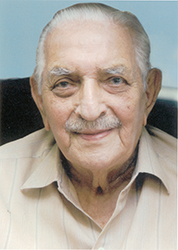
It’s a handsome volume that commemorates the many faceted splendor of the life and philosophy of Jehangir P. Vazifdar (pictured) (1920-2011), an architect-builder with the soul of an artist.
"Where his heart was progressive his soul was always that of a rebel,” explains his son Pheroze Vazifdar, in the preface to the book.
In his professional career as an architect of note, Jehangir was associated with many iconic buildings, such as the Bharatiya Vidya Bhavan, the new Tata Memorial Hospital, Hotel Sun n Sand, Breach Candy Apartments, Bombay, Ashoka Hotel, New Delhi, as well as numerous residential apartments. He established his own firm in the late 1940s and was the founder director of the Vazifdar College of Building Industries.
Small glimpses of Jehangir’s personal life mention his lifelong association with dogs, horses and horse racing. There is an annual trophy in his name at Bombay’s Royal Western India Turf Club. He was not only a regular at the Willingdon Sports Club where he had his own reserved space in the evenings, but would apparently make a stop at the flower shop at the Taj Mahal Palace and Tower Hotel to gauge the resilience of the Bombay Stock Exchange based on whether the public was affluent enough to spend money on flowers! Besides being a devoted family man, we are also reminded that "Vazifdar made his living as an architect, contractor and builder but found his greatest pleasure in painting.”
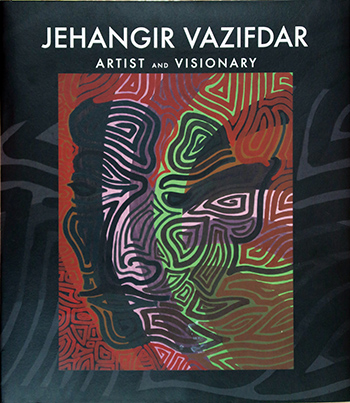
The book commemorates this aspect of the artist’s life, collating a huge range of his paintings, sketches and drawings with an incisive commentary on his work by Anahite Contractor, followed by his own comments and writings. Jehangir had a highly individualistic approach to viewing both nature and art. For instance, he has been quoted as asserting: "There is not a single form which can be seen in nature with perfect straight lines, as in a triangle, or a square or even a cross…when man first invented the straight line, human civilization emerged and when symmetry was created, progress took over.” There are many such observations in the volume that the reader may take as being ‘visionary’ as the title of the book suggests, or as a challenge and open to debate.
Though the senior Vajifdar painted over 10,000 works during his lifetime and showed regularly at the then iconic Taj Art Gallery, he did not sell his works. In some cases he gifted them to famous world figures, statesmen and saints that he admired. In the book, one may note the eclectic range of some of these persons: Rabindranath Tagore, for instance, painted in 1971 shares a page with Swami Chinmayananda (1972); there’s an abstract composition dedicated to John F. Kennedy entitled Courage (1965) along with a more conventional portrait of the German Chancellor Willy Brandt; there is a quirky rendering of the "Beatles” at the height of their mop-headed fame and many years later, in 2011, Jehangir painted an elegant portrait of Shivaji, the Maratha warrior-king.
In several of these images he demonstrates the use of a technique that he labels "Fail-Proof Art.” He explains three steps almost in the manner of a formula, the last stage involving the use of a "foot-rule” to mark the thick impasto surface of the painting with strips of parallel lines. But far from it being a mechanical trait, Jehangir infuses each one of his paintings with a vibrant use of color and individuality. The image of swirling almost psychedelic lines on the cover is a ‘self-portrait’; an excellent example of both the painter’s methods and his theories. He also has an interesting theory about colors and their emotional, or even psychic co-ordinates, that govern his use of particular colors and the intensity in which they are left on the canvas. Since the era in which these canvases appeared, scientific advances such as brain mapping using electromagnetic spectography have allowed us to photograph and map the brain.
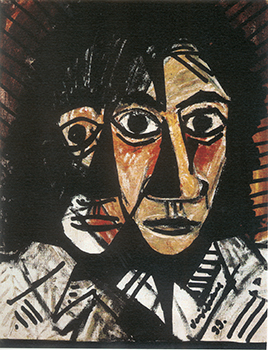
Portrait of a Thinker, felt tip on printed paper
Still-Life (vase with yellow flowers), oil on canvas
Meherbai Vazifdar, the artist’s mother, oil on canvas
Enhanced by color these may in some cases vindicate Jehangir’s own color codes to denote the personality types that he painted, or at least the reasons for his own response to them.
As an antidote to his color theories, Vazifdar also created a large number of black and white compositions, using strict geometrical forms in what may be termed his "Mondrian” phase. The use of negative-positive space and repetitive forms, lines and experiments with color were all part of the mid-20th century’s artistic experiments with "Pop” and "Op” art. It’s in the latter part of the collection that we see the artist’s theories colluding with found works, or printed images, on which he has used a thick felt pen to ‘doodle’ his own signature vision onto them and transform them into art objects.
No matter how one responds to the paintings, the volume is full of interest both to the seeker and art enthusiast.