After 17 years as editor of Hamazor, the quarterly publication of the World Zoroastrian Organisation (WZO), 80-year-old Toxy Cowasjee (pictured) bid adieu to her readers stating: "It has been a wonderful experience producing the Hamazor, learning all the way, ‘meeting’ remarkable people through their contributions to this publication.”
Her final editorial in the first issue of 2019 that was published in April cited her reasons for retiring: "Too many years for a person 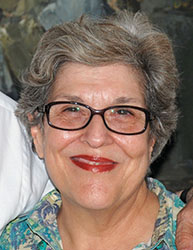 to produce a publication without it going stale… New ideas with younger people has to take place otherwise how can progress be made?” The 100-page issue was delayed to incorporate articles on the new World Zoroastrian House outside London that opened its doors and celebrated Navroz on its own premises in March as also the inauguration of the Bhandara Atash Kadeh in Houston on March 21.
Responding to Parsiana’s queries, Cowasjee noted in her email of August 9, "I am happy to say within a few weeks we have found a new editor. She came forward herself and I am more than confident that given the chance she will excel. It will only be an online Hamazor, something I wanted to do since quite a few years, and now, at last, the vision will be a reality.” Parsiana approached her successor Natasha Nozer Mistry for more information on herself and her vision for the periodical, and she said she would revert.
Cowasjee appre-ciated the four WZO chairmen with whom she had worked — Rumi Sethna, Sammy Bhiwandiwalla, Darayus Motivala and Shahpur Captain — "all of whom have given me a free hand to do as I please to produce the Hamazor, without any suggestion, making the post of editor so much simpler.”
As the lone woman editorial team, Cowasjee would single-handedly manage conceptualization, layout, proof reading, working on a dummy, getting it ready on a compact disc for the printer, spending on an average 10 weeks per issue. Other individuals in Karachi whose inputs she valued were professional graphic designer Tannaz Minwalla of Creative Unit for the covers, Shahnawaz Khan who assisted with printing, and Adam Musa and Ayaz Naseem, staff members of Cowasjee and Sons on whom she depended for distribution.
When she took over the periodical that was then a four/six-page bulletin in 2002, she was expected to focus on Zoroastrian news. In her first issue Cowasjee had expressed her aspirations "to make the Hamazor a medium for all Zarathushtis to share their thoughts in, whether traditionalist, mainstream or progressive, as we are fortunate in the teachings of Zarathushtra who tells us to use our minds.” Did she feel she had succeeded in her mission? Responded Cowasjee, "I think I achieved this. Since I had to make my own guidelines for the Hamazor, in my opinion it was important each person had the right to express himself/herself. 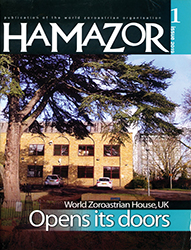 After all Zarathushtra in the Gathas keeps telling us to use our Vohu Mana so who was I to decide what was right or wrong? But if any writer was derogatory to others, this was not entertained.”
Gradually with many non-Zoroastrian writers contributing on Zoroastrian themes, and Zoroastrian writers covering universal issues, she moved away from religious topics while ensuring that at least one article in each issue touched religion. She particularly "loved covering architecture, history and our people.”
Among the chal-lenges of bringing out a periodical on the community she referred to the current trend of a surfeit of information reaching homes via the Internet. "I felt, what was the point of regurgitating the same information? It made no sense at all and rather than produce mediocre publications, it was best for me to call it a day.” She also expressed her disappointment with writers who would promise articles and when sent reminders a fortnight before the submission date, would convey their regrets and inability to submit the promised piece. "Frustration for sure!” admitted Cowasjee. It was gratifying though that "professionals in their field never let me down… I felt humbled these scholars took out the time to write. Initially they never knew me and it was just their kindness and generosity for sharing their knowledge.” Devoting five pages of the April issue to name those who had facilitated the publication of the magazine, the sponsors and nearly 400 contributors, Cowasjee expressed her "sincere thanks to each one of them.”
Editor of FEZANA (Federation of Zoroastrian Associations of North America) Journal, Dr Dolly Dastoor had given Cowasjee credit for devoting "a good part of her life to provide the community with quality and well researched material… (and for having) raised the awareness of the community towards some of the burning and pertinent issues of the day…(giving us) articles on our past heritage and shaping the views of the Zarathushti reader over the decades (see "Covering the community,” Parsiana, October 21, 2005).”
Knowledgeable on all matters concerning the community in Karachi, Cowasjee was earlier honorary secretary and president of the Karachi Zarthosti Banu Mandal (KZBM), had given birth to its monthly newsletter What’s On, had compiled and edited a cookbook Manna of the Angels whose proceeds were donated to the KZBM. The a&t Zoroastrians of Pakistan Directory too was largely her initiative. In the eighth edition published in 2016 she had mentioned that the Parsi count in the country was 1,416 (see "New Pak directory,” Zoroastrians Abroad, Parsiana, August 7, 2016). Since then she has been meticulously keeping a count of each new arrival and departure.
When asked what project she is currently preoccupied with, prompt came the response from the grandmother: "Just thawing out and loving not having to worry about what topic and whom to approach!”