One night around 10.30 Dr Erach Udwadia returned home distraught from his Lower Parel clinic. A young, impoverished Parsi girl suffering from meningitis "was very ill and going to die,” recalled his eldest son Dr Farokh Udwadia addressing the 68-year-old Zoroastrian Dentists Organization (ZDO) at its annual Scientific Convention on February 20, 2022 at The Taj Mahal Palace hotel.
"There was no medicine for diseases like that.” There were one or two general drugs used for a multiple range of common ailments. But those could not combat such a grave illness. His father’s "empathy for patients made a deep impression on me,” said the eminent physician in his talk titled "Random thoughts on why and how I trod the path I did.” Most of the senior’s patients were poor and he often waived their fees. The family would wait for him to return home and eat dinner together. He would narrate "interesting things about his patients,” said the son. "He was the kindest man I’ve ever known.”
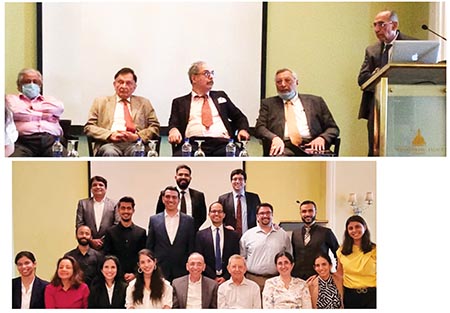
Top: At the Zoroastrian Dentists Organization (ZDO) meet
(from l) Dinshaw Mehta, Dr Farokh Udwadia, Adi Jehangir,
Dr Firoze Mirza, Dr Porus Turner; above: ZDO members
Farokh said he had an "extraordinarily kind yet paradoxically an extraordinarily strict mother,” Perin (née Lentin). "She believed if you spared the rod you spoilt the child. I think this was maybe because I was an exceedingly mischievous child.” When family and friends knowing Farokh was a topper inquired of his mother how he had fared in his exams, she would respond "Quite well.” The annoyed youngster would berate her for not stating he did "very well.” She said she wanted to instill in him a sense of modesty. She taught him to be disciplined and to "speak the truth. I’d be thrashed, if she caught me telling a lie.” His grandmother was indulgent "and let me eat whatever I wanted, even three mangoes, three times a day.” His mother would give him only one.
The school Farokh attended, St Mary’s, taught him egalitarianism. "There were very rich boys and poor ones on scholarships given by the Jesuits.” But what mattered was not the wealth or social standing of a student but his academic performance and sporting ability.
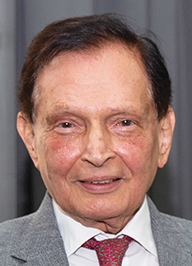
Dr Farokh Udwadia: caring is crucial
Farokh related the important principles of medicine to the gathered medics and guests: first do good, "beneficence. Understand the patients’ pain or suffering… Relieve them of their pain…Caring is most important. What did medicine have first except caring?
"The next important message is do no harm, malfeasance, to a patient. A patient’s autonomy is important. Often it can be in conflict with beneficence” when the patient does not want to follow a recommended line of treatment in favor of another. An important quality is justice. Farokh recalled when he started the tetanus ward at the Sir J. J. Hospital there were only three ventilators. The number of "dreadfully ill” patients may number 10. Who does one short list? If the answer is the "three worst,” what happens if a new patient is admitted who is critical? These are the dilemmas doctors face, he noted.
Doctors should be charitable. "You cannot refuse a patient treatment because he or she cannot pay...
"Today the trend is for doctors to go hammer and tongs and treat the patient right to the very end… That’s not right. A good physician knows when he has reached the limit…When that point comes you should desist. Doctors and patients must realize there is a time to live and a time to die…Accept there is going to be an end. You’re not going to live forever…You can’t make death horrible, extremely expensive, ruinous to a family…Dreadful to watch and prolonged in agony.”
Farokh said he found solace and peace in the humanities, literature, poetry, music, drama, movies. He termed them, "a window to the outside world. It is also a window to your inside world…Helps you to improve as an individual.” He referred to the healing power of music and said many of his patients benefited from hearing Austrian composer Mozart’s clarinet concerto. For Farokh, his family was his "main support.” His religion was important to him, not the rituals "but the philosophy of good thoughts, good words and good deeds.”
The pleasant duty to "introduce a legend” fell on Adi Jehangir, a close friend of Farokh and his supportive wife, Vera. Jehangir spoke of Farokh’s interest in history and how he was familiar with "each era and each epoch” of the subject. Jehangir, a descendant of Sir Cowasjee Jehangir, first baronet, was instrumental in getting Farokh to address the dentists, said Dr Porus Turner, chairman and scientific convenor of the ZDO Charitable Trust. He described Jehangir as a historian, art connoisseur, philosopher and guide. Regarding Farokh, Turner said, "I don’t think there will be another physician like him. After physically examining the patient he would make a provisional diagnosis then and there” and then list whichever tests were required. "He never bothers about fees. Numerous people were and are treated free.” Farokh’s example inspired Turner to take up medicine, though he opted for dentistry.
A reprint of a 16-page booklet titled "Medical Emergencies in Dental Practice,” written by Turner in collaboration with Farokh, initially published in 1986 under the then presidency of Dr Cyrus Daruwalla and now updated, was distributed to those present. ZDO was founded in 1954 by dentist Dr Fali Mehta, three times president of the Indian Dental Association. The present president of ZDO is Dr Karen Mulla and the secretary, Dr Ruxshin Bhot.
Others sharing the dais at the function included senior dentist Dr Firoze Mirza, the first to introduce dental implants in the country, and former Bombay Parsi Punchayet chairman Dinshaw Mehta. The Scientific Convention was principally sponsored by Colgate Palmolive India Limited. The co-sponsors were Dentsply Sirona, Bredent, Geistlich and Nobel Biocare.