God Save The Hon’ble Supreme Court by Fali S. Nariman. Published in 2018 by Hay House Publishers (India) Private Limited, Muskaan Complex, Plot No. 3, B-2, Vasant Kunj, New Delhi 110070; website: hayhouse.co.in. Pp: 304. Price: Rs 599.
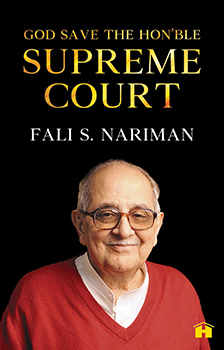 Within the senior echelons of the Indian legal community, Fali Nariman has few peers as a commentator on public affairs. For decades now, this octogenarian stalwart of the Indian Bar has written, broadcast and spoken at public meetings on a regular basis. He has regaled his audiences with a mix of wit, wisdom and quiet authority. Now, as he approaches his 90th birthday — and with three score and 10 years in the legal profession under his belt — Nariman has come up with this new book which offers his thoughts on a diverse range of topics, all connected, to a greater or lesser degree, with the state of law and justice in contemporary India.
The title of the book is a bit misleading. Most people are likely to assume that the work is a searing indictment of the country’s highest court — or at least a deep and thoughtful analysis of the ills that have been plaguing that benighted institution for the past several years. Although there is a bit of that, Nariman spreads himself on a wider canvas. The 11 chapters which comprise the book deal with such diverse topics as freedom of expression, minority rights, the importance of advocacy in constitutional cases, equality under the Indian Constitution, the bane of defamation cases, declining standards of conduct in parliament, and judicial activism. To add to the pot pourri, Nariman has also included two chapters of personal tributes, one to a fellow-lawyer (R. N. Trivedi) and the other to the well-known former judge, V. R. Krishna Iyer, both of whom died in the recent past.
The views expressed, including on contentious issues, are for the most part what would be considered middle-of-the-road. In that sense Nariman is no Nani Palkhivala or Homi Seervai (two other stalwarts of the Indian legal profession whose willingness to speak their minds was legendary). But he does take sides occasionally, albeit with caution. An illuminating example concerns the unprecedented press conference that four of the country’s senior most judges addressed on January 12, 2018 in protest at the behavior of the then Chief Justice of India, Dipak Misra. Nariman is, broadly speaking, critical of the four judges (and especially Justice Jasti Chelameswar who took a leadership role in that protest), accusing them of a "singular lack of a spirit of collegiality.” But he is quick to add that the Chief Justice was not entirely blameless because he failed to respond to a letter addressed to him by the four judges listing their grievances.
Lest an impression is created that Nariman shies away from controversy reflexively, it needs to be stated that such a characterization would be unfair. He went for the jugular in a epistolary combat a few years ago with the legal academic Upendra Baxi who had taken him to task for his role in the Bhopal gas tragedy litigation against the Union Carbide Corporation. The ensuing spat, reproduced in piercing detail in Nariman’s earlier book, Before Memory Fades, reveals a side to our author’s disposition that will surprise many. At the very least, it matches the pugnacious manner in which Nariman has sometimes dealt with his opponents in court.
Nariman’s achievements and successes as a lawyer were topped about two decades ago when he was nominated by the President of India to the Rajya Sabha under the category of persons distinguished for their contributions to art, literature, science, and social services. During the six years he held that office, Nariman was seen as one of the most diligent and conscientious parliamentarians who put his knowledge and experience to the service of the nation in a way that few others have done. His reflections of that time – and his thoughts on how parliament can be raised in esteem – find a prominent place in this book. They are, arguably, among the most readable parts of his current offering. With an endearing mix of disappointment, despair, self-deprecation and touching sincerity he talks about what a "great privilege” being a member of parliament (MP) is and how that privilege has, unfortunately, been abused by a large number of those lucky enough to be elected or nominated to that office over the years.
Not for nothing, he says, are MPs called "‘honorable.’ It is a device deliberately used to keep one on the right path and keeping oneself on the right path is what ethics is all about,” he argues. His first attempt to inject ethics into politics was, he laments, "a total failure.” This came in the form of a bill which, if passed, would have ensured that no MP would be paid for the time that he absented himself without cause from parliament. Nariman preached what he proclaimed: shortly after being inducted into the Rajya Sabha, he realised that he couldn’t do justice to his position by devoting only a couple of hours to the job while running his practice at the Bar for the remaining part of the day. He therefore did the decent thing and temporarily gave up his flourishing practice, with all the sacrifices that it entailed.
As well as reminiscing about parliament, its work and eminent parliamentarians, Nariman offers some tangible suggestions for the betterment of that institution. Foremost among them is the view that the presiding officer of either House should not, under any circumstances, adjourn proceedings when they are sought to be disrupted (as happens frequently in both Houses). "[I]f only the presiding officer keeps his/her cool and remains seated in the chair, from which he/she will not move — for minutes together or even for hours together — MPs who come shouting and gesticulating down the aisle will have, at some time or the other, to stop their activities, at which point proceedings will (hopefully) resume.” He is also firmly of the belief that standards of parliamentary conduct should be laid down by an external agency and not by MPs themselves.
A notable feature of Nariman’s writings is his colloquial, almost conversational style which has, of course, stood him in good stead when communicating with lay audiences and has frequently drawn praise from reviewers in the popular Oress. That style certainly makes for easy reading, especially on topics which otherwise would be a turn-off for many readers. But it can also be a bit jarring when employed in contexts that demand a certain formality. Discerning readers of the present volume are likely to experience just such a feeling when wading through some of the chapters in this book. Part of the blame should, indubitably, be placed at the door of the editors who prepared the work for publication at Hay House – a lack of tightness in editing and insufficient attention to detail (alas, an all too familiar and recurring problem with books published in the sub-continent, despite all the improvements in printing technology and the upskilling of design personnel) also reduce the value of the book.