Fire temples in India will have two cans of fire retardants each "by December this year,” noted Udvada High Priest and trustee and president of the Athornan Mandal Dastur Khurshed Dastoor, while speaking to Parsiana on October 27, 2020. "One will be placed in the kebla and another in the area where ceremonies like afringan, farokhshi and satum are performed… We already have a donor lined up,” he stated.
An email of November 1 from Dinshaw Tamboly, chairman WZO (World Zoroastrian Organisation) stated that the cans of retardants will be distributed by volunteers of Empowering Mobeds. A video on how to stay safe while tending to holy fires is envisaged for mobeds, Tamboly stated.
The precautionary measure comes on the heels of a fire incident at Surat’s Goti Adarian. Fifteen-year-old Ervad Zahan Turel, a class 10 student of the Dadar Athornan Institute (DAI) reportedly suffered 40% burns on his hands and chest when during the Rapithwin gah (12.40 p.m. to 3.40 p.m.) boi ceremony on October 24. He "suddenly realized that his jama (floor length, mulmul priestly robe) caught a spark,” noted an email circulated by his grand uncle Ervad Nairyosang Turel. Reportedly, two ladies attending the maachi could not help the young mobed. The lad is being treated at Bombay’s Masina Hospital which has a specialized burns unit.

Zahan "was probably very engrossed in prayer,” noted H. B. Wadia Atash Behram High Priest Dastur (Dr) Firoze Kotwal. He expressed surprise ("ajaayebi laagéch”) that the incident happened in the sanctum sanctorum of the Adarian. While offering maachi in the kebla, priests recite the Atash Niyayesh standing at a short distance from the afarganyu, he stated. "Precautions have to be taken by individual priests…There is no need to change the attire of priests (the jama) when offering boi…. Atash Padshah ni service ma aapro libas malahja bharélo hovo joiyé (When tending to the holy fire, the priests’ attire must be respectful),” stated the scholar. The High Priest reiterated that for prayers outside the sanctum sanctorum like afringan, farokhshi and satum, priests could wear a dagli. He signed off stating he would remember Zahan when reciting the Dua Tandarosti (prayer for well-being). Dastoor told Parsiana that he concurred with Kotwal that a dagli could be worn by priests while reciting prayers outside the sanctum sanctorum.
This is the second known incident of a fire related accident in a fire temple this year. Septuagenarian Ervad Nozer Vajifdar had passed away on March 16, from burn injuries sustained when his jama caught fire while reciting prayers at Bombay’s Aslaji Agiary (see "Dugli or jama,” Events and Personalities, Parsiana, July 7-20, 2020). Kotwal had then noted that "during rituals such as afringan or satum which are performed by a single priest, and also for the jora nu afringan (where two priests are involved), the mobeds performing the rituals can, if they so choose, wear a dagli.” Previous incidents, some fatal, have been reported from fire temples in Bombay, Bangalore, Navsari and Nagpur.
Panthaky of the Mevawala Agiary and trustee of the DAI, Ervad (Dr) Parvez Bajan told Parsiana that recently ordained mobeds should be accompanied by a senior priest when offering boi. He added that experienced mobeds need to mentor younger priests on the practical aspects of tending the holy fire. "Their eyes should be on the fire, door thi oobhu réhvanu (they should stand at a reasonable distance),” he recommended. Reportedly, Zahan was tending to the fire by himself. The Turel family has served the Adarian for eight generations.
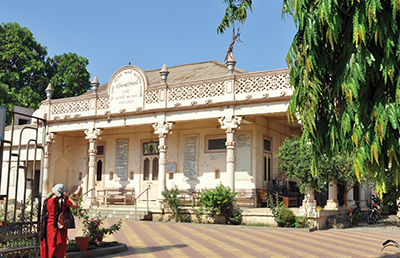
Top: Ervad Zahan Turel at a Dadar Athornan Institute
function in December 2019; above: Goti Adarian
Eighty-two-year-old Ervad Asphandiar Dadachanji, panthaky of Vatcha Gandhi Agiary told Parsiana that priests should be vigilant while at prayer ("nabharvas nai rèhvanu”). To him the incident involving Zahan does not merit a debate on a change in priestly attire when offering boi. He mentioned that in Surat’s Shahenshahi Atash Behram, priests wear the jama even when cleaning the kebla. The senior priest recalled an incident when a priest he was praying with about half a century earlier was injured due to a fire related incident in a Navsari fire temple. That priest, Ervad Eruchshah Karkaria, had the presence of mind to roll on the ground to prevent grave injury to himself.
If the community and the priests come together, the jama can be done away with for routine prayers, stated DAI principal Ervad (Dr) Ramiyar Karanjia. "All the children at the Institute were talking about Zahan in their online classes…They all said that they would pray for his well-being.”
When three priests in three fire temples in three months were victims of fire related accidents, in May 2009, Parsiana approached nearly 30 stalwarts of the community on an all-India basis asking them for their views on the subject (see "Death by diva,” Parsiana, August 7, 2009). Kotwal had stated even then that "the attire of the priests when reciting the prayers for the deceased — afringan, farokhshi, satum — should be changed from the ‘labarto jamo’ (excessively long robe trailing the ground) to a modified dagli stretching to the knees.”