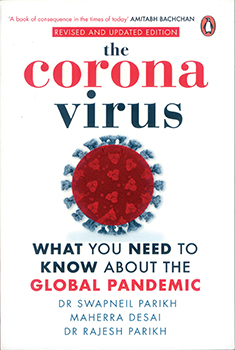
The Corona Virus: What You Need To Know About The Global Pandemic by Dr Swapneil Parikh, Maherra Desai, Dr Rajesh Parikh. Published in 2020 by Ebury Press, an imprint of Penguin, Random House India Pvt Ltd, 7th Floor, Infinity Tower C, DLF Cyber City, Gurgaon 122002; website:www.penguin.co.in. Pp: xvii + 314. Price: Rs 299.
The coronavirus has ushered in one of the most widespread global pandemics of our times, changing the pattern of our lives in a totally unforeseen manner. The long-term effects of Covid-19 on the generations to come are yet to unfold.
The authors, Dr Swapneil Parikh, Maherra Desai and Dr Rajesh Parikh have brought out the effects of viral infection on the immune system, along with the importance of reinforcing immunity to reduce and overcome the virus. Historical aspects of past pandemics are a thrilling read, particularly as they throw light on what we should be prepared to expect in the post-Covid era.
The book traces the rapid rise in the number of cases in our country and the circumstances leading to this, but also shows that we are fortunate that our death rates are low. The controversies arising out of this have been well discussed, lack of adequate testing being one of them.
Above from l-r: Dr Rajesh Parikh, Dr Swapneil Parikh, Maherra Desai
Surprisingly, the story of the coronavirus dates back to 1965, when a British virologist Dr David Tyrrell from the UK identified a virus similar to the structure of the corona in a young boy who was suffering from a common cold. A detailed account of its mode of invasion and destruction of the body’s immune system provides an interesting read.
Chapter 5 gives an insight into epidemiology as it relates the story of the English epidemiologist Dr John Snow. As far back as 1813, when he was a sanitation inspector, he had brought out the relationship between an outbreak of cholera and the contamination of water supply by sewage. This mode of transmission and the germ theory were later validated by both Drs Louis Pasteur and Robert Koch and to this day form the foundation of epidemiology. Details of further developments in this field are worth reading. The book also brings to light the work of the World Health Organisation in identifying and containing epidemics.
The coronavirus is spread primarily through droplet infection, the degree and distance being dependent on both the propelling force and weather conditions. This underlines the importance of masking and social distancing. Further risk lies in the ability of the virus to mutate and recombine, increasing its chances of survival and resistance to earlier drugs. The propensity of the Covid virus to attack the respiratory tract and the lungs, causing a lack of oxygen and hence risk to life, is highlighted. It is the organs having cells with ACE-2 receptors that attract the virus, as they are the entry point, and are thereby damaged.
The various modes of manifestation of the infection vary from respiratory symptoms like cough, sore throat and breathlessness to diarrhea and vomiting, depending on the site attacked by the virus. Immuno-compromised patients are at higher risk, require hospitalization, and often the end result is multi-organ failure.
The authors stress the importance of early diagnosis. Patients should be alert about symptoms and seek medical attention. Based on the history and symptoms, the diagnosis may thereafter be confirmed by testing for Covid-19 using the tests available at hand so that the patient may be isolated and early treatment initiated.
This book too, like The Vaccine Book for Covid-19 (see "Vaccines and the virus,” Books, Parsiana, August 7-20, 2021), highlights the importance and efficacy of vaccines in the control of pandemics from the time of Dr Edward Jenner to the Covid vaccines of today. Additional measures needed to curb spread of the virus like wearing masks, social distancing, hand washing and hygiene inside and outside the home are mandated, so that people are not lulled into a false sense of security.
Today, with the internet and various social media, both knowledge and misconceptions spread rapidly and get magnified, so the true status of the disease is difficult to determine. The quantum of government funds spent on a pandemic is astonishing for the common man, resulting in a severe drop in the economy not only of the country but also of individuals. The manner in which the authors have brought out this aspect is a revelation.
Readers are cautioned about the chances of future pandemic outbreaks through varied sources — microbial and viral encephalitis, animal trade practices and possible bacteriophages (bacterial viruses). At the same time scientific progress is being made to use phage therapy (using bacteriophages to treat pathological infections) for killing viruses. The virus itself may be reprogramed with a therapeutic agent to destroy various diseases.
This interesting and knowledgeable book provides a complete guide to the Covid era. Dr PILLOO HAKIM
Dr Hakim is professor emeritus, Grant Medical College and Sir J. J. Group of Hospitals, Department of Ear, Nose and Throat (ENT) and Head and Neck Oncology, and honorary consulting ENT surgeon at Saifee and The B. D. Petit Parsee General hospitals.