The vigilance of senior Parsi engineers helped the
Indian Railways operate smoothly over land, hills and water
From rebuilding tunnels that had collapsed on mountainous terrains, to maintaining and inspecting bridges across rivers, to building stations, Parsi engineers and architects had played a significantly constructive role in the Indian Railways. Some of them had been selected for further training in London by their British employers and on their return to India lent their expertise to the expanding rail network. Featuring those who had served on the senior echelons of the Railways over two instalments in Parsiana, the October 21-November 6 issue covered those who were in the administrative sector (see "Lineup of legends”) and the current issue includes those who made a mark in the engineering domain. The information was primarily provided by the children/grandchildren who remembered the role their father/grandfather and his peers played in the Indian Railways. Three decades ago we had covered the engine drivers (see "Romance with the railways,” Parsiana, December 1990).
In an undivided India, Rustom Irani was entrusted the extension of the railway line from Karachi city to Karachi cantonment. Maintenance of the 19th century suspension Lansdowne Bridge connecting Sukkur and Rohri across the Indus river fell within the purview of this divisional engineer as did other bridges. Both Rustom and his elder brother Meherwan were divisional engineers with the North Western Railway.
Nozar Satarawala was reportedly the youngest chief engineer and laid the foundation for electrification of both Northern and Central Railways. In 1962 he was posted to London to study the electrical railway system in the UK and Europe. On his retirement in 1968 he was invited by the Shah of Iran as industrial advisor to the Industrial Development and Renovation Organization and prior to the revolution in Iran in 1979 he was chief executive officer of Arak Machine Building Plant.
In the late 1950s/60, Nariman Shroff was among the chief architects on the Railway Board, New Delhi, with his office at Connaught Circus. For a brief spell he was president of the Delhi Parsi Anjuman. Among the projects that he designed was the new Churchgate Station in Bombay. After spending some years in Singapore, he relocated to Zambia where he joined the Public Works Department and was director of the Zambian Standards Institute.
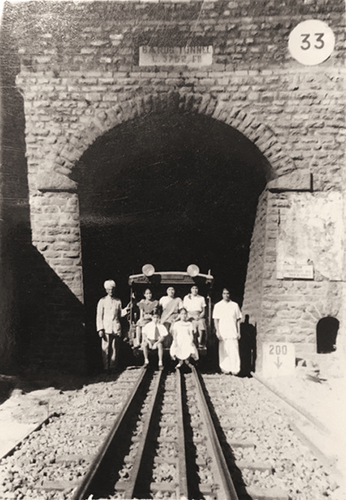
Pesi Mehta’s family at the Barog Tunnel on the Kalka-Simla line
Memories of Muncherjee
In the East India Railway Jal Muncherjee made his mark in the newly established mechanical engineering sector, served as director on the Railway Board and retired in 1967 as general manager, Western Railway.
Muncherjee was from the second batch of 16 special class (mechanical) apprentices selected by the Railways in 1927 to differentiate them from the general engineers. After receiving his initial training for three years at Jamalpur (Bihar), he was sent to England for another three-and-a-half years. He was then appointed junior officer in the newly established Mechanical Engineering division. His batch included two other Parsis: Dadi Vachha had stood first from their batch but his early death prevented him from reaching his zenith; Rusi Nadirshaw retired as general manager of the Berambur Integral Coach Factory.
Muncherjee’s son Dinshaw remembered the family relocating every two-and-a-half years to lovely palatial bungalows. Still in touch with his childhood friends from the Railway fraternity, Dinshaw, now 80 years old, mentioned how they "grew up like one big, wonderful, close-knit family with no distinction of class, race or religion.” The cementing bond for these cohesive ties, he acknowledges, is film director Shyam Benegal’s wife Nira (née Mukerji).
Among the photos that Dinshaw shared with Parsiana is one of his father as general manager taking the salute at the Independence Day parade. But more than any of his railway accolades, Jal, who was the state chief commissioner of Bharat Scouts and Guides, treasured the Silver Elephant (the highest honor in scouting) presented to him by Lady Baden Powell.
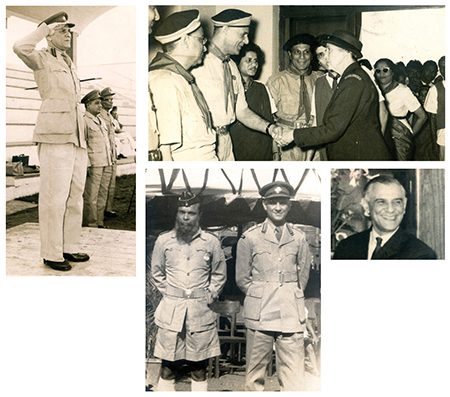
Clockwise from above: Jal Muncherjee taking the salute as general manager;
greeting Lady Baden Powell; the genial engineer; on inspection duty as chief mechanical officer
Mehta’s many moves
Hailing from a landed gentry family in Panchol, near Navsari, Pesi Mehta preferred to forego a life on the farms in favor of pursuing his dream for higher studies that his father Hormusji refused to fund. With his single-minded determination, he joined St Xavier’s College in Bombay but failed in the first year due to his poor command of the English language. In the second year of college, along with some of his classmates he sat for an entrance examination and was admitted to the N. E. D. College in Karachi, opting to specialize in civil engineering. With some assistance from an uncle in Calcutta, and self-funding by winning annual scholarships, he managed to finance his tuition fees, board and lodging.
Being good in academics and sports, he stood second at the graduation examination after which he joined a state railway at 23 years of age and also took the examination for the central cadre of the British Indian Railways but missed the grade by one place. Not to be dissuaded, he reappeared for the examination the following year when he ranked fifth for four positions. Fortunately for him, one seat fell vacant and he was selected for the probationary job with a posting to Bhatinda as assistant engineer with the North Western Railway in 1942.
In 1946, he was asked by his English boss to go to Delhi but, drawn to the hills, he requested for a posting to the challenging Kalka-Simla section. Located at 7,116 ft in the foothills of the Himalayas, Simla became the summer capital of British India in 1864, and was the headquarters of the Indian army. This meant that twice a year it was necessary to transfer the entire government from Calcutta to Simla by horse and ox drawn carts. In 1891, the 5’6” broad-gauge Delhi-Kalka line opened, which made the construction of a branch line up to Simla feasible. The 95.7 km line opened for traffic on November 9, 1903 and was dedicated by Viceroy Lord Curzon. Due to high capital and maintenance costs, and difficult working conditions, the line was purchased by the government on January 1, 1906 and originally managed as an independent unit from the North West Railway office in Lahore until 1926, when it was transferred to Delhi Division.
So it was agreed that Pesi would go as engineer in charge. The track has 20 picturesque stations, 103 tunnels, 912 curves and 988 bridges and viaducts. The most architecturally complex bridge is No. 226 which spans a deep valley, requiring it to be constructed in five stages, with each level having its own stone-arched tier.
Stationed at Dharampur, approximately midway to Simla, Pesi and his wife Nargis (née Alamshaw) with their two infant daughters, Nina and Villy, lived in the Engineer’s Bungalow, the official residence of the engineer in charge of this section of the line. (In the late 1960s, it was converted into the Northern Railway Safety Institute.)
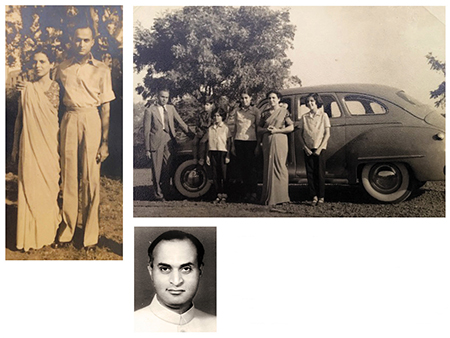
Clockwise from above: Pesi Mehta; with Nargis at his first posting in Bhatinda;
with Daraius, Roda, Nina, Nargis, Villy in the late 1950s
The journey from Kalka to Simla and vice versa was made in a rail car, a legacy of the British. This was like a large car on wheels with a well-polished wooden exterior, red leather row seats fitted with shining brass buttons — for about 12 to 14 passengers in all. The driver sat in the front, hands on a horizontal steering wheel and all the instruments before him. To his left was a passenger seat. In front of the engine was a large lamp for night driving. This car was a truly luxurious way to travel!
There were also narrow-gauge steam locomotives for passengers and cargo. During the monsoons, there were heavy rains in the hills. Once, late into the night, Pesi was alerted that Tunnel No.10 had collapsed and needed urgent attention. He rushed with his team by push-trolley down hill to assess the damage and initiate immediate action. While at the spot, one trolley man happened to notice the headlight of an upward approaching train on a bend in the hill just before the tunnel. The four trolley men accompanying Pesi, in a split second, threw him towards the hill side, overturned the trolley into the ravine, and jumped themselves. With presence of mind, they shouted for the train to stop, and it did! It was a passenger train and a major accident was averted! The tunnel was rebuilt in record time. At its entrance, the name "P. H. Mehta” has been inscribed on a stone plate.
There was a time in 1948-49 when Nargis suffered a miscarriage and had to be rushed to a hospital in Simla where she was diagnosed with rheumatoid fever. Leaving her behind alone, Pesi decided to return home to take charge of the two daughters who had been left in the care of faithful Pahari staff only to find that one of the tunnels had collapsed, making it difficult for him to get across.
Yet another traumatic incident happened while he was inspecting a tunnel one day, unaware of a landslide outside. He suddenly heard a loud thundering sound as the tunnel collapsed around him. With no modern-day communication equipment at the time, his men who had fortuitously been outside, ran to find him but without any earth-removing equipment failed to do so. So they ran along the tracks to the nearest station to alert the head who was stationed in Simla. By the time men and manual equipment reached the spot, and Pesi was located and dug out of the ground, he had lost count of the days. His immobile torso, waist down in the ground, had completely numbed. It took many days to recover from the ordeal.
Sometime in 1948-49, Pesi was transferred to Ferozepore division (now Firozpur), still being on probation. The city on the banks of the Sutlej River in the Punjab is a major cantonment. Their third daughter Roda was born in 1950 after which came Pesi’s confirmation as executive engineer! Son Daraius was born 14 months thereafter.
In 1952, the family moved to Delhi with Pesi being posted to the newly formed Northern Railway. As there was no accommodation available, for a year the family stayed in tents pitched in a garden off the New Delhi Railway station. Later, they moved to the Railway Colony on Kitchener Road, now Sardar Patel Marg.
During the next decade, Pesi headed many works and stamped his name in the three Railways he worked in. His expertise was construction of bridges, tunnels, buildings and other civil structures. Designing and executing projects was his forte.
In 1960, Pesi was transferred to the Central Railway, Bombay. His office was in the old, majestic, heritage building known as Victoria Terminus. In December 1962 with the Chinese aggression, he was recalled to Northern Railway and relocated to Delhi. In early 1966, he was selected as part of a small team for an intensive six-month tour of the United States to study their rail innovations, systems, products, etc.
When the Kanpur-Howrah line was to be electrified, Pesi was asked to take charge of the prestigious project and was transferred to Allahabad Railway Division the following year.
Thereafter, in April 1970, Pesi was promoted as chief engineer (survey and construction), with transfer orders to join the Central Railway. Soon after he was required by Western Railway. Both postings were in Bombay. In November 1974, he retired at the then compulsory age of 58 years and chose to settle in Poona where he worked for seven years with the civil engineering firm Atur India. He later appeared for an examination for appointment as government property valuer and served in that capacity for 10 years before hanging up his boots.
Parsiana is grateful to Rusi Sorabji for information on the Irani brothers and Nariman Shroff; to Dr Shernaz Cama for inputs on Nozar Satarawala; to Dinshaw Muncherjee for reminiscences of his father Jal and other batchmates; to Roda and Daraius Mehta for relating their father Pesi’s experiences. The images that they have shared capture a bygone era.