Three western classical aficionados discuss the soothing and healing properties of music
Firdaus Gandavia
What compels an eminent physician and an equally distinguished judge of the Supreme Court of India, both with demanding and challenging professions, to turn to western classical music not merely as a hobby or to pass the time but as a passion which has made them experts in this field as well? Khushroo Suntook, chairman of the National Centre for the Performing Arts (NCPA), brought together Dr Farokh Udwadia and Justice Rohinton Nariman (retd) to discuss the importance of music in their lives and how it has influenced them as well as enabled them to help others in moments of crisis.
On January 28, 2023 at Khandala, Suntook engaged with the two music aficionados for nearly an hour to understand when their great interest in western classical music originated and how it persists and continues to remain such a focal part of their lives.
Udwadia’s love for music started when he was five years old. His mother Perin was appearing for the Fellow of the Trinity College of Music exam and he was compelled to hear her practice on the piano all day every Thursday and Sunday which were his weekly school holidays. He grew up hearing the music of Johann Bach, Wolfgang Mozart, Ludwig van Beethoven and Franz Liszt. Said Udwadia, "I could recognize Bach and the Hungarian Rhapsody but would mix up the others.” His mother insisted that he learn the mandolin which was not a great success. But when he was given the violin, the attachment was so strong that he finished his eight grade in music when he was 16. Unfortunately, he had to give it up when he went to medical school. He took it up again when he was in his 50s under a brilliant and demanding teacher, Melbourne Halloween, and suffered his insults and nasty comments without a word. But as a result he played better when he was in his 50s than when he was in teens. He had an ambition to play Beethoven’s Violin Concerto by heart which he fulfilled. The octogenarian has recently taken it up again and has started with the Bach Double Violin Concerto.
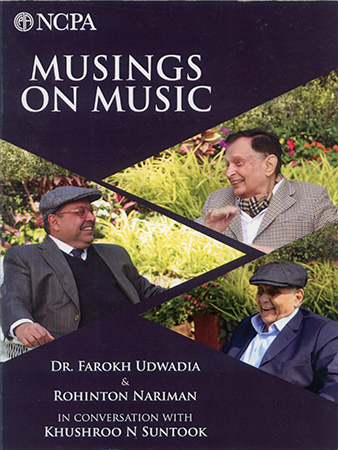
Cover of the CD made for private use only
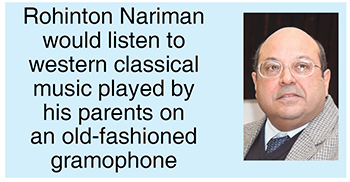
Nariman, with his prodigious memory, remembers the year of the performances he attended, the names of the artistes, the orchestras, the conductors as well as the venues. He is passionately fond of the late romantics like Richard Strauss and Richard Wagner. As far back as he could remember, he would listen to western classical music played by his parents on an old-fashioned gramophone. His earliest memory is listening to Gustav Mahler’s Symphony No. 4 and strangely, the very first concert he was taken to during the Proms at the Royal Albert Hall was the same work. He disliked studying the piano but nevertheless did well. His greatest pleasure was to go to the British Council Record Library and particularly to Rhythm House to listen to the records he could not afford on account of his limited pocket money. He narrates an amusing story about a young Zubin Mehta, aged 26, who was invited to conduct the Schumann Cello Concerto played by the Berlin Philharmonic Orchestra. Mehta was so nervous that he went on stage without buttoning his fly. It was the concert master who alerted him to the situation and, says Nariman, "he did the needful before taking a bow.”
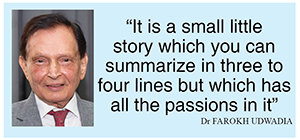
Initially Udwadia could not bear the opera. A friend bought tickets for him and his family for The Magic Flute by Mozart and he was "completely floored” by the experience and became an ardent fan. "What makes opera great? It is just a slice of life. You hear great music, great voices. It is a small little story which you can summarize in three to four lines but which has all the passions in it. Every time the passion comes in, the story is magnified 20 times over by the singer. The music, the setting and the singing are literally thrown at the audience and hits them in the heart, uncensored by the brain.” Otherwise how could you accept that a character who is dying can sing powerfully and loudly. Nariman enjoys both German and Italian operas equally. He was fortunate to study law at Harvard where he had a festival ticket and saw 10 concerts of the Boston Symphony Orchestra. As luck would have it, in New York he lived very close to the Lincoln Centre, with its four great halls, and saw four to five concerts a week.
The importance of patrons and their contribution to music was also discussed — heads of states, kings and queens, emperors and dukes who were important sponsors for great music. It was regretted that Mozart and Franz Schubert, both of whom were geniuses, had no sponsors who could support them and alleviate their penury and poverty. This type of patronage continued even in the 20th century. Suntook narrated the story of the Wealthy Rothschild family who opened their house to several musicians and helped them to recover from mental illness and poverty. Each composer had to write a song in a book which would only be sung by a member of the Rothschild family. Charlotte Rothschild, a well-trained soprano performed an entire program of these unique songs by Frédéric Chopin, Wagner, Liszt and Robert Schumann at the NCPA.
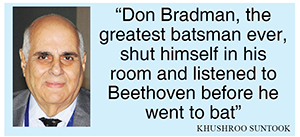
Suntook mentioned that Don Bradman, the greatest batsman ever, shut himself in his room and listened to Beethoven before he went to bat. Udwadia’s love for classical music helped him when he was very young and stressed, looking after very ill patients. Lying awake at nights he would listen to Bach. Udwadia finds it very useful to introduce his patients to music, especially that of Bach which calms the person, reduces the blood pressure and pulse rate especially before the patient goes into surgery.
"Music is therapeutic. It reduces the need for analgesics, painkillers and is useful not only for patients who are convalescing after surgery but also in wards for chronically ill patients. I have even recommended it to outpatients particularly those who are anxious and stressed. I suggested that a young girl who hadn’t slept for four weeks in spite of being prescribed with sedatives and tranquilizers listen to Mozart’s Clarinet Concerto. Though she did not like classical music, she came back after two weeks saying that, thanks to my suggestion, she has begun to sleep again.” He has used this on at least 100 people and not one of them has said that it has not benefitted them in some way or the other. Pieces which he often recommends to people who know music are the adagio of Mozart’s G major Concerto, the 2nd movement of Beethoven’s Violin Concerto or the adagio of Malher’s 5th Symphony and Chopin’s nocturnes. "All this was hearsay but now it bears the stamp of science. It has been shown conclusively how music acts. It works on the neuroendocrine apparatus which controls the immune system. Dr Claudius Conrad, a Boston based surgeon, suggests that a person who is critically ill and listens to Mozart has a sudden burst of the growth hormone which is important for healing.”
Nariman narrated a story when his daughter, Nina, was seven months in his wife’s womb and they went for a concert at the Homi Bhabha auditorium. "Nina started kicking as soon as the music started playing and stopped when the music stopped.” Udwadia added that a professor in California maintains that a baby recognizes the music it has heard as a fetus in a womb.
There was a general consensus that western classical music has not developed in India to its full extent and few Indians excel in the playing of western classical music as Indian music is so rich and varied. In spite of this Suntook feels "Western classical music is present in every continent, every city, and it taps the universal part of us. In India, we tend to downplay it but it needs more encouragement.” He quoted the culture minister of Britain who said that culture matters as it reflects the personality of the country, the values of the people and it is the induction of culture into the minds of the citizens which results in civilization. Explained Nariman, "Article 29 of our Indian Constitution is the only one of its kind in the world which specifically lays down that the cultural rights of any section of the citizens of India should be preserved.” For Udwadia, music stems more from feeling and emotion than from the intellect. "When you are alone and listening to music you forget the outside world and delve deep within your psyche and renew yourself. Renewing yourself over and over again makes you a better human being.”