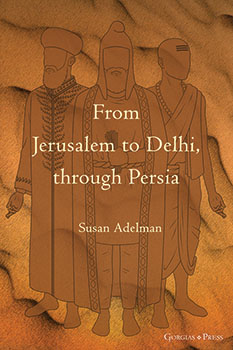
From Jerusalem to Delhi, through Persia by Susan Adelman. Published in 2022 by Gorgias Press, Piscataway, New Jersey (USA). Pp: vii + 330. Price: US $ 35.
Ram Jethmalani, the legendary and colorful lawyer who died some three years ago at the ripe old age of 95, was known for many exploits and accomplishments. To those must now be added being responsible, even if only indirectly, for this interesting book

which attempts to explain the connections between Israel, India and ancient Persia. Its American author, Susan Adelman (pictured), a pediatric surgeon by training who also identifies as an artist and a silversmith, traces the linkages between Judaism, Hinduism, Zoroastrianism (and Buddhism, for good measure) as well as the myths, legends, literature, customs and languages of the three countries over the centuries. Jethmalani was responsible for introducing Adelman to the delights of India — and providing her with introductions and logistical support for her researches which led up to this and at least one other book — after the two had got to know each other in the late 1970s (the author’s husband was then a professor of law at an American university which gave Jethmalani shelter when he was on the run during the 1975-77 state of emergency in India).
This tome, it has to be said, is a bit of potpourri. There is travelog, philosophical musings, historical reflections, cultural commentary, mystical experiences and dollops of personal anecdotage covering a variety of topics. If there is a central question it addresses, it is: "What is it with Jews and India?” Adelman attempts to answer that question based on her own numerous journeys to that fascinating land undertaken over a period of nearly half a century, thanks in significant part to the Jethmalani connection.
She begins the book by tracing the entry into India of successive waves of Jewish migrants, most of whom came for either refuge or commerce. The traffic started as early as the 10th century BC, during King Solomon’s reign, and continued well into the 16 th century AD. Unsurprisingly, recent decades have seen a reverse exodus, with many of the settled Jews choosing to leave India, mainly to escape the economic deprivations which became a constant feature of Indian society from around the 1970s. Adelman then discusses the "wandering Jews of today,” the traction that Buddhism and Hinduism have gained within Israel, and the political, economic and cultural ties between Israel and India. The last of those themes leads her to discuss a wider point, namely, that "Israel and India were not just part of the British Empire, both once were part of ancient Persian empires, the empire of Alexander the Macedonian, the Timurid Empire and the Muslim empires that followed.”
An exegesis of the history of Persia ensues, including references to the Achemenids, the Parthian empire, the Sasanians, the advent of Islam, the Abbasid caliphate, the Safavid empire and the Iranian Revolution of 1979. What struck Adelman in the course of her research was "the remarkable number of religions that were born in Persia.”
Most of us have heard of Zoroastrianism, but what were Mithraism, Zurvanism, Mazdakism or Mazdeism? Who were the Mandaeans, Manichaeans, Yazidis or Yarsanis? Did Zoroastrianism or any of these other religions influence Judaism, Christianity or Islam? Do Zoroastrianism and Hinduism really have common origins? Does it matter?
Adelman pays much attention to these matters — including to Baha’ism — in subsequent chapters before returning to her main theme, viz the "antiquity of the connections between Judaism and Hinduism.” She admits that "it is impossible to date most of the mutual influences or connections” but proffers the view that "they would have taken place gradually, and considering the age of these traditions, it would be reasonable to think that the relationships between them could have developed over the course of centuries.”
Of particular interest to readers of this journal might be two chapters in the book, one discussing commonalities between Judaism and Zoroastrianism (given the historical and cultural links between the peoples of Israel, Mesopotamia and Persia) and the other arguing that "(d)espite (the) differences in their evolution, many similarities continued between the gods of Zoroastrians and Hindus and between their respective languages.” There is, predictably, also a section specifically devoted to Parsis, which includes the obligatory nod to modern-day stalwarts of the community such as maestro Zubin Mehta, lawyers Soli Sorabjee and Fali Nariman and industrialist Nusli Wadia. Adelman ventures the opinion that "Parsis have lived comfortably in India for generations” because "(t)heir religion has a common origin with Hinduism…” — an observation which will resonate with those, like the political gadfly Subramanian Swamy, who have long argued along similar lines in domestic debates on tolerance and multiculturalism.
The book does not shy away from discussing difficult issues. One of them concerns Jews who marry non-Jews. "Many synagogues refuse to give mixed couples full membership, though increasing numbers do go out of their way to welcome both members of such families.” Echoes of the perils attaching to inter-communal marriages in India? Another, a more Western problem, relates to the increasingly hostile environment that Jewish students face on campuses from politically correct campaigners who spew venom against Israel. "Universities,” laments Adelman, "are also seeing a resurgence of anti-Semitism, with visible signs of Jewish observance potentially problematic on campus. And the student who is actively harassed in college will learn to conceal his Judaism, internalizing the message that being Jewish is embarrassing, or dangerous.”
All in all, this is an interesting book which, despite its somewhat disjointed structure, offers much food for thought. What comes through, most of all, is a warmth towards India which is as unmistakable as it is genuine.
Iyer is a UK-based barrister and legal academic.