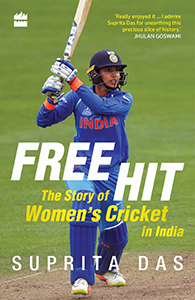
Free Hit: The Story of Women’s Cricket in India by Suprita Das. Published in 2019 by Harper Sport, an imprint of HarperCollins Publishers, A-75, Sector 57, Noida, Uttar Pradesh 201301; website: www.harpercollins.co.in. Pp: x + 260. Price: Rs 499.
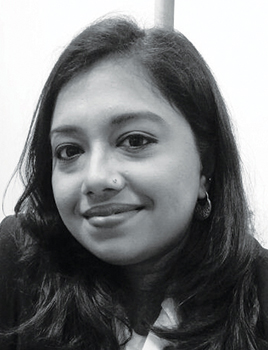
With a journalist’s eye for detail, Suprita Das (pictured) lucidly shows the journey of Indian women’s cricket. From the inaugural Test series against West Indies in 1976 to 2017 when India made it to the ICC (International Cricket Council) Women’s cricket
World Cup final at Lord’s, the 41-year-old journey is revealed not just in facts and figures but through anecdotes and stories of courageous women who struggled for gender parity, overcame sponsorship difficulties and tackled the indifference of cricket administrators. The book is factual and sociological with the dominant narrative being the stories narrated by players, past and present. Historical facts like India staging the first ever Women’s World Cup in 1978 and the wealthy Board of Control for Cricket in India (BCCI) takeover of the Women’s Cricket Association of India (WCAI) in 2006 are interspersed with the stories of players and matches. The author also provides philosophic dimensions in the book when she narrates the travails of women journalists and TV presenters who have entered the game in the 21st century. She concludes that cricket’s treatment of its women, both players and media, must change and they should be respected as professionals and not for their looks and figure.
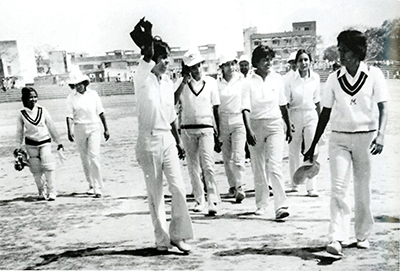
Diana Edulji (3rd from l) celebrating a 17-wicket haul during the 1976
series against West Indies Photo: Rajeshwari Dholakia
Das has provided fascinating insights on those who laid the foundation for women’s cricket in India. Parsis were in the forefront in these pioneering ventures. Aloo Bamji from South Bombay started India’s first women’s cricket club, the Albees, for girls in Bombay. The club conducted nets for girls at the Cricket Club of India (CCI) on Wednesday evenings and Saturday mornings. The first Parsi woman cricketer to join this net practise was Tina Lalo (a cousin of former Indian wicket keeper Farokh Engineer). Neeta Telang and Nutan Gavaskar (Sunil Gavaskar’s sister) founded the Indian Gymkhana cricket team in Bombay. Then there is Mahendra Kumar Sharma from Uttar Pradesh who set up the WCAI, registered it under the Societies Act of Lucknow and held the first women’s national cricket championship in 1973 in Poona.
However, the most renowned Parsi cricketer is Diana Fram Edulji, who has remained connected to the game as a player and then administrator for nearly five decades. At present she is a member of the Committee of Administrators looking after cricket in India. Earlier she was also a representative of women’s cricket in the BCCI. Das provides a wonderful insight into the baptism by fire of Edulji. As a courageous young schoolgirl she started playing tennis ball cricket with boys in Badhwar Park, the residential complex in Bombay for officers of the Central and Western Railways. The daughter of a Western Railway officer, she enjoyed bowling to the boys and became a member of the colony cricket team. But playing forward on a matting wicket without prior experience against a six-foot-tall fast bowler led to a major accident. The ball banged on her face and she lost four of her front teeth. She needed an operation and the dentist put in dentures for her. But she did not give up and soon became a useful all rounder.
As Das has written, this was the first indication of Edulji’s incredible determination and willingness to overcome adversity. A left arm spinner and useful batter, Edulji’s forte was her attitude, revealed in 1976 against West Indies, in the fourth Test at Patna. India was tottering at 25 for five, chasing 55 for a win on the final day on a difficult pitch. Edulji, who had earlier taken three wickets, decided to counterattack, hit boundaries and guided India to a five-wicket win, with a sweep to the square leg boundary.
The author has aptly used incidents in her portrayal of several cricketers. She has shown how Edulji used her persuasive skills to obtain money from the Chief Ministers Fund to sponsor the Bombay girls selected in the Indian team for a tour to New Zealand. Their allowance was just a dollar a day and so they stayed as guests in houses of either Indians or local players. Edulji and Fowzieh Khalili stayed with a Kiwi family and arriving at the house in the evening they were offered tea. The girls declined but realized their faux pas when they enquired after dinner. The hostess said, "But I asked you earlier if you wanted tea and you said no!” In New Zeland tea equalled dinner, a lesson that Khalili and Edulji learnt the hard way.
Das shows that Edulji was a gutsy competitor. Accustomed to sharing bats, gloves and pads, Edulji was overawed by Sir Richard Hadlee’s "Crown” bat. She had a wager with Hadlee that he would grant her a wish if she hit a six in the Test match. She achieved the feat and went to Hadlee and took possession of the prized Crown bat.
The team also trusted Edulji fully. During the 1978 World Cup, the Indian team was not paid their dues. They threatened to boycott their last match against Australia at Patna. They only relented when the organizers assured them the gate money would come in after the first hour and the players would get paid. The responsibility for negotiations and collecting money was given to Edulji. The role of this Parsi girl from Bombay in the development of women’s cricket in India is legendary. She was employed by Western Railway, but retained her pioneering spirit. She persuaded the then minister for railways, the late Madhavrao Scindia, to form a Railway’s women’s cricket team. The Indian Railways not only provided employment to dozens of women cricketers but also often organized the national championships.
Edulji has all her life been a crusader for promoting women’s cricket in India as have been other stalwarts like Shanta Rangaswamy, Purnima Rau, Shubhangi Kulkarni, Anjum Chopra, Mithali Raj, Jhulan Goswami and so many others whose travails and successes have been narrated by Das in her thought provoking book.
NOVY KAPADIA
Kapadia is a versatile sports commentator and author.