Paris based watercolorist, Danesh
Bharucha had his maiden exhibitions in India
Parinaz Gandhi
It was at Villa Savaric on the French Riviera that Danesh Bharucha, then 21 years old, spent his first 11 months in France as the guest of Sir Dinshaw (Fali) Petit in 1970-71. It was at the same elegant mansion that Bharucha studied watercolor landscape painting under the famous Belgian artist Laurent Moonens. In appreciation of both, Paris based Bharucha named his maiden solo exhibitions in India in February-March 2018 "Villa Savaric” and dedicated it to Moonens.
Danesh Bharucha's painting Villa Savaric Revisited (Eze Village)
Danesh Bharucha Photo: Gautam Rajadhyaksha
Sponsored by the Alliance Francaise in Poona and Chandigarh, of the 78 of Bharucha’s paintings and sketches on display, the most valued work was not surprisingly Villa Savaric, priced at Rs 1.5 lakhs. "Many of the landscapes in my current exhibitions are of the south of France, both the Riviera and the mountain landscapes and Provencal villages, some miles inland from the Cote d’Azur,” wrote Bharucha in his email responses to Parsiana. The other works by the Indo-French artist that caught the eye of reviewers at Poona’s Darpan Art Gallery from February 15 to 26 and the Alliance Francaise galleries in Chandigarh from March 1 to 7 were done in the African cities of Abidjan, Nairobi, Johannesburg, as also in Jerusalem, Moscow and Kathmandu.
"Villa Savaric belonged to Sir Dinshaw Petit whose wife Sylla was J. R. D. Tata’s sister (Sylla and JRD’s mother Suzanne was of French origin). Sylla had just died when I arrived at Savaric. And although most of the members of JRD’s immediate family are buried in the Tata family crypt in Paris, Sylla was buried in Eze village where the Villa Savaric still is. But the Petits sold it about 15 years ago,” revealed Bharucha. Moonens was commissioned by the Petits to paint all the portraits of the family over the years, states Bharucha.
Water color painting is a particularly challenging medium for even if one stroke goes wrong, you can’t save the painting, explains Bharucha who was inspired to work on more than 600 paintings. While most of his watercolors feature landscapes, he occasionally portrays humans, animals or still life. "I have always maintained that the most successful watercolors are those that are done on the spot, plein air (in the manner of a 19th century style of painting outdoors which became a central feature of French impressionism), and rather quickly,” maintains 68-year-old Bharucha. To demonstrate his art, he showed art lovers in Poona how he could complete a canvas within an hour and 20 minutes. Some of the paintings at the exhibition were done within 30 minutes.
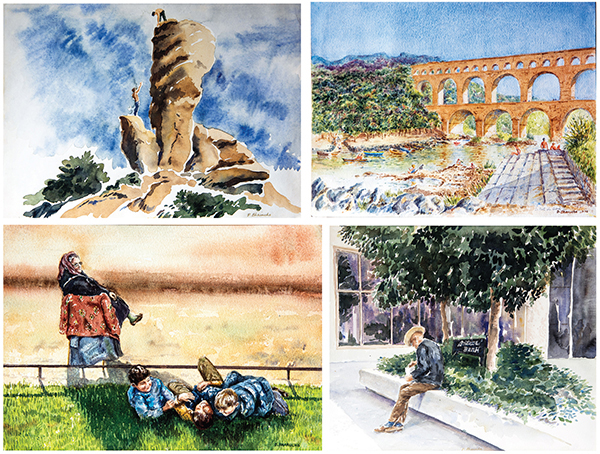
Bharucha’s watercolors (clockwise from top l): The Summit — Mount Lemmon, Arizona;
Le Pont du Gard; Interlude in Tucson, Arizona; The Scuffle
Sketch of Nicolas Nancel at home — Chantilly
"My pen and ink sketches are also very quick works: five minutes is my maximum. Even if I have not completed a drawing in that time, I stop. Later when I look at it, it looks complete in any case. The short time devoted to each sketch is what gives it an immediacy, a fresh touch; much like a candid photograph. But not as easy as a photograph, of course,” he comments. "Anyone can take a fabulous photo today as a result of iPhones but can everyone do a quick sketch that catches a moment?” his rhetoric statement was carried in The Indian Express of March 4. Bharucha had taken a year’s course in figure drawing at the Ecole des Beaux Arts in Paris where he was able to master the art of pen and ink drawings. Residing in the suburbs of Paris, on his frequent travels by metro, he says he always carries his sketch pad.
Working for the US Embassy in France for 31 years of which 24 were spent as administrator at Voice of America (VOA), when traveling on work assignments the bachelor would use his weekends to pursue painting. "I have never lived off my art sales,” states Bharucha, clarifying, "In France, making a living off art is very hard as there are just too many pretty decent artists.” When the VOA hub office in Paris was closed down in 2010, Bharucha obtained a TESOL (Teaching English to Speakers of Other Languages) diploma from the School for International Training in Vermont, USA and has since taught at various language institutes in France and the Nagarvala School in Poona on his biannual visits to India where he loves educating children.
Bharucha’s primary education was at the Sardar Dastur Hoshang Boys’ School in Poona and secondary education at St Stanislaus School in Bombay. Graduating in English and French from St Xavier’s College, Danesh had stood first at the Bombay University in both the Inter Arts and BA examinations, according to his life profile.
It was from his father Nusli that Danesh learnt the basics of watercolor painting. Being the sole representative for Singer sewing machines in Poona, Nusli had had no formal training in art but was "quite a talented watercolorist,” according to the son. Mother Mani Noble-Bharucha was a professor of English and French at the Wadia College in Poona for several years before she became principal of the Dastur Girls’ School in the same city. When Sir Dinshaw Petit invited her to take charge of the Petit Parsi Orphanage in Bandra, the family relocated to Bombay where she succeeded in transforming the institution into the prestigious Avabai Petit Girls’ School during the 17 years she was its principal. Danesh’s elder brother Farsheed who studied commercial art at the J. J. School of Art in Bombay later became a comics book publisher in France and now lives in Paris.
"Over the years, the number of Indian or Pakistani born Parsis has dwindled in France and today we are only 12 or 13 in the whole country,” conveyed Danesh, recalling the earlier years when there was the Paris Zoroastrian Association and he would attend prayer meetings and social events. He described himself as "quite a strong believer in the precepts of Zoroastrianism.” Naming Jehangir Sabavala as a Parsi artist whose work he admires, Danesh added, "I do know that Parsis have made a huge contribution to the appreciation of art in India, whether western or Indian, just as they have kept alive the passion for western music in India.”
At the last exhibitions, Danesh’s favorite work was The Summit, a large watercolor of two young men climbing a rock in the Arizona desert. "I was very happy with the success of my Poona exhibition… (that) generated many sales, perhaps because my prices are not high,” he told Parsiana. While most of his paintings were in half imperial size (18” x 24”), the other exhibits varied from 7”x 9” to 36”x 44”, with the prices ranging between Rs 9,000 and Rs 45,000. "The Chandigarh public that visited my show was appreciative but did not buy much, perhaps because their interior décor is not western, and watercolors of France and Africa would not have been quite right in their homes.” He realized that the "reception in India for watercolor work is very positive. This is also true for America, and watercolor is often called ‘The American Medium.’ But in Europe, oils and acrylics are more commercially viable.”
For the watercolorist, "the most fulfilling moments in my two shows… always had to do with children viewing my works.” He shared the feedback of "one little boy at the Poona show who stood transfixed before what I personally considered one of my least interesting works: it was a balcony in Vancouver with some potted geraniums and the Lion’s Gate Bridge in the misty background. When I asked him why he was so taken with this picture, he looked at me and said, ‘I think I like it because when I look at it, I just want to be inside that painting.’”