Sooni Taraporevala experiments with a new medium to film
the story of two Bombay boys who follow their dance dreams
Farrokh Jijina
"I was anyway dying to get behind the camera again and when they (Memesys Culture Lab) proposed that I should direct their virtual reality (VR) film, I jumped at the chance,” says filmmaker, writer, publisher and photographer Sooni Taraporevala of her latest English film, Yeh Ballet. "I am always keen to experiment with new things,” explains Taraporevala. The "15-minute 360° VR film” is about two real-life boys, 15-year-old Amiruddin Shah and 21-year-old Manish Chauhan from disadvantaged backgrounds who dream of making it big in the world of ballet. The filmmaker told the newsmagazine The Wire on June 7, 2017, "I saw them dance and they took my breath away. I found myself getting teary-eyed. It’s beautiful and rare to see such natural talent.”
A VR film is generally shot with about four to 12 cameras, which gives the viewer the feeling that he is actually there on the set or on the spot where the movie is being shot. Taraporevala says she shot Yeh Ballet with six. "The fames are then ‘stitched together’ to create a shot,” she explains. Taraporevala’s last directorial venture, Little Zizou, a comedy about an 11-year-old soccer-crazy Parsi boy won the "Rajat Kamal” National Film Award for Best Film on Family Welfare at the 56th National Film Awards (see "Zizou awards,” Events and Personalities, Parsiana, April 7, 2010).
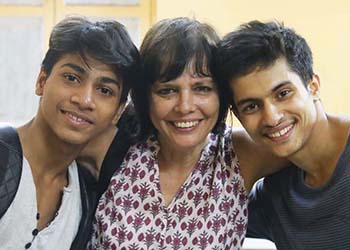
Amiruddin Shah, Sooni Taraporevala, Manish Chauhan Photo: Rohan Raut
Chauhan and Shah (back to camera)
Over tea at her elegant South Bombay residence on June 15, Taraporevala, award winning script writer of Salaam Bombay! and The Namesake, describes how Yeh Ballet came her way. Her son Jahan Bativala, a student at Brown University, USA, who played the title role in her 2008 film, was interning for Memesys, which is a "cinema and new media studio at the intersection of science, philosophy and culture,” according to their website.That was what got her interested in exploring the medium further. You cannot let anyone within a three-foot radius of the cameras, explains the Padma Shri awardee. With the "rig,” as she calls the cameras, placed in the middle of the studio, the boys were made to dance around it without coming too close, enabling the viewers to virtually trace their moves. "It was like shooting with one hand tied behind your back.”
Compared to Little Zizou which had a 40-day shooting schedule, Yeh Ballet was completed over nine schedules between June and December last year. Ideas for the subject of the film were shortlisted by Memesys. "They gave me a list and I jumped at this one as I had learnt ballet as a child,” Taraporevala said. Also, she was "fascinated by this story of the two boys who had never heard Western classical music before.” With the efforts of their Israeli coach Yehuda Ma’or who spotted their talent, after two years the duo was able to get placements at American ballet schools. "Imagine, till two-and-a-half years ago, they did not know anything about this dance form. Now the best ballet schools are vying for them,” the filmmaker exults.
VR eyeglasses in place, with a head set for the sound to come through strapped on, we settle down in Taraporevala’s drawing room to watch the film. Jahan, credited as a production assistant in the film, helps in adjusting the focus of the viewing glasses and the volume of the sound in the film. Whizzing suburban trains where the protagonists Shah and Chauhan share their dreams, 360° views of the studio where the boys are being put through the paces by Ma’or come alive. The protagonists share their trepidation at "their second time only at the airport.” The viewer needs to turn his/her head upwards or sideways or even at 360° to get views of what is ‘around’ the actors, or ‘behind’ them, to experience the VR.
It’s not only technical wizardry though. The director has made the human interest angle come alive on film: the boys’ trepidation over visa interviews, excitement at actually getting one, advice from the parents on how to be humble, and from the taxi driver colleagues of Chauhan’s father on the importance of taking medical insurance before the boys fly off to the USA. Ma’or talks about the potential of his protégés and how angry he was that their visas were refused in the first instance. Subtitled in English (some of the dialogs are in Hindi), the film made its debut at the Sheffield Documentary Festival and London Indian Film Festival in late June. "I got a lot of audience reactions,” says Taraporevala who was not present for the screenings. "A lot of people wanted to see a sequel, but there isn’t going to be one,” she stated, in a follow up phone call with Parsiana on June 29. That was also the day The Press Trust of India announced on their website that Taraporevala was invited to join The Academy of Motion Picture Arts and Sciences, USA, along with film stars Amitabh Bachchan, Priyanka Chopra, filmmakers Goutam Ghose, Buddhadeb Dasgupta and others. Members of the Academy vote for the best American and foreign films for the Oscars each year.
Taraporevala is present in many frames in the film: at the railway station when the boys do a happy dance; peeking out while the boys are dancing or just watching them speaking. Hitchcockian, we ask her? (Legendary film director Alfred Hitchcock always made a cameo appearance in each of his movies). "No, no, I had to be in the frame. Remember it’s a 360° view. The four cameras see everything,” she tells us. She intentionally kept out of the family shots of the protagonists as she wanted the intimacy of the kith and kin of the dancers-with-dreams to emerge, she reveals.
If one is not in possession of a VR headset, the film can be watched on Youtube. "If watching on your computer you can move your mouse or your finger on the track pad to see 360°,” she tells us. If watching on a phone, you can either move the image with your finger or move the phone and the image will move, she adds. Viewing a 360° film may become less cumbersome as technology improves (with lighter headsets), foresees Taraporevala.
Chauhan, who is currently studying at Oregon Ballet Theatre School with a full scholarship of one year and has also been a part of one month intensive program at California Dance Arts School, says this about Taraporevala in an email to Parsiana: "(She) really mentored us and helped us in many ways. She played a pivotal role in getting us here. She has always been like a caring mother to us. And I would like to thank her for all the help and a lot of love and support. It wouldn’t have been possible without Yehuda and her.” The dancer says he now understands "what it means to start ballet at an early age... And I got (a) chance through this movie (to) put that across to all aspiring dancers.” He aspires to be "very famous and tour around the globe and represent India in... ballet, and bring ballet to India so dancers don’t have to travel abroad for good training. Because not everyone can afford it or get sponsors or get noticed.”
"It was an amazing experience… I’d love to do more of these (films) if I am offered,” shares Taraporevala, who is now working on a historical Hindi television series. "I cannot tell you more about it at this stage,” she says.