Renowned physician Dr Farokh Udwadia makes
a case for a more holistic, less machine oriented approach to patients
Farrokh Jijina
The past, present and future are not contiguous, they are intermingled,” stated physician Dr Farokh Udwadia at an online public talk titled "Medicine in Bombay through the ages” organized by the Mumbai Research Centre (MRC) of The Asiatic Society of Mumbai (ASM) on National Doctors’ Day, July 1, 2021. Udwadia took his audience through the diseases and pandemics the city has seen in the last three centuries, and his vision for medicine in the future. "I hope this (current) pandemic does not go the way of the Spanish flu,” that reportedly took 17-18 million lives in India in the second decade of the 20th century, stated the doctor. 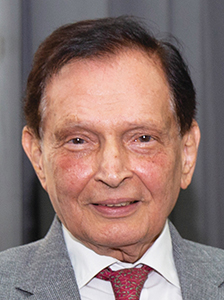 "The (corona) virus treats everyone the same… All are in the same boat… We have to look at the virus in a much broader sense…We have to look at humanity as a whole,” he stated. "Only globalization of care and concern for the human” can save us, stated the celebrated diagnostician, teacher and writer. "But no pandemic goes on and on…it has to end,” he said.
Diseases like plague, cholera, small- pox and malaria in the 1700s must have caused "significant decimations” of the country’s population, stated the physician. These were rampant in the West too, well into the 19th century. In the next century, these were "reasonably controlled” in the West, but there were endemic pockets of infection in the city that burst its boundaries to create epidemics. The reasons: climatic conditions, soil, socioeconomic factors, dogma and superstition, he stated.
The outbreak of plague in the last decade of the 19th century caused much social upheaval. "Volunteers would smash open doors, take the infected to hospitals or to quarantine in large tents… family members hid patients… riots erupted…hospitals were attacked.” Reportedly half of Bombay’s population left the city. "Many died…others spread infections.” It was much like the exodus that we saw in 2020 when migrants fled from the city during the current pandemic, said Udwadia. Recalling Drs Waldemar Haffkine and Nusserwanji Choksi, the physician narrated the stories of their trials and tribulations during the outbreak of plague and thereafter. The discoverer of the plague vaccine, Haffkine, gave himself and his assistant Dr Nusserwanji Surveyor "four times the normal dose, fell ill, but recovered.”
Udwadia recalled the work of Dr Edward Jenner who pioneered the concept of vaccines and created the smallpox dose. Malaria that kills one million people in India alone has no vaccine, he bemoaned. Medicine in the early 20th century got a fillip thanks to the discovery of penicillin by Dr Sir Alexander Fleming. "Then came a plethora of antibiotics… Overuse of antibiotics can result in mutation of viruses,” stated Udwadia giving the example of strains of drug-resistant tuberculosis-causing bacteria. "From the cauldrons of war” have arisen many advances in medicine and surgery, he said, specifically naming orthopedics and plastic surgery, and a better understanding of trauma.
While medicine cures, the side effects cannot be ignored. "Some diseases could be spawned by doctors in hospitals…They perform dangerous operations… carry out many invasive procedures.” The other danger to the practice comes from the social aspect, when the profession builds itself up so much that "for every little thing the individual will run to the doctor… That is good for the profession but not for the individual,” he stated. Many professionals believe that the patient must be kept alive "at any cost…  This is tragic… may lead to financial ruin… Doctors now understand that there are limits beyond which it is pointless to proceed (to provide care),” stated the physician. In providing the flipside of medicine, the doctor referenced the work of Viennese theologian and philosopher Ivan Illich who believed and wrote that the medical establishment was a major threat to health. "I am sure if Ivan Illich fell ill, he would take no medicine,” he quipped.
Bemoaning the "dreadful” fall in ethics, Udwadia stated that the glitter and glamor of machines has so enraptured the modern physician that he pays less attention to the patient. "The advancement of science has dehumanized medicine in some way… The doctor does not have as much rapport with the patient as he does with his machine,” he stated. When doctors are so immersed in the science of medicine, they forget that "medicine is, in equal measure, an art as it is a science,” stated Udwadia who is often lauded for his appreciation of the humanities. (The doctor is an honorary Fellow of the Asiatic Society since 2018.) "The art of medicine lies in the application of science to the holistic overall care of a patient,” said the physician.
What does the future hold? Artificial intelligence (AI) in medicine will solve many problems, but would lead to atrophy of the brain, he quipped. "You will stop thinking… Of course use AI in medicine, but with discretion,” was his prescription. "Medicine is going to become more and more machine oriented… There will be a time when patients will ask for a human doctor!”
Introducing the physician, senior counsel and trustee of the Asiatic Society Navroz Seervai stated that one could well call Udwadia the classic Renaissance man. "Like painter Leonardo da Vinci who introduced himself to the Duke of Milan as ‘I can also paint,’” Seervai believed that Udwadia could well say "I also practice medicine,” referring to the physician’s many interests in art and music. The doctor’s last book, a compilation of nine essays, Tabiyat: Medicine and Healing in India and Other Essays was released in Bombay in March 2018 (see "A toast to Tabiyat,” Parsiana, April 21, 2018).
An introduction to the Asiatic Society’s activities by president Vispi Balaporia and a welcome address by MRC chairperson Dr Shehernaz Nalwalla preceded Seervai’s introduction. The vote of thanks was provided by convener Dr Madhu Kelkar.
More than 500 people attended the lecture, which was available on both Zoom and Facebook, Nalwalla told Parsiana after the event. Established in 2009 to undertake studies on the city and the erstwhile Bombay Presidency, the MRC aims to build a data base of books, manuscripts, maps, paintings, illustrations and photographs. The 217-year-old ASM promotes learning in Asian and world studies and its library holds many rare books and periodicals, ancient manuscripts, painted folios, coins, artefacts and maps.