East Meets West. A selection of Asian and European Art from the Tata Collection in the Chhatrapati Shivaji Maharaj Vastu Sangrahalaya, formerly Prince of Wales Museum of Western India edited by Pratapaditya Pal in association with Sabyasachi Mukherjee and Rashmi Poddar. Published in 2010 by Marg Publications, Army and Navy Building, 148, M. G. Road, Bombay 400001 and the Chhatrapati Shivaji Maharaj Vastu Sangrahalaya. Pp: 196. Price: Rs 1,950.
"You enjoy it even though it doesn’t belong to you. You protect it even though it belongs to everybody.”
— Jamsetjee Tata on a work of art
It was an enlivening day in the rather sluggish history of Indian art when the House of Tatas, recognized for its vast philanthropies to umpteen causes, decided to donate the precious art collections of Jamsetjee Tata’s sons, Sir Dorab and Sir Ratan Tata, and of their wives Meherbai and Navajbai to the Prince of Wales Museum [now known as the Chhatrapati Shivaji Maharaj Vastu Sangrahalaya (CSMVS)]. By one of those happy coincidences that give history a sparkle, this happened at the same time as when the great Rabindranath Tagore had turned late in life to the belief that "only painting has deathless quality” and when the dispute between the Rabindranath Bharati University and the Rabindranath Bharati Society over 300 of his paintings was sought to be brought to an end.
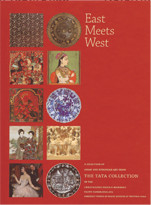
The donation of the art collections was accompanied by a beautifully designed book by Marg Publications entitled East Meets West, sponsored by the Navajbai Ratan Tata Trust, with a scholarly introduction by none other than Pratapaditya Pal in association with Sabyasachi Mukherjee and Rashmi Poddar. Quoting Rudyard Kipling’s prophecy that East and West could never meet, Pal counters "in the case of the collecting interest and aesthetic taste of the two siblings, however, East and West did meet felicitously, as is clear from this collection. No other collection in the sub-continent acquired both Asian and European works as prodigiously before and since, and how fortunate we are that so much of it remains intact.”
Above: Portrait of patriarch J. N. Tata by Edwin Ward and images of sons Dorab (top, left) and Ratan
Referring to Richard Spears’ remark that by and large both brothers avoided collecting works with religious themes, Pal argues that even so they remained an inspiration for the next generation of Parsis, several of whom such as S. K. Bhedwar, R. S. Sethna, Nasli Heeramaneck, Karl Khandalawala, and N. Bomanbehram were among the most discerning collectors that India has known. Incidentally, the principal interest of all of them remained Indian and Himalayan sculptures, mostly bronzes, and paintings. Many of these collections were dispersed after the death of their owners and so India became part of the great western assemblage of Indian art, both private and public.
Observes Pal: "It is a measure of their civic duty and selflessness that both Tata brothers bequeathed their prodigiously extensive collections to their local museum and thereby to the nation. No other instance of such munificence to a public museum is known in India.”
The director of the museum from 1950 to 1974, Dr Moti Chandra, made the significant point that had not the Tatas collected art objects from different parts of Asia and Europe, the public would have been deprived of seeing the arts of other countries which is very essential for liberal education, at least in the realm of art.
Above, l to r: 19th century Pashmina rumal; porcelain vase and cover, circa 1890; tin-glazed and lustred pottery flask and cover, circa 1880-90; 18th-19th century boxwood statue of Dongfang Shuo, Qing dynasty; Alongside, far left: Lidded vase in the form of an incense burner, circa 1890; 18th century silver water jug
Pal’s scholarly introduction to East Meets West covers details of Indian decorative arts, Indian arms and armor, Indian textiles, Indian paintings and manuscripts, Himalayan art, as well as Chinese, Japanese and Burmese decorative arts and European paintings and decorative arts. Pal dwells on the details, accompanied with illustrations of this "tremendous” contribution of the Tata donation to art in general and India in particular. With exemplary modesty Pal admits that these examples in the catalog exemplify the breadth and depth of the Tata collection and expresses the hope that his "simple” introduction will bring the rich and varied collection to the attention of collectors and art lovers around the world. Needless to say, the Tata donation is the core of the museum’s collection. The book opens on two dramatic, superbly colored portraits of Lady Meherbai Tata (1897-1931) by Sir John Lavery and the other of Lady Navajbai Tata (1877-1965) by J. J. Shannon.
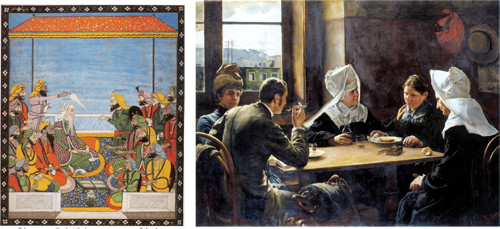
Left: Court of Maharaja Ranjit Singh (opaque watercolor on paper, 1825) Right: Late 19th century oil on canvas At the Crossroads (the World or the Cloister)
East Meets West introduces you to some of the finest Asian and European paintings, assorted works of art by the greatest artists from all over the world. Writing it called for not only deep understanding, a certain reverence and much love, but also a flair for design and an eye for the most eye-catching illustrations. All this makes for an outstanding product that deserves superlative praise and, according to this reviewer, gives it pride of place among the paintings and artefacts that are its subject matter.
East Meets West is a supreme work of art by itself, not a book to be read and laid aside, but to be preserved as a prized possession, "a joy for ever.”
It has been said that the worth of a painting is in the beholder’s pocket, but its value is in his eyes, how much joy he derives from it and for how long. There are no rules, it is highly individualistic, it varies from individual to individual. Take the case of that fine gentleman and artistic genius Jehangir Sabavala. His painting of a serene landscape, whose pre-sale estimate was Rs 60 lakhs, came to fetch three and a half times this estimate, a record Rs 1.7 crores. It is saddening to think that in his finest glory days Sabavala has to struggle with lung cancer. Dinesh Vazirani, CEO (chief executive officer) and co-founder of Saffronart, proudly declares that the Indian art market is on a sustained growth path. At the same time, the sad truth is that this market is supported by a handful of individual collectors — only 20 to 25 of them — a number so small as to be embarrassing for a billion-strong nation.
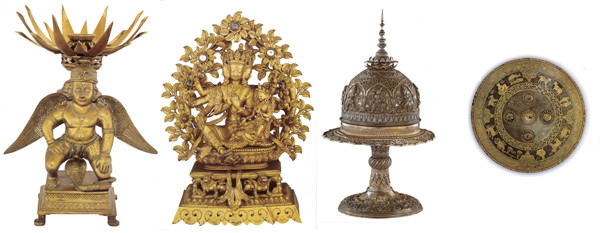
(L to R) Early 20th century brass lamp with Garuda; 18th century gilted bronze Dharmadhatuvagishvara; late 19th/early 20th century silver stand with dome-shaped cover (ext right) Steel with gold damascene shield of Emperor Akbar (1593)
Things would be better if corporate India understood that "a nation is considered great for the culture and art it begets, and Indian corporate houses can play a key role in this aspect of nation-building.” Artists like Ravi Varma, M. F. Hussain, S. H. Raza, V. S. Gaitonde, Suresh Gupta and Atul Dodiya continue to sell at high prices. Art galleries like the Pundole Gallery in Bombay continue to focus on a few artists and diligently pursue their interests. Never to be forgotten in art history is the classic case of Vincent van Gogh who painted an ancient, unused chair whose "meaningness” became apparent to him in a moment of inspiration, a chair which if purchased in the market would have fetched, say, a hundred dollars, his painting of it fetched no less than $ 35 million!
Editors (l to r) Pratapaditya Pal, Rashmi Poddar and Sabyasachi Mukherjee
A former director of the Prince of Wales Museum, Pal has been associated with leading American museums holding Indian collections and has taught in several universities in the United States and abroad. He deeply deserved the Padma Shri awarded to him by the Indian government; in fact, he deserved much more. His associate Mukherjee, present director of CSMVS, has made a name for himself by his recent articles on aspects of Indian art and architecture. Poddar earned her PhD in Indian architecture and sits on various boards as trustee and director. She is also the associate editor of Marg Publications and director of Jnanapravaha Mumbai. Together, the three of them have produced what future generations will accept as a masterpiece. Who knows but the unique donation and the book it inspired may bring about a renaissance in the Indian art field.
BURJOR K. KARANJIA