Stage and cinema actor Jal Khambata was also a painter and writer
Farrokh Jijina
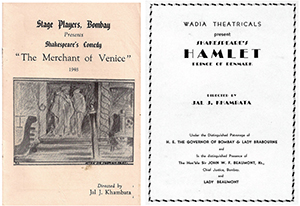
"The untiring energy with which Jal Khambata has labored for 20 long years to study Shakespeare in all his glory has prompted Wadia Theatricals to take this bold initiative (of undertaking the production),” according to a foreword from the producers in the playbill of Hamlet staged in 1935 at the Excelsior Theater in Bombay. The production was the "initial attempt on stage” of Wadia Theatricals, an arm of Wadia Movietone, the film studio established in 1933 by brothers J. B. H. and Homi Wadia.
Veteran stage and Hollywood actor John Barrymore witnessed a rehearsal of director-cum-lead-actor Khambata’s staging of
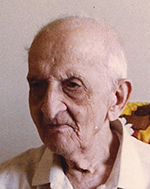
Shakespeare’s classic, according to Phiroze Banaji, a 92-year-old reader of Parsiana. Khambata’s career in Bombay films and stage spanned over two decades. Armed with the program booklet, Banaji, a nephew of Khambata, proudly displays a personal note from Barrymore reproduced therein, offering "sincerest good wishes” and averring "belief in his success.” Elaborating that the Hollywood star, who himself had played Hamlet on the London stage in 1925, could not come to any scheduled staging due to his departure from the city, Banaji mentions that the two actors did indeed meet at the Taj Mahal Hotel. Leaving his only copy of the program booklet, illustrated with scenes from the play with us ["barabar sambhaljo, (look after it well) please”], Banaji followed it up with a brief handwritten note on Khambata, complete with anecdotes and references, on December 20, 2016.
Born in 1894, Khambata graduated from St Xavier’s College in 1915 with honors in English and Persian. "It is not ascertainable what prompted him to make a career of the acting profession,” muses Banaji. He was perhaps influenced by his father Jehangir, a dramatist and writer, nicknamed Jehangir Lambo (tall one), he adds. Quoted in The Parsi Theatre: Its Origins and Development by Somnath Gupt and Kathyrn Hansen, we learn that Jehangir penned almost two dozen plays, including one in Urdu, and two translations of Shakespeare’s Othello and Two Gentlemen of Verona.
One of the early movies that Khambata acted in was Sacrifice, directed by fellow-Parsi Naval Gandhi, Banaji informs us. IMDb (Internet Movie Database), the online compendium of world-wide films states that the story of the movie "addresses the conflict between reformist enlightenment and obsolete, inhuman ritual …the conflict between the king who banned animal sacrifice, and the priest (played by Khambata) who calls for the king’s own blood.” IMDb credits the screenplay of the film to another Parsi, Jamshed Ratnagar. Writing in the 1996 book So Many Cinemas, filmmaker Bhagwandas Garga says "Arguably the most important film of the silent era is… Sacrifice (1927) with Sulochana (Ruby Myers) …and Jal Khambata based on (Rabindranath) Tagore’s play Balidan.”
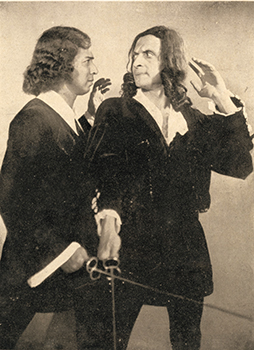
Jal Khambata (top and above right) scene from Hamlet
Scenes from Hamlet
Khambata (right) with John Barrymore
IMDb credits Khambata with a dozen movies between 1927 and 1948, spanning the silent and talkie eras. The listing includes Lal-e-Yaman (Heir of Yemen), a Wadia Movietone production, "an oriental fantasy derived from classic Parsi theater” in 1933. A large part of his film work was with Wadia Movietone, who are in the process of transferring their memorabilia into digital form, according to Nargis Wadia, doyenne of the Indian advertising world and daughter-in-law of J. B. H. Nargis shares that Khambata was her father’s first cousin. Khambata acted in the 1941 Wadia Movietone classic The Court Dancer (Rajnartaki) which was made in English, Hindi and Bengali — India’s first multi-language film, shot separately in the three languages, notes Nargis. The movie credits Khambata with ‘dialog direction,’ with dialog inputs by D. F. Karaka; one B. M. Tata is credited as sound engineer, while the recording was done by Behram Bharucha.
In 1948, "Khambata directed and acted in Merchant of Venice at the Regal and at St Xavier’s College under his own banner of Stage Players, Bombay "and received …rave reviews …I had the pleasure to see the rehearsals and of course the live show,” states Banaji, who attended as a young adult. Nargis, then a teenager, remembers the staging too. She recalls tittering with her friends at the line "All that glisters is not gold,” which, she says, is true to the original, but the young Nargis thought the players had got the word ‘glitters’ wrong. Khambata, a frequent visitor to her childhood home at Matunga, was "very courtly,” she shares. She recalls receiving a copy of extracts from the Shahnameh handwritten by Khambata, copied from the Persian, "which I kept till 1972.” She rues losing it while moving homes in that year.
Getting hitched
Banaji sets the background for Khambata’s marriage with his maternal aunt Pilla: "He was goaded by his younger brother Sam, a professor of physics at St Xavier’s College, to think of settling down.” Pilla, a sister of Banaji’s mother, was called over from Karachi "with the sole object of finding her a suitable match.” Banaji says "the chemistry matched and they were married one
rainy morning in July 1937 at Cama Baug, and in April 1938, a beautiful baby girl (Daulat) was born in Karachi.” Banaji mentions that Khambata was employed at the M. F. Cama Athornan Institute in Andheri as a teacher of Persian from 1946 till 1953.
Daulat, who married Kersi Mewawala and settled in New Jersey from 1972 onwards, recalls, "My father was… gifted by nature through his genes.” She informs us that "he was good at …painting and sketching in all mediums and had a fluent pen of great elegance. I am not aware that he had any formal training in any of these fields,” she reminisces.
The daughter, now 78, says, "As an individual he had no pretensions... (despite) being very well read, he was also the first to admit his lack of knowledge on any given subject.” Daulat says Jal was "clear-eyed and had a liberal way of thinking…” She has "no recollection of him or my mother stopping me from reading any book or going to any movie... Papa had a copy of Richard Burton’s Arabian Nights (which is quite different from a child’s version of these tales). When I was still rather young, I wanted to read the book. He …told me to go ahead and read but doubted I could understand it, which of course killed all desire to read the book,” she states in an email to Parsiana, from the USA. While she remembers her father acting in films when she was growing up, she is "unaware which and when.” She does recall being informed that Barrymore had invited Khambata to go to the USA. Daulat moved Jal and Pilla to the USA in 1977 when her daughter Gulnar was three months old. "They were instrumental in her upbringing,” she recalls.
Actor as artist
Jal "painted and sketched till the last day before he died... landscapes and seascapes expressed themselves through his imagination... At times when he started, he would not know what his brush, charcoal or pencil would create. However, if you saw the finished picture it would strike a familiar chord and you would say this is some place somewhere,” according to Daulat. Friends often asked him to paint a view of the hill or the bay at Bandra (where they lived) or some other place. "He would oblige but was not most comfortable doing this; he preferred to let his imagination roam.” According to Banaji, his uncle "presented beautiful pictures to us and other close relatives in Bombay.” Sadly, none exist, he rues.
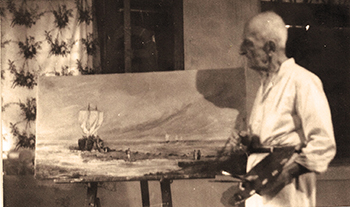
Khambata, painting, April 1975
"He also wrote — on many subjects with an insightful perspective,” Daulat recalls. She has "a collection of his notes and scribbling but they are rather disjointed.” Sharing a biography of Ferdowsi, author of the Shahnameh written by Jal, she informs us that when he was 33, Jal had brought out a slim book of 20 pages, Our Blotting Book under the pen name of Zealo, dedicated to Sir Patrick Geddes, the Scottish biologist and town planner with an interest in painting, who taught at St Xavier’s College. "It is a lecture on the techniques of painting...illustrated with 10 different works,” she states and has offered to share some of the images of the original paintings with Parsiana readers.
"With his command over English and Persian, he became very popular by narrating funny anecdotes at his (Buttonwood) old age home in New Jersey, USA,” Banaji reminisces of the thespian’s twilight years. Jal and Pilla passed away in 1989 within a few months of each other, he concludes.
.