Big and burly, cricketer Polly Umrigar, acknowledged as one of India’s all-time greats, was nicknamed “Palm-tree hitter” in the West Indies
Kersi Meher-Homji
Polly Umrigar, the titan of Indian cricket along with Vijay Hazare and Vinoo Mankad in the 1940s, ’50s and ’60s, was always a schoolboy at heart despite holding many records in Indian cricket. The burly six-footer with a prominent nose and a determined chin gave his all as an adventurous batsman, accurate off-spinner, slip fielder, captain, coach, chairman of the national selection committee and executive secretary of the Board of Control for Cricket in India (BCCI).
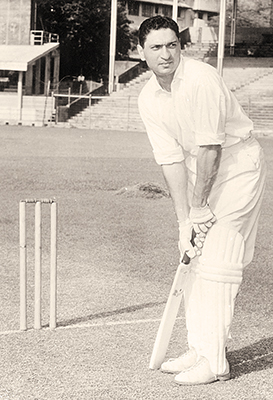
I still can’t believe that he died 14 years ago in November 2006 but happy memories will forever linger with me and with his friends and fans. Full of life, he enlivened boring matches by lifting both sixes and our spirits. More recent Test cricketers respectfully addressed him as Polly Kaka (uncle) and he never hesitated to play maidan cricket with schoolboys, even in his late 60s. Despite his many-splendored successes and being acknowledged as one of India’s all-time greats, he remained at heart a cricket-loving schoolboy.
In the 1950s, when Indian cricketers were called "dull dogs,” Umrigar infused life into the game with his towering sixes. In the West Indies he was nicknamed "Palm-tree hitter” because he was a six symbol of his generation.
Until Sunil Gavaskar came on the scene, Pahlan (Polly) Ratanji Umrigar held almost all Indian Test records: most number of Tests played, most runs scored, most centuries, the first Indian to hit a Test double century and the first to score more than 3,000 Test runs. He scored 3,631 runs at 42.22 in 59 Tests, hitting 12 centuries (highest score 223), took 35 wickets and 33 catches. He captained India in eight Tests, winning two of them and drawing four.
Of the 11 Parsis who played Test cricket for India, Umrigar was in the most number of Tests, scored the most runs, hit the most centuries. Only Rusi Modi had a better batting average (46.00), Rusi Surti took more wickets (42) and wicket-keeper Farokh Engineer held more catches (66). Yet statistics do not tell the whole story. Umrigar was big in every way, in build and heart.
Although Fred Trueman, the aggressive English speedster, scared young Umrigar as he did all his teammates with a barrage of bouncers in England in 1952, Polly went back to the nets and eliminated fear from his vocabulary.
I had the pleasure of watching him score 102 spectacular runs, adding 183 runs with Hazare (146 not out) against Pakistan in the November 1952 Bombay Test. This led to India winning the Test by an innings. I would not have watched these masterful batting displays but for the generosity of Dr Jal Wadia, principal of the Sir J. J. School in Bombay where I studied. Keen on cricket, he paid from his own pocket to take the school’s cricket team to the Brabourne Stadium to watch the above Test on all five days.
Later, Umrigar faced the chin music of the West Indies’ menacing pace trio of Wes Hall, Roy Gilchrist and Charlie Griffith with courage and deft footwork, driving them on the up and with power.
Umrigar kept his best for his last overseas tour. Aged 36 and suffering from a painful back, he top-scored for India in both innings against the terrifying pace of Hall and the spin of Lance Gibbs in the Port of Spain Test of April 1962. He scored 56 out of India’s 197 in the first innings and an unbeaten, heroic 172 in the second. He captured five wickets for 107 runs off 56 overs in the first innings; his victims included master batsmen Conrad Hunte and Rohan Kanhai.
In this match he became only the second Indian cricketer after Mankad to score a century and capture five wickets in an innings in the same Test. (Later, India’s Ravi Ashwin joined them by becoming the third Indian to achieve this "double.” In fact Ashwin performed it twice; against the West Indies in Bombay in 2011 and again, also against the Windies at North Sound, West Indies in 2016.)
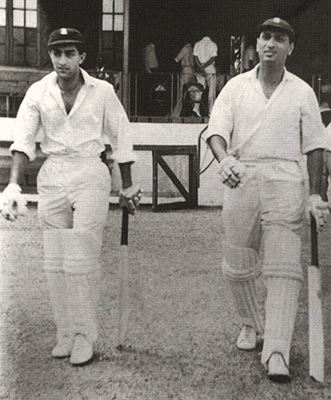
Above: Polly Umrigar (right) walking out to bat with Nawab of Pataudi Jr
"Polly was always solid — solid man and cricketer,” the Nawab of Pataudi (junior) told me. "He was very helpful when I became captain by default in the West Indies in 1962.” At 21, Pataudi became India’s youngest captain on that tour after Nari Contractor was hit on the head and almost killed by Griffith’s chucking bouncer.
Unfortunately, one-day and Twenty20 internationals came too late for Umrigar as he retired from the game in 1962. He would have been a striking success with his huge sixes, nagging off-spin bowling and acrobatic fielding.
One of his regrets was not playing a Test in Australia as there were no Indian tours to Australia from 1948 to 1962, his Test span. Yet his sharp off breaks (four wickets for 27 runs) against Richie Benaud’s team in the 1959 Kanpur Test contributed to India’s first victory over the mighty Australians.
Umrigar was the manager of the Indian team when the elegant teenager Dilip Vengsarkar made his Test debut at Auckland on the 1976 tour of New Zealand. Umrigar was held in such high esteem that Vengsarkar’s guardians who had come to see him off at the airport told Umrigar, "Polly Kaka, as long as you are in charge we have nothing to worry about.”
Umrigar later toured Australia in 1977-78 again as the manager of the Indian team led by the colorful and turbaned Bishan Singh Bedi. The team provided dramatic moments as the series was tied two-all before Australia won the final Test in Adelaide despite India amassing 445 runs in the fourth innings. It was engrossing cricket in direct competition with Kerry Packer’s breakaway, star-studded World Series Cricket.
The tour marked the start of our friendship. As I watched the Indian cricketers do net practice at the Sydney Cricket Ground (SCG), Bedi threw the ball at me saying, "Bowl Kersi, bowl.” Stunned, I bowled to Surinder Amarnath and Ashok Mankad at the nets along with spin kings Bedi and E. A. S. Prasanna. I was in seventh heaven, feeling 10 ft tall.
But Umrigar brought me down to earth. Aged 51, he donned pads and came with a bat in hand to the nets to punish my bowling. Much to his boyish delight, he smashed my slow off-spinners all over the park, sixes galore! But one of my innocuous deliveries managed to beat him and he presented the ball to me.
When I visited Bombay in 1979, he invited my wife Villy and me to his home for dinner. We were cordially welcomed by him, his wife Dinoo and daughter Shireen.
He was in the news again when India beat Australia in the Bombay Test of November 2004 on a spinner-friendly pitch. He had supervised the preparation of the pitch which was marred by unseasonal rains.
When Australian captain Ricky Ponting complained about the state of the pitch, Umrigar hit back by saying that Ponting had erred in using a heavy roller on a moist last-day wicket. Despite oozing friendliness, Umrigar could counterattack, even at 78.
The BCCI has instituted the Polly Umrigar Award, presented to an Indian cricketer for outstanding performance in international cricket. It was instituted in 2006-07, with Sachin Tendulkar being the first recipient. The award includes a trophy, citation and cash prize of Rs.1.5 million. Virat Kohli has won it five times, four times in a row from 2014-15 to 2017-18.
Umrigar’s passing away on November 7, 2006 at the age of 80 of lymph cancer was a personal loss to me. The cricket ball he had presented to me at the SCG nets in 1977 remains on my trophy table, admired and treasured by me and by friends visiting us.