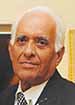
At the age of 80, Rumi Nanavati plays the piano dexterously
Mehroo Kotval
"I taught children at the Yamaha School in Singapore,” recounts professional pianist Rumi Nanavati with a benign smile. "At the school in Singapore one of the children ran around the piano and defied me to catch her during her lesson,” he says with a belly laugh, continuing, "I don’t really enjoy teaching kids.” Needless to say the job did not last very long! He then adds gravely, "Don’t know what the future of music is. There seems to be no patience or inclination to study the piano which has a soul.” He means serious classical piano-playing. A statement born from experience as a professional steeped in music as teacher, lecturer in the history of music and performer for over 60 years.
At his recital on November 15, 2016 at the Experimental Theatre at the National Centre for the Performing Arts, he struck a chord with the audience by beginning with Toccata and Fugue in D minor by Johann Bach, two scherzos by Frédéric Chopin and ended the evening with all 10 pieces of the suite Pictures at an Exhibition by Modest Mussorgsky. He performed for an intimate but knowledgeable audience. The program notes enlighten us that the artiste played at Chopin’s birthplace Zelazowa Wola on the composer’s piano.
As a performer, Nanavati believes he is a medium between audience and the composer. After all he says a musician’s expertise lies in the interpretation of what the composer has written in relation to the age in which he wrote it. Before his navjote, aged around seven years, the rookie started lessons with his unmarried fui (paternal aunt) Gool. "We lived in a bungalow on Hill Road (Bandra) and people would stop by on the road to listen to me. At that time I was ambitious as I was learning pieces way beyond my age,” expounds the Bombay Scottish School alumnus who wended his way to The Trinity College winning a gold medal at age 16. One more gold medal was awarded to Nanavati at The Royal College of Music (RCM), London for his licentiate. Then he proceeded to Moscow to study briefly at the Tchaikovsky Conservatory. He proceeded to Paris where his father’s mama-mami (maternal uncle and his wife) were residing. The added attraction being that "they fussed over me as they had no children.” The budding artist took master lessons from the Brazilian Magdalena Tagliaferro in the French capital. With a grin, he narrates how the irascible piano exponent "stripped off a button from her clothing when she was particularly frustrated and angry with her pupil,” much to the consternation of the pupil.
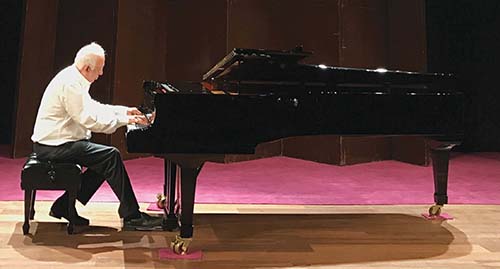
Rumi Nanavati (above) performs in Bombay once again
Harry Lyttler, the well-known British piano teacher of the 1950s in Bombay, spotted Nanavati’s talent and encouraged him to go the United Kingdom. Very soon the teacher-student duo realized that father Rutton, a liquor merchant, was not going to part with a dime to send the young Rumi abroad. Rutton firmly believed that there was no career in music and he must rely on a more professional calling. Rumi reminisces about a much used phrase by his dad "toon jharoo marsé” (you will be a sweeper in life). Rumi plays down this remark saying, "Dad was not encouraging. He urged me to keep piano-playing as a hobby.” Lyttler used his personal contacts and goodwill with trusts — especially the Tata trusts — to garner the money required to study the percussion instrument abroad. "I found my way to Europe thanks to Lyttler and because others worked so hard, I was very motivated. I believe their investment in me was not wasted. I also happened to be at the right place at the right time.”
The contented performer rattles off the celebrities before whom he has played — Queen Elizabeth II, to whom he was presented at St James Palace and the queen of Spain. He met Queen Elisabeth of Belgium when he participated in the Queen Elisabeth Competition named after he for career-starting musicians held in Brussels. He was presented not only to royalty but also presidents and prime ministers. He was also invited to play at Rio de Janeiro, Barcelona, Mallorca. Budapest and several stops in Europe. Having played with the Moscow and Warsaw philharmonic orchestras Rumi believes, "It is still a rarity to have an Indian who plays the piano on the international forum.” It drove him to ask his impresarios: "Why do you make me feel more important than I am?” The rhetoric question is answered in the same breath: "I brought a perspective which is different, which I believe is spiritual (as an Indian). There was a different angle to my interpretation.”
A contemporary of maestro Zubin Mehta, he names erstwhile western music stalwarts who promoted classical music in Bombay in the ’60s and ’70s — Hoshang (Hoshie) Vazifdar of the Bombay Madrigal Singers’ Organisation; Gool Savaksha of the Time and Talents Club; the earnest ladies of the National Association for the Blind for whom Nanvati played gala concerts; Perin Bhiwandiwala and a list is rattled off. He is grateful to all of them for supporting him by arranging concerts and all the hassles that go with them, "so I could concentrate on the piano.” "I played often at the Patkar Hall (and) at the Max Mueller Institute some 30 years ago,” he adds. With nostalgia he recalled Zenobia Vakil at the Mozarteum in Salzburg, Austria. Sotto voce, he adds, "I find Mozart too, you know, too fluid.”
At RCM he performed Johannes Brahms’ second piano concerto in B-flat major, Op. 83 with the college orchestra when he was 20 or 21 years old. This he believes led to some envy prompting a divide between him and the other fellow students. He felt aloof in London and New York but "It is part of the music scenario,” he states matter of factly and then talks of "the warmth of Europe or Singapore.” He also toured India and held recitals in Delhi and Calcutta with both cities’ symphony orchestras whose players performed voluntarily, around early 1970s. "I am still an Indian — not part of their milieu. Color prejudice! I don’t know what I’d do if I lived there.” He refers to his shift back to India, where he has a strong sense of belonging. He lives in Poona, though he "hates the cold.” The bleak Poona winters are not as trying for him as the fact that he is not allowed a piano in his flat as playing it may disturb the neighbors. He lives in an apartment complex built by the Poona Parsee Panchayat and his neighbors are unaware of his piano playing prowess and connections. With no family, the self-proclaimed loner enjoys his own company and garners little attention from others, "Like my (late) mother Silla,” he expands. "I don’t know what tomorrow brings. I live one day at a time,” says the 80-year-old pianist.
He addresses the financial commitment needed to be a musician and believes the "Force” helps him. He admits several Parsi mothers eyed the talented musician as a potential son-in-law when younger, but "marriage entails responsibility...” Silla understood his stand and did not want to force him into marriage. He asks a telling question, "What guarantee that we (a married couple) would be together? What if a spouse departs?”
Surrounded by good friends, the artiste was urged to write his autobiography when there were few and far Indians on the international western classical scene. He completed it sitting at The WZO Trust Funds Senior Citizens Centre in Navsari.He acknowledges that he had little in common with the inmates of the home in Navsari as he penned his memoirs as "I felt purged… I have no airs and graces about myself. People are people. I never coveted anything or felt I wish that were mine.” He has written his biography in detail and it is ‘decomposing’ somewhere in his loft in Poona.
He refers to his non participation in prayers said before meals at the Senior Citizens Centre on the rationale: "To say something without meaning it is making a mockery of it, it’s primordial.” To the agnostic, "God is a creation of the mind... The fire burning is a great thing but it is a figment of my imagination to give it powers... See the misery, the wars because of religion. If you slaughter, where is the belief?” He concludes this strain of thought with "To those who believe in God, no explanation is necessary to those who disbelieve, no explanation is possible.”