Firdos Cambatta’s initiative has resulted
in a green cover for the 23-acre Doongerwadi property in Ahmedabad
Parinaz Gandhi
He sows so that others reap. In the last 25 years, The Serenity Trust that Firdos Cambatta founded with his wife Yasmin has been endeavoring to create awareness and conserve natural heritage through environmental education in Ahmedabad. His latest efforts have resulted in changing the landscape of 100,000 sq m of Ahmedabad Parsi Panchayat’s (APP) Doongerwadi property following the plantation of over 30,000 trees and creating three water bodies.
"His single-minded purpose of creating a green cover for the Doongerwadi has brought back in abundance, good health and oxygen to the otherwise starved industrial area of Vatva,” noted APP president Brig Jahangir Anklesaria (retd), in his foreword to the pictorial booklet Forestation at Parsi Doongerwadi recently sent to Parsiana. The 18-page compilation includes Google Earth pictures of the parched Doongerwadi property prior to 2017 when the bare foliage mainly comprised gando baval as compared to the subsequent verdant green cover in 2020.
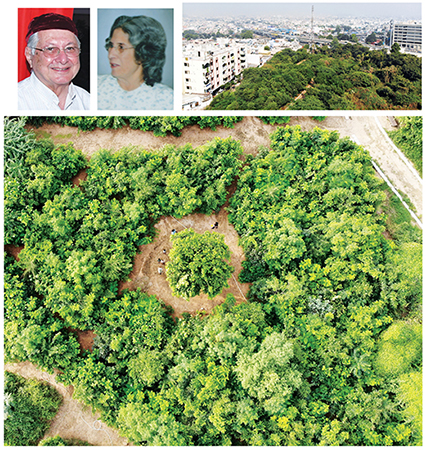
Clockwise from top l: Firdos and Yasmin Cambatta, urban forest,
green cover at Ahmedabad Doongerwadi after October 2020
Urban forest, boundary foliage, walking trail
"Pained to see the barren area at Doongerwadi… for the past 40 years,” in 2017 Firdos approached the APP to undertake forestation efforts there. The project cost of around Rs 75 lakhs and the annual maintenance expenditure of nearly Rs 16 lakhs was "borne by me as I wished to dedicate this project to Yasmin who passed away in 2016,” Firdos stated in response to Parsiana’s queries. A memorial tablet at the Doongerwadi Botanical Garden in memory of Yasmin who died at the age of 80 years quotes Rabindranath Tagore, "Trees are earth’s endless effort to speak to the listening heaven.” On the same plaque is inscribed Firdos’s tribute, "Trees are nature’s gift to mankind. Nurture them and preserve them. They give back so much, asking for nothing in return.”
The three-year "collaborative effort” by the Ahmedabad Panchayat, The Serenity Trust and Acacia Eco involved dense boundary plantations, creation of a forest walking trail, individual tree and shrub plantations, and development of water bodies. Fortifying the boundary with verdure was meant to provide privacy and simultaneously stop neighboring apartments from using Doongerwadi as a dumping ground. Development of water bodies including a lily pond was intended to harvest rain water, raise the water table and draw birds to this region. In addition to planting individual flowering and fruiting trees throughout the campus, one area was set aside to create a forest using the Miyawaki method.
As explained by Firdos, the Miyawaki method pioneered by a Japanese botanist Dr Akira Miyawaki, seeks to replicate natural forests swiftly by soil enhancement and cluster plantation of native tree species in a close grid. Besides fast growth, the Miyawaki method involves lower maintenance, promises higher survival rate and biodiversity with 40 times more carbon absorption and resulting air purification, reduced temperature, noise and dust control.
"Selection of tree species is a critical aspect of project planning,” stresses Firdos. When seen as layers, forests are classified into shrub, sub tree, tree and canopy. Sixty-four species of trees were used at Doongerwadi. "At least 30 to 50 different tree species are used in each Miyawaki forest,” explains the philanthropist. Proportions are assigned to each species depending on whether they fall in the major, supporting or minor category. "While some saplings are sourced from forest and local nurseries, the Acacia Eco team works closely with nursery partners to germinate seeds of native species that are not readily available,” Firdos gives credit to the Acacia trustees Ajay Mehta, his daughter Shailie Mehta and Pooja Shah who "regularly visited and supervised the plantations.” He further commended the dedication of three adivasi couples who with their "love for nature” were able to nurture the trees to a height of 18 to 25 ft resulting in some areas resembling a rain forest.
"There is a lot of research that suggests that urban forests have a huge impact on overall health and wellbeing,” reinforces Firdos who believes that "if every human were to plant five trees in their lifetime” it would make a major difference. While appreciating the cooperation of Anklesaria and the other Panchayat trustees, as also Ahmedabad resident Farokh Motwala, Firdos regrets that "very few Ahmedabad Parsi inhabitants (appear) interested in the maintenance of the Doongerwadi Botanical Garden. We at The Serenity Trust have taken on the onus to maintain it as long as it is possible.”
Keen to encourage community youngsters to become naturalists or botanists, Firdos says he has been discussing this issue with the Panchayat "but we have not had the good fortune of seeing one young person coming forward in spite of the fact that salaries could be quite handsome as is being earned by the naturalists working for us at The Serenity Trust in Koteshwar.”
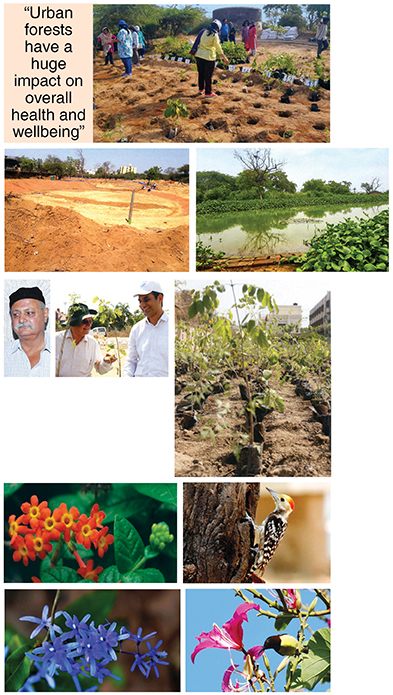
Top: plantation drive at Ahmedabad Doongerwadi;
2nd row: creation of a water body between 2017 and 2018;
3rd row (from l): Brig Jahangir Anklesaria (retd), Firdos Cambatta, Vijay Nehra, plantation at Oxygen Park;
4th row: flora and fauna at The Serenity Trust Botanical Garden
Create and conserve
Most people living in concrete jungles are left with very few open breathing spaces and greenery to stay connected with nature. To fill this void, the Cambattas created The Serenity Trust in 1995, donating 10 acres of their property in Koteshwar, about five kilometers from the Ahmedabad airport. Located on their vibrant campus is a botanical garden, a nature library and overnight camping facilities with a cafeteria that serve as an ideal center to impart environmental education. The landscaping and architecture for Serenity was undertaken by Kamal Mangaldas of Ahmedabad and Bernard Kohn of France. "Of the total number of school children who visit our premises, one-third are underprivileged for whom we pay for the transport charges as well,” mentions Firdos.
Their botanical garden is home to 950 species of vascular plants which are naturally grown or planted over the years, according to one of the colorful pamphlets issued by the Trust. A vegetable and herbal garden, a rockery garden that houses succulents and cacti, three green houses and a nursery, one big aquatic body for the flora and fauna with a smaller one for water lilies and lotuses are the other attractions.
The Serenity campus hosts more than 100 species of terrestrial and wetland birds, over 50 species of butterflies as also other insects, amphibians and reptiles besides small mammals like the blue bull, jackal, porcupine and mongoose. The library has a rich collection of 3,000 reference books, magazines and journals on nature and environment related subjects, and in their 60-seater auditorium workshops, talks, events, and documentary films are screened. The library also houses a seed and herbarium collection. An introduction to the herbs, birds, reptiles, butterflies and spiders at Serenity was made possible for Parsiana thanks to the many informative brochures thoughtfully forwarded by Firdos.
The Cambatta family being residents of Ahmedabad for over 135 years, Firdos states that his grandfather Nowroji Faramji Khambatta migrated from Cambay (Khambhat) to Ahmedabad to set up a hotel and liquor distribution business. Firdos’s father Sorab, better known as Soli, entered the business in 1936 dealing with textile mills with bobbins, air compressors, chemicals, water treatment plants and textile machines from Germany. Joining the business in 1961, Firdos further expanded it. He is also founder trustee of the Sorab Cambatta Charitable Trust.
Once the Doongerwadi plantation project started making steady progress, The Serenity Trust and Acacia Eco undertook forestation for the Ahmedabad Municipal Corporation (AMC) by working on the Oxygen Park at Ugati Lake, opposite Science City. After the inauguration by AMC commissioner Vijay Nehra, 25,000 trees were planted on 11 acres over eight months.
Those interested in carrying out such plantations may email Firdos (fsc@enaindia.com) or Ajay (ajay@amayaproperties.com). "One of our stipulations is that water and electricity be provided without which plantations can never be a success,” specifies Firdos. Visits to The Serenity Trust Library and Botanical Garden are permitted on prior appointment by phone (0091-9327291282) or email: the serenitylibrary@gmail.com. The Doongerwadi Botanical Garden is accessible to all Parsis while members of other faiths can visit it after taking prior permission.