"As an Indian and a Parsi Zoroastrian, Iran is the Mader Vatan (motherland) of community memory, while India is my homeland,” explained Dr Shernaz Cama, director of UNESCO Parzor, in her introductory remarks at the international seminar on "Cultural Similarities between Iran and the Indian Subcontinent: Indigenous Cultural Fragmentation in the Era of Globalization.” The event, commemorating 60 years of the cultural agreement between the two countries was held at India International Centre (IIC), New Delhi, in collaboration with the IIC, Indian Council for Cultural Relations (ICCR) and Parzor Foundation on January 18 and 19, 2017, notes an email sent to Parsiana by Mahtab Irani, researcher and advisor technical support for Parzor. Scholars from Iran, Afghanistan, Bangladesh and India conducted academic sessions on history, art and literature at the seminar.
Cama highlighted that though today the world is looking at Central Asia as a place of tragedy and violence, we must not forget that it was once the cradle of civilization, the generator of tangible and intangible heritage. The Iranian government had sent national treasures to India for the very first time to be displayed at The Everlasting Flame International program held in Delhi from March to May 2016, and the current conference too would usher in the flow of intangible heritage honoring six decades of the cultural agreement.
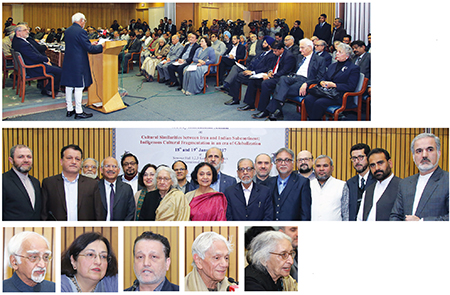
(Top row): Dr Hamid Ansari addressing seminar;
(middle row): speakers and delegates;
(bottom row, l-r): Ansari, Dr Shernaz Cama, Dr Ali Dehgaha,
Prof Lokesh Chandra and Kapila Vatsyayan
Vice President of India Hamid Ansari, in his inaugural address referred to the deep and historical relations between Iran and India. He said the common cultural potentials could ensure the convergence of these two countries for stability and prosperity. Regarding the effects of globalization, he emphasized that cultures cannot be separated from the societies in which they emerge. Dr Ali Dehgahi, cultural counsellor of the Iranian embassy articulated that "the best way to understand one another and conserve the common heritage is to initiate a dialog.” Prof Lokesh Chandra, ICCR president felt that India and Iran are "cousin cultures” and both face the onslaught of information and ideas in all their diversity. The seminar therefore shed light on amalgamating and strengthening these ties through collaborations in education and arts.